Rigging Program

Re: Weaker line gives safer loading

Hi Spyder,
Almost all ropes will elongate at the MBS to some degree but to get this elasticity means your going to be cutting well into your factor of safety in double braids and semi statics there by reducing your cycles to
failure.In this situation when a rope elongates most of the energy is not dissapated but stored in the line when the mass becomes static again the peak force stored in the rope will now be greater than the object and will cause a bungee affect.This can lead to unpredictable changes of direction and swing of objects.
In my experience there is no place for any large amount of elongation in high control rigging systems.You can get rid of the energy safer by the use of heat and friction on the friction device.Yes the rope should always be the weakest link, but working on this logic you don't need a weaker rope just bigger bits.EVERYTHING IS RELATIVE.....

Didj
 
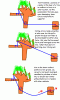
All at observations; these forces are partially dissipated by every imperfection, slip, elasticity of support, pulley sling, porty sling, porty slip etc. any place the high force can escape.

i think the software shows a glimpse of forces, perhaps the outside constraints to plot the rest of the actions by and inside of, and how you are chipping away from the immense, immense forces. And, from this view,it isn't all about drowning something in SWL, more of following the recoomendations of X/1, than going too high depending on support factors, or, how to take as much as you can safely! Of which support loads are a part of, as a part of the system. If it doesn't load the rope well, it doesn't extrract as much of the dampening of the elasticity. Stronger is not always better, there is a point of finesse, and really understanding enough perhaps to walk a thinner line of SWL to use the line best to the situation. A stronger rope, when the previous set one woulda done, will increase support loads for the choice, and time spent! There is more to be learned.

This isn't about field number crunching, but finding pattern guides for decision making later. Mebbe, the best thing to advance your rigging on a rainy day is to learn more at desk with software etc.!

Enquiring Minds, Need to Know!
-KC
 

Attachments

  • 10822-untitled.GIF
    10822-untitled.GIF
    57 KB · Views: 96
Re: Weaker line gives safer loading

Ken, you said:

<<This means there is mucho differance between tethering a saw to your hip with a 3/4"StableBraid vs. a 200# tensile nyon line; by virtues of elasticity and % of tensile loaded; assuming matching laods and leash lengths, saw dropped from just as high etc.>>

Most nylon lines are very dynamic. So the transferred force will be much less from the nylon line. Is that what you meant to say, or were you thinking the added fibers in the 3/4 SB would mean it would be the referred line?

Dynamic mt climb lines are designed so that most falls will not transmit more than a certain (non fatal) amount of force to the climber. Not so with our very static climb and work lines.
 
Re: Weaker line gives safer loading

i think the root lesson here is that there is never an energy loss; just transferance.

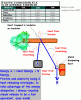
As a support line redirects around a branch to ground control; the sum of both legs pull on the support. The only way to reduce the energy pulling on the control line, is to give off heat; an energy itself. So that energy on support line is the input, and must appear as outputs of the system, for everything to balance. So, Input Energy on support leg = Energy on control leg + heat Energy given off. Or mostly, Input Energy on Support leg - Friction (Heat Energy Producer)= Output Energy on Control Line.

The stretching of the fibers scrubbing against each other produces heat, but only while in motion; hence a dynamic correction only, not a static hanging one. To produce this heat form the elasticity we can use more elastic lines and/or over a longer distance and/or to a higher percentage of the line tensile (allowing load force to 'beat up' line, not line connections)

Going to Samson Ropes Arborist Guide/Catalog we can find lines elasticity rated by their material, construction and percentage of tensile to gain this elasticity heat energy 'steam' escape for the high dynamic loads of motion. Stable Braid, ArboPlex etc. come in different tensiles, but that is not mentioned, just a factor for that construction and material when loaded to a % of tensile, then work specific tensile for that line type from there. Also notice the mountain/rescue static line is more elastic than our lines!!! Now as they seem 50 years ahead of us on a lot of stuff, ya gotta wonder what point we might be missing here sometimes....

Or, something like that
/forum/images/graemlins/propeller.gif

Great Graemlin Pallete, make MB drool! But i guess he couldn't link to them over thar very easily!!!!!!!!!! Looking Good, when can i advertise the new TreeBuzz complete??
 

Attachments

  • 11670-Losing Steam in System.GIF
    11670-Losing Steam in System.GIF
    56.6 KB · Views: 90
Re: Weaker line gives safer loading

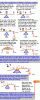
Here is the heat dissipation model for friction and elasticity, to lessen dynamic loading, by allowing the 'steam pressure' to dissipate from the dynamic loading applied to a wooden board for comparative analagy. For the loading is finite, the energy must show up somewhere; elasticity and friction give a chance to lessen the energy fought on control side of system; by subtracting energy from the finite source in the form of heat energy; individually or collectively.

The lower tensile performs this function. The art of line choice becomes more difficult like the mountaineering/rescue folk's lines; flooding with tensile strength is not always the best, highest SWL answer to dynamic motions that constitute the usually highest potential loading in friggin'riggin! The best answer, is in consideration to loading, support, tensile construction, available space etc. A finer ribbon to walk, that could really make the differance in occasions were the possible loading to support SWL grows narrower, and the deacceleration space is available. Thus, if a rock climber falls, the line dynamics of elasticity will pull less on them and anchor etc.

A high tensile doesn't allow the loading to 'beat up' on the line, so the force is taken out on the supports/connections. Meaning the load's hitch, support, Porty etc.; the links the line connects like hosewiring; whatever isn't lost in heat is transferred to the connection points through the stringy device of either wire or line.

Or something like that,
/forum/images/graemlins/propeller.gif
 

Attachments

  • 11678-2-Equivalent Forces.GIF
    11678-2-Equivalent Forces.GIF
    63.6 KB · Views: 95
Re: Weaker line gives safer loading

[ QUOTE ]
Ken, you said:

<<This means there is mucho differance between tethering a saw to your hip with a 3/4"StableBraid vs. a 200# tensile nyon line; by virtues of elasticity and % of tensile loaded; assuming matching laods and leash lengths, saw dropped from just as high etc.>>

Most nylon lines are very dynamic. So the transferred force will be much less from the nylon line. Is that what you meant to say, or were you thinking the added fibers in the 3/4 SB would mean it would be the referred line?


[/ QUOTE ]

i was meaning that both the composition and tensile mattered, quoting both extremes of elastic low tensile and staitc high tensile.

/forum/images/graemlins/propeller.gif
 
Well guys, I have read all the posts and come to the conclusion that I will consider the need for production and safety rather than argue in metrics. You guys know what you and your gear, tools, and employees can handle. Recently, we speedlined an 80 foot sugar pine 600 feet in three sections over an enviromental sensitive area in Lake Arrowhead and sweated the tension- all was good.
When in doubt, get a new rope.
Jeff
 

New threads New posts

Back
Top Bottom