Rigging Configuration Pics

Daniel

Carpal tunnel level member
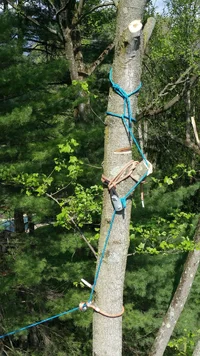
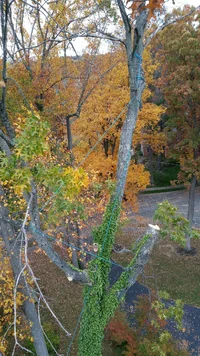
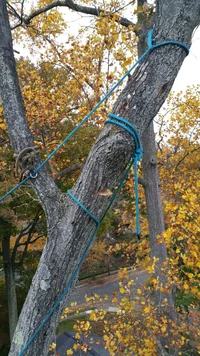
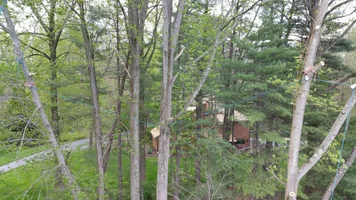
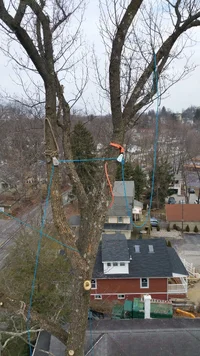
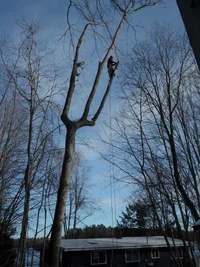
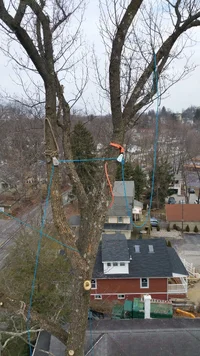
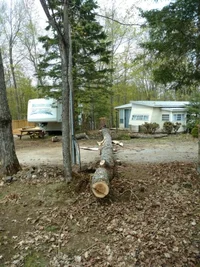
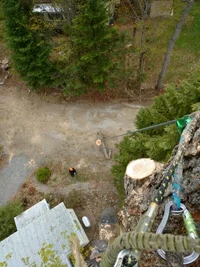
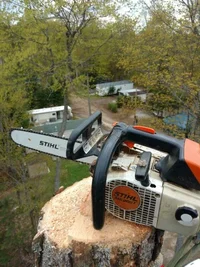
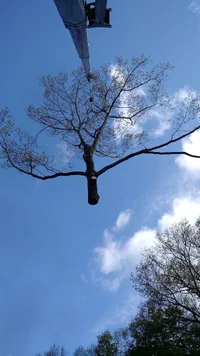
I've been getting creative lately with rigging configurations, mostly to get good vectors with rope angles, sometimes to introduce more rope in the system, and always spread the force with multiple high rigging points... using hybrid systems, blocks, NC, rings, and shackles.... Here are some pics.. Thought this would be a good topic to stimulate some thought on rigging.. Would love to see your pics too...
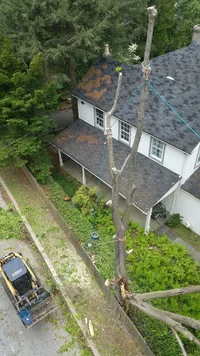
 

Attachments

  • near base rigging redirect.webp
    near base rigging redirect.webp
    749.5 KB · Views: 320
  • tulup top rig.webp
    tulup top rig.webp
    794.5 KB · Views: 324
  • oak rig top 4.webp
    oak rig top 4.webp
    918.4 KB · Views: 314
  • oak top rig 2.webp
    oak top rig 2.webp
    866.1 KB · Views: 307
Here's another rig system.. lower redirect is to keep the line away from the trunk, or to keep it from twisting the block.. the second line is used to get the pieces into a good LZ once they are hanging, that line is tied on..
 

Attachments

  • paoli tulip rig 1.webp
    paoli tulip rig 1.webp
    687.9 KB · Views: 196
In the original post, 2nd photo (Tulip top rig) you have a slip knot just above the block. I presume you had that there to keep slack in the line so it didn't hop up above that thumb? Did you make the cut with the slip knot still in there, and the falling piece just un-slipped it? Not too much extra fall and shock load?
 
Re. that second photo, why you would not just have cut that stub off prior to setting the block? Having the line run over the (sharp) cut edge of the stub, the slip knot, etc....
Confused as to how your methodology is safe or efficient. I have failed. Which is a reflection on my inability to understand.
Also concerned that some of those photos (to my eye) seem to show lowering angles directed far away from the base of the tree.
 
Last edited:
Re. that second photo, why you would not just have cut that stub off prior to setting the block? Having the line run over the (sharp) cut edge of the stub, the slip knot, etc....
Confused as to how your methodology is safe or efficient. I have failed. Which is a reflection on my inability to understand.
Also concerned that some of those photos (to my eye) seem to show lowering angles directed far away from the base of the tree.


In the original post, 2nd photo (Tulip top rig) you have a slip knot just above the block. I presume you had that there to keep slack in the line so it didn't hop up above that thumb? Did you make the cut with the slip knot still in there, and the falling piece just un-slipped it? Not too much extra fall and shock load?

Here's the video that goes with that set up:


though I do use the slip knot to keep slack in the system when needed, the reason I used it here is because we are using an old school porty on the back of the bucket truck and that keeps the porty from dropping when the rope goes slack, which can let the wraps off...

The stub was left to allow for adjustment in the notch if needed, as I was setting this top up for a remote trip and only had a low set pull line and 2 men on the ground pulling by hand....
 
Re. that second photo, why you would not just have cut that stub off prior to setting the block? Having the line run over the (sharp) cut edge of the stub, the slip knot, etc....
Confused as to how your methodology is safe or efficient. I have failed. Which is a reflection on my inability to understand.
Also concerned that some of those photos (to my eye) seem to show lowering angles directed far away from the base of the tree.


I like your ring block ring block set up...

and not sure what you mean by "lowering angles directed far away from the base of the tree." IN a way that's the point of this thread.... the use of re-ditrects and multiple overhead anchor points allows one to keep the Landing Zone away from the base of the tree, which is often much easier for the ground guys..
 
I like your ring block ring block set up...

and not sure what you mean by "lowering angles directed far away from the base of the tree." IN a way that's the point of this thread.... the use of re-ditrects and multiple overhead anchor points allows one to keep the Landing Zone away from the base of the tree, which is often much easier for the ground guys..

Yeah, I get and agree with the second part.
But, some of your set ups look like significant initial rigging forces (esp. when negative blocking) is getting transferred AWAY from the base of the tree. Which to me would be the same as if you set the porty up on a tree 15' (whatever) away, instead of at the base of the tree. I dunno. Am not trying to be argumentative here, cause I like learning new stuff, (and pretty much all I do are tree takedowns, but it looks like some Awakening techniques in the making.
 
Yeah, I get and agree with the second part.
But, some of your set ups look like significant initial rigging forces (esp. when negative blocking) is getting transferred AWAY from the base of the tree. Which to me would be the same as if you set the porty up on a tree 15' (whatever) away, instead of at the base of the tree. I dunno. Am not trying to be argumentative here, cause I like learning new stuff, (and pretty much all I do are tree takedowns, but it looks like some Awakening techniques in the making.


It's all about the leverage.. you can side load a big tree all you want at 15-20' no worries... and the ones that are set up higher are pulling back against the direction of fall, which is where the bucket truck is parked too!!!!!
 
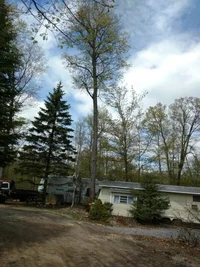
Sugar maple this afternoon. Speedlined top, lowered 2X8' chunks before winching down the 45' corn stalk. Note lamp post to the right of the log in the background and hydro pole to the left in the foreground.

IMG_20160517_140712833-600x800.webp IMG_20160517_160943909-600x800.webp
 

Attachments

  • IMG_20160517_154534526-600x800.webp
    IMG_20160517_154534526-600x800.webp
    122.6 KB · Views: 84
  • IMG_20160517_154452287-600x800.webp
    IMG_20160517_154452287-600x800.webp
    110.3 KB · Views: 81

New threads New posts

Back
Top Bottom