Rescue Climbing

The winch is a good idea, but when you work on life safety, mechanical devices are out of the question. No control of forces!!

1. You can rig a dynamic rigging system to bring the rescuer back up. It would have to be manpower intensive on the gound but it could be done through mechanical advantage. The second situation over the water would have to be taken care of with a high line or a sloping line. You can make a great anchor with steaks and rope. There are limitless possabilities.

Send me a pic and we can talk......

Check our www.specrescue.com

Also look for "Engineering practical rope rescue systems" By don Brown, Delmar
ISBN#0788601977 1st edition!

Awsome book. I am a rescue technician in virginia and have a bunch of rope training. Thats the most difficult thin about tree work for me. In rescue everything is "bomb proof" and redundant. Its kind of crazy to do so much with so "little" protection and redundancy compared to rescue work.

Also let your friend know, the 8 is only good for decents 200' or less. Any more will cause some terrible twist and spin in the rope. He'll eith knott up or spin like a helicopter roter. Not good. You shjould generally use a rack.

Great pics!
 
</font><blockquote><font class="small">Als antwoord op:</font><hr />
The winch is a good idea, but when you work on life safety, mechanical devices are out of the question. No control of forces!!


[/ QUOTE ]

I think you have more control in the resque effort when the resquer is lowered with a winch (and wireless comm. up/down). This way the resquer can focus on the victum and prevent or act on possible strange behaviour by that (scared)victum. It seems very hard to me to ease the victum and going down safely. With a device for lowering (mechanical or by hand from above) it seems more obvious to me. Also i know mechanical systems can fail. But human error can also occur. I suggest a mechanical device to lower and human backup if a wich get stuck? Also a mechincal system looks to me as a easier to operate system, i dont know how in a accident the resque crew is the same as in practise the resque manualy? So with a 'standard' procedure using a winch it seems to me that a crew made from some different people (fireman, police, etc.) is easier and faster to work with.

Rgrds Ronald
 
I totally get your point with the mechanical systems. When you are the rescuer, your only focus is the patient. You are there for them and your rigging team and lowering team control your movement, generally speaking. If you do a pick off, where you rescue another climber, yes you control the decent with your gear. It is easy because you can compensate for the extra weight by adding extra bars for friction on your repel rack. As far is human error, yep absolutely......but there are standards that require back up systems. there is always atleast 2 to 4 means of redundancy in the system, including rope. If there is a rescuer with a victim, even though you only have 1 rope to repel on, ther is a back up rope incase that one fails. Always a dual rope for life safety. There is so much cool stuff to see when it comes to rope......... thanks for the discussion!
 

Attachments

  • 24788-P0001492.webp
    24788-P0001492.webp
    102.5 KB · Views: 62
I was telling my brother about this. He said, why wouldn't the park just higher a crane for that special occasion. He said you can get a driveable crane there with a jib to reach 400ft easily. So, why not? And I'm thinking it probably would only take an hour, so it would just cost their minimum charge.
 
</font><blockquote><font class="small">Als antwoord op:</font><hr />
I was telling my brother about this. He said, why wouldn't the park just higher a crane for that special occasion. He said you can get a driveable crane there with a jib to reach 400ft easily. So, why not? And I'm thinking it probably would only take an hour, so it would just cost their minimum charge.

[/ QUOTE ]

I am not sure if big cranes are available at that short notice. A crane that big has some trucks with counterweights and gear t follow up i believe. And manouvre all those into a crowded park? ( and in a real accident do want to rely on a cranecompany to show up from who knows where in very short notice?)

I wonder how it comes that after a a big toy is set up and in working for public the park still has to find a propper and secure way to retrieve people out the buckets when a failure happens. Maybe there is a procedure i dont know the content of. But if after a resque practice these questions come drifting above i guess that on the drawing table, engenering the tower, they had to do a better job to see ahead in a resque effort. (the park owner could have know before that his or firebrigades equipment wanst suited forthat hight.)

Rgrds Ronald
 
Can someone post a pic of the rack thing you've been talking about? I'm somewhat familiar with the rescue eight but I would like to see the rack. In action if at all possible. Mark..those looked like rock climbing shoes...any good on the steel surfaces?
 
</font><blockquote><font class="small">Als antwoord op:</font><hr />
Can someone post a pic of the rack thing you've been talking about? I'm somewhat familiar with the rescue eight but I would like to see the rack. In action if at all possible. Mark..those looked like rock climbing shoes...any good on the steel surfaces?

[/ QUOTE ]

Rack? that rescue stretcher?

fall protection/rescue

Looks like a nice gadget to replace footlock with that hoist device:)


air rescue winches

I tried to find info on industrie electrical winches but not that easy to find. I saw the one i ment in a brochure from a safetygear company once.
 
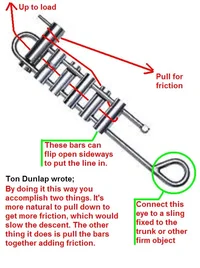
This is a braking rack:
nfpa%20rack.jpg


These are the shoes I was wearing (Glen Pangotangomangos) /forum/images/graemlins/grin.gif
Trango S
 
Hey Mark,

Sorry about all the suggestions.

I was thinking about this yesterday at work. You were just posting some pictures and sharing your story. Then we all started blabbing out suggestions. You weren't asking for "better" ways of doing it. So, sorry about that.

R Schra: I don't think a big crane would need those stacks of counter weights just for running a boom, but I will try to find out. I'm pretty sure NO though.

Mark, I ordered some shoes similar to yours. I researched boots for hours and hours one night. Thought I'd go with those boots Mangoes and BUK suggested, but after researching changed my mind, I really wanted one to help me get some grip on footlocking (I need all the help I can get). I liked how your Trango S doesn't have any arch groove in the sole. And they are sicky sole and rands and just seem perfect for footlocking. So I was about to order the discontinued Trango S, but then found another version. Actually found two that might be good. And ordered both. Same maker. I wrote all this and more to ya a week ago, but you are blocked from PMs(since you probably get too many) and it was lost. I had some questions, but eventually I figured them out for myself. I'll let ya know how they do, maybe you could see them if you came to that splicing class.
 
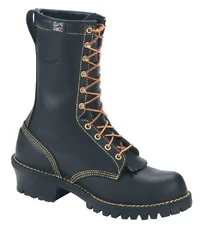
These are the type of boots I wear (the logging style with the big heel) they work great for ankle support, working grounds crew or using spikes but man do they suck a$$ for footlocking. I've been practicing with these boots but it is tough when the rope slips through the heel. Oh well, if I can learn to FL in these it should be easy with flat soled boots.
 

Attachments

  • 25048-18000_Fire_Line.webp
    25048-18000_Fire_Line.webp
    30.6 KB · Views: 59
[ QUOTE ]


I am thinking of another solution. Maybe you all could suggest some ideas?

[/ QUOTE ]

suggestions were wanted i thought
 
And now for the third post in 5 minutes...I'm just trying to catch up with Nick /forum/images/graemlins/grin.gif... That rack or brake??? looks like an interesting device. I have an image in my head as to how it works but i could be completley wrong. Can anyone post a pic of that device attatched to a line? or a website for reference would help too. thanks
 
</font><blockquote><font class="small">Als antwoord op:</font><hr />
Can anyone post a pic of that device attatched to a line? or a website for reference would help too. thanks

[/ QUOTE ]

Pic attached....

[editted after comment from Tom below. He's totally right!]

I just drawed it from what i 'believed' was the way as i seen it. I dont use or used a rack ever /forum/images/graemlins/9lame.gif

Rgrds Ronald
 

Attachments

  • 25054-rack1.webp
    25054-rack1.webp
    67.2 KB · Views: 92
I've never seen the directions for rigging a rack by using a wrap around the hyper bar. The hyper bar is the upper bar with the extended length and pin. The way that I've always seen the HB used is to take the tail end of the rope, where it exits the bottom, bring it back up to the HB and then down.

By doing it this way you accomplish two things. It's more natural to pull down to get more friction, which would slow the descent. The other thing it does is pull the bars together adding friction.

Racks are wonderful tools. I think that they're not used because they don't have as high a Cool Factor as other devices. They don't twist ropes. Friction can be added by taking more bars into the system.

After a suggestion from someone here I took the Gri Gri out of the anchor system in my SRT and put a four bar rack in. This is a good place to use the rack.
 
[ QUOTE ]
After a suggestion from someone here I took the Gri Gri out of the anchor system in my SRT and put a four bar rack in. This is a good place to use the rack.

[/ QUOTE ]

Tom,

Two questions.

First, what type of rappel (braking) rack do you use or recommend? There are a several different designs, including the one in the picture in Mark's earlier post. For example:

http://www.rocknrescue.com/acatalog/Catalog_Racks_6.html

http://www.onrope1.com/PDFs/Rappelling.pdf (Categorized by open or closed design. Also, note the illustration of the use of the hyperbar as you described.)

I am particularly interested in the differences between an open and closed design after reading the following:

http://www.bmsrescue.com/racasbly.html

Second, how do you lock off your rack when you use it as the anchor for your SRT system in place of a Gri Gri? (I understand and have used the Gri Gri system.) I have read about various methods, some depending on the particular rack design. Examples are illustrated on the following pages:

http://www.ozultimate.com/canyoning/descenders/rack.htm (Shown with two ropes, but I assume the same could be done with one rope.)

http://www.srte.com.au/pdf/Rappel%20Racks.pdf

http://www.bmsrescue.com/micrack.html ("Soft" lock off by using the "extra friction" configuration illustrated in the middle picture, then passing a bight of rope through the frame and looping it over the hyperbar.)

Thanks for your help.

Riz
 
what on earth are you wearing on your harness that you need to use the hyper bar to add friction?
When I rappel with a rack with 5 bars and the rope tailing out the bottom, I can rappel or stop just by moving the bottom bar with my two pinky fingers. I think you would need three people on the line to require the hyper bar for anything more than locking off.

Also, when using an 8 to rappel over 200 ft the tail of the rope acts as a brake and you need to pull the rope up to feed it through, it's a pain in the butt and a little unsafe. Ditch the 8's it's a crappy piece of kit. When I go rappelling I won't even let someone put an 8 on one of my ropes because of the twist they put in.

Use a rack for over 100 ft or for rescue,

B0000E5M12.01-A1XXVUHO1OFX0M._SCLZZZZZZZ_.jpg


Use an "ATC" for under 100 ft

blatc_041.jpg


Use the Canadian Italian hitch for emergencies, packing light, or when you are short on gear.

[image]http://www.treebuzz.com/forum/images/upload/22405-Uten%20navn.bmp[/image]


Dave /forum/images/graemlins/iconcan.gif
 

New threads New posts

Back
Top Bottom