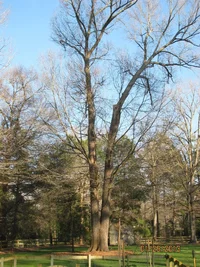
Remove it? Leave it alone? Cable it? Steel? Cobra?

Hopefully the attached photo is good enough to see some of the decay from a previous branch failure. I think the (now missing) branch on the right, about half way up failed and ripped a healthy branch on the left trunk many years (ten maybe) ago, but I'm not sure. The tree is located in a back yard and there are no significant targets. Quercus pagoda

I'm looking for opinions, and your rationale.
 

Attachments

  • 350031-IMG_1908__1.webp
    350031-IMG_1908__1.webp
    648 KB · Views: 364
I would look at targets and traffic through the area. Is this a park or someones back yard? Is the soil and area conditions favorable for this tree?
 
First look at targets. I notice a swing frame, maybe move it. Tree is in fenced area so I am guessing there are few people ever near the tree.

Two inspect the tear out and the topped right side

Three perhaps prune to reduce turning moment

Four install a cable high in the crown and one lower around the trunk

Use Cobra (or boa)

Tree is likely good for years to come. That is about all I can say without more information
 
I would probably remove it because it looks like there is decay on the left stem and it happens to be leaning towards the house. I can't tell for sure if it could reach the house from the picture. Besides it isn't the most beautiful specimen.
 
Leave it. Do some aerial inspections to make certain there isn't anything that can't be seen from the ground. Cabling (cobra) would be a good preventative measure for some piece of mind, but definitely don't do any more harm but bracing or metal cabling.
Nice looking tree. If there are no obvious or high value targets then let it be...
 
Glen, I'd recommend removal. The longitudinal cavity on the left stem looks pretty dodgy (an old lightning strike?), and the right stem has that large reduction cut that has decayed around the wound. Those wounds seem to be large enough where the decay is unlikely to be successfully compartmentalized. Probability of failure is perhaps a 3 The tree is in a backyard--perhaps a "3" for the target rating. Size is 3. That gives us a combined score of 9, on the lower end of the high risk tree scale. My 2 cents. Removing it while it is still safe to do so is a factor worth mentioning.

I want to also address the cabling option, which seems merely pointless at best and perhaps unnecessarily luring the customer into a false sense of security at worst. Where the left stem, or right is likely to fail will not be mitigated by setting a cable. I think it will fail right the way through the stem where the cavity is. Heavy rain and wind might do the trick.

Only way to really get a sense of it is to get an Arbotom reading of the cavity itself.
 
What a joke Ward. It is so called arborists like you who try to scare everybody into cutting that drags the industry into the toilet. You should learn something about tree risk assessment and cabling before spouting your hatred of trees. Perhaps better yet learn something about tree preservation.
 
That was overly harsh, mrstree.

I'd leave that old beauty alone if it was mine. If the client valued it, I would recommend reduction of tip weight of the more horizontal limbs above that decayed section
MaybPGRs, decompact root system, add organic material and boom,Tree falls down whenever a great enough force is applied. Then you charge to clean it up.
SZ
 
Bet you that boy in the avatar wishes you learnt something about trees rather than being a third rate hack.
 
The web is great, you can call me a women I can you an idiot or diddler or anything else. You don't have to stand in front of me and call me a women because I doubt you have the balls to do that. You can be a coward!!!
 
Lots of accusation and hatred in your note, there, Mr. Tree. I don't know where you get this "hatred of trees" line. Best of luck to you in your confusion--and best of luck to you boxing those shadows!

Maybe they all look like removals after 9 p.m....

Got to do the Arbotom and id any fungi

not enough info in a picture but Quercus pagoda is reputed to make excellent lumber...;)
 
[ QUOTE ]
The web is great, you can call me a women I can you an idiot or diddler or anything else. You don't have to stand in front of me and call me a women because I doubt you have the balls to do that. You can be a coward!!!

[/ QUOTE ]

It's great to see someone have a sense of humor around here.

SZ
 
Lol,mister tree. I just read your pm. You threaten to smash my teeth down my throat because I called you Mrstree?

You got some serious anger issues. I don't wish to "fight" you, tough guy. I was merely calling out your overly aggressive tone with Ward. Lol, you showed me how aggressive you can get.

Way to keep the industry out of the toilet.

And for your information I am a second rate hack.

SZ
 
lets be nice.

Glenn, you said nothing about climbing the tree. Those wounds and decay can be assessed with a yardstick screwdriver and hammer. i have arbotommed 30 feet in the air and it aint easy.

Adding up ordinal numbers in a rating scheme is mathematically invalid, sorry.

I'd bid 2 hrs work to aerial assess and then prune while rope is up there reduce 10-30% above the wounds, per the decay and stability. more off the leaning lead obviousdly.

then i'd hunt down whoever made that big flat cut and sic mrtree on them!

someone needs to explain rationale for cable as the fork seems undamaged. i am clueless.

o and fwiw i am a 1st rate hack. and attached is a review for those who think they can stand on the ground and judge how a tree grows and rots and stands and falls.
 
Biomechanics and Support
Trees support themselves in mysterious ways. Our job is to keep trees together, so it pays for us to study and solve some of these mysteries, and to figure out how and when to supplement our trees’ natural support systems. Imagine a mob of scientists and arborists teaming up to tear apart trees with new and unusual gear, then sharing their discoveries--wouldn’t that be something to see! All that and more took place August 23-27 at Tree Biomechanics Research Week and Symposium. Organized by ISA and hosted at the Davey Research Institute and Farm in Kent, Ohio, this event solved some mysteries for those lucky enough to attend. At the same time, it posed some questions about some familiar principles and practices.
I drove directly to the site to see if I could pick up some tips on assessing trees’ natural support systems. After parking my rig I was met by one of the most notorious scientists, who offered me a ride to the tree demolition site. I gratefully accepted, stowed my gear, and hopped in.
“These pull tests are amazing”, he exclaimed as we bounced down the road, his bright blue hard hat jostling about on his head. “We looked at one tree with an obvious defect, and figured it would break straight away under tension from the four-tonne winch. Another tree had no visible defects, so we figured the trunk would hold strong, so that one would uproot instead. But the exact opposite happened! We know next to nothing about tree biomechanics.”
“Trees have many mysteries”, I agreed. “Perhaps we’ll get a better handle on them as we see what these guys are up to.” As we approached the group, we heard words like “mechanoperception” and “thigmomorphogenesis” being bandied about. This was getting interesting.
First up was Philip van Wassenaer, an arborist from Ontario, Canada. When an earlier conference on tree biomechanics was held in 1992, he borrowed money to attend. Excited by new methods of measuring tree stability, Philip traveled to Europe to apprentice under a pioneering expert on Tree Statics, Erk Brudi. An expert climber temporarily grounded by sciatica, he has set aside his carabiners, picked up his computer, and carried on. Less physical strain, but a new kind of mental strain accompanies his present work. Reading information sent from sensors on the stem to the laptop balanced on his forearm, Van Wassenaer supervised the destruction of a 6” dbh plane tree, Platanus sp. Over 2 metric tons of pulling force were required to break the roots, while the stem held firm.
Next came engineer/arborist Lothar Gocke of Germany, who demonstrated the use of two devices that deliver images of the inner tree, which is hidden from our eyes. First he sent sound waves into the stem with a tomograph, which rendered an image that roughly showed the location of a cavity. Next, he sent electrical impulses into the the tree at the same level, which showed a better image of cracks in the trunk, which the tomograph does not always show accurately. This new information could be critical in determining risk, and whether or where to install a brace rod. Viewed together, the images reveal a more complete picture of the soundness of the stem. By comparing images taken over time, the silent battle between tree and pathogen indicates potential treatments. If a stem is over 2/3 hollow and increasing, for example, it could be propped on a beam or guyed back to a structure or the ground.

John Goodfellow of Washington, US, followed with a look from the utility perspective at branches that overhang wires. The damage to tree stability from “ground-to-sky” pruning when contractors take previously reduced limbs back to the trunk has cost utilities , Goodfellow noted along with many others that “Crown reduction is too beneficial a technique not to study.” His work has identified a CFZ—Critical Fracture Zone—where branches typically fail, a short distance out from the origin. Goodfellow found that observable “defects” are poor indicators of failure. Direct observations of branches bent by snow after a storm were extremely valuable. Experiments are being designed with reduction cuts being made at different points on the branch, testing each for strength. In one study, a 15% crown reduction increased stability by 50%. Goodfellow, whose foresight spearheaded the gathering, observed that we cannot control trees, but we can manage them. Reliable electric service remains the goal, as utility vegetation management continues to evolve from tree trimming into line clearance pruning. This work in the US is on the same path as the more comprehensive examinations of tree biomechanics that ETS carries out in Australia.

Craig Miller and Tim Newsom of British Columbia, Canada teamed up on science and soil. Basic engineering terms like loading and bending moments and moment of inertia were defined, to give us an idea of the principles involved. After blasting away the soil around a spruce (Picea sp.) tree, we could see that roots grew away from competition and into the open. This fact speaks to arborists defining critical root zones in construction projects—the “edge” trees in a grove will sustain more damage from root disturbance in the open areas than our formulas would indicate, because that’s where most of the roots are. Their team sliced into the roots and installed sensors at set locations, then recorded data on how the roots flexed when the trees moved.
“We’ve been three days gathering data, but we’ll be ten years analyzing it. We’ll get back to you then with the results.” We were told. The difficulty of doing research on living organisms exposed to the vagaries of nature also limited other research related to calculating wind load and tree movement. Data for some studies could not be gathered when the wind did not blow. In others,,,The best place to start is the databank of literature at the ISA,,,,

Andreas Detter of Germany examined the issues involved with applying the information we get from our testing into safety factors. Devices do not give you the goal without evaluation! Evaluation uses analysis, guidelines, judgments and limits—which can be many, regarding both strength and loading. For example, a tomogam shows degree of hollowness, but not degree of safety. Strength loss thresholds using formulas are not sufficient alone—short trees can be very hollow, and still reasonably safe. Balance between strength and load determine safety factor. Detter showed a newly exposed and leaning tree at a school. His wind load analysis used surface area, load center, damping factor, and anticipated wind load. Reduction was recommended, to get the tree into the green zone of safety. Another tree on the site had other aggravating factors that made safety too hard to achieve, and had to be removed. Re support, Detter has observed a “karate chop” after static steel cabling immobilized the base of a branch, so the end snapped a short distance away from the fastener.

Greg Dahle of New Jersey, US studied tree form as it develops, noting that tree function shifts from sun-collection to structure building. As Louis Sullivan, mentor to legendary architect Frank Lloyd Wright, said in 1896: form follows function, which all changes over time. Wood is a structure, varying with growth. At approximately 10’, radial growth increases as branches spread out to collect more light. The length/slenderness ratio used by foresters translates into branches and can guide our decisions to reduce or support individual branches. What is good branch structure? We know we usually need to reduce or remove codominant and rubbing branches—that’s routine. But when restoring topped or otherwise damaged trees, how do we guide the growth of the crown? “We are flying by the seat of our pants”, Dahl said, though we do have principles and experience to follow. But getting back to the biological basics gives us a fresh perspective, and guides us further.

Ed Gilman of Florida, US has done several studies comparing the effects of different pruning treatments on tree stability, proving that reduction is very effective, thinning is quite effective, and crown raising—removing lower branches—can cause trees to fail. That research was done with 900-horsepower wind machines, generating 190 km/hour hurricane-force winds, which makes fopr some very entertaining video. The recent work done with pulling tests was a real eye-opener for him: “What looked like defects to us, where we predicted breakage, stood firm as the tree failed elsewhere. The trees that looked free of defects broke at places with weaknesses we could not see. There is so much we do not know about tree biomechanics!” Gilman’s work with shaving off the edges of potbound root systems was illuminating—one video of an unshaved root system showed one root moving like a spring, providing much of the stability under tension.

 
Other researchers focused exclusively on the bottom half of the tree. Blasting away the rich black soil common to the region using the largest Air Knife exposes the root system underground, Jason Grabosky and his team set to work mapping out root systems. Just as branches do, roots add reinforcing tissue where the stress is greatest. “Let’s look at the BIO in biomechanics”, Grabosky said. “All of these factors are strands in a spiderweb. How do roots grow in secondary thickening? Roots form a mat in the interior. Long roots move with wind and optimize their form. This work is difficult and expensive, and better done in collaboration.” Jason’s done a lot of research with branch pruning, and his work on small root development helped advance the development of structural soil. Having big tools to study big roots was something newith ledhe’s unaccustomed to working with roots. He learned one lesson the hard way—his wedding ring is buried somewhere on the site.
Australia’s Ken James has measured tree movement for years, building a database of numbers and videos. By comparing steady, static pull with variable, dynamic pull, James demonstrated how the shock that many climbers experience when rigging out the top of a spar can be minimized by retaining lower branches to dampen the movement. It’s the difference between “wiggling”—swaying motions, side to side—and the erratic and unsteady “wobbling”. Trees build strength under moderate stress over time in response to wiggling in set patterns. That strength can be strained by severe storm loading from new wind patterns, or increased exposure due to the removal of lower and interior branches or the clearing of adjacent trees. When movement is no longer dampened, the tree,,, The same principle extends to routine pruning—retaining lower and interior branches builds stability. This is why lion-tailing a tree by stripping out the inner branches, or raising Cain by stripping lower limbs, is so harmful. “Form determines dynamic response, so it’s time to tune into tree architecture. It’s also time to set aside plantation (forestry) tree data—much of it is not applicable to exposed urban trees. The answer”, James wisely concluded, “is predetermined by the tree. “ As much as James knows about tree biomechanics, you will not catch him making a lot of recommendations when he does his consulting. “I just report information to the client” he said. “I let them figure out what to do with it.”
MESSAGES RECEIVED
So how can we apply the huge range of pruning possibiliities to production arboriculture? Some general principles came out of this mob of scientists’ destruction of trees:
1. Reduction cuts properly made are good for structure
2. Thinning cuts, properly made and in moderation, can also improve structure
3. Removal of lower branches has several negative effects on tree structure
4. Removal of large lower branches can be catastrophic—how to avoid it!
5. Abnormalities in form are often misinterpreted as “defects”, sending false signals to the trained and untrained eye alike.
6. Root damage is deadly to tree structure
7. Offering opinions is risky, without full confidence in one’s knowledge
Philip van Wassenaer perhaps summed it up the best: “We need to shift our thinking and our training to pruning with the tree’s potential in mind, and integrate that into corporate culture.” Easier said than done, but once we see trees as organisms linked to human well-being, that shift will be a natural one.
 

New threads New posts

Back
Top Bottom