












Navigation
Install the app
How to install the app on iOS
Follow along with the video below to see how to install our site as a web app on your home screen.
Note: This feature may not be available in some browsers.
More options
You are using an out of date browser. It may not display this or other websites correctly.
You should upgrade or use an alternative browser.
You should upgrade or use an alternative browser.
Removal technique suggestions?
- Thread starter AW4130
- Start date


guymayor
Branched out member
- Location
- East US, Earth
"He's just super concerned about his long term investment."
He's got insurance, right? So why the super concern?
If lower risk is the objective, removing this tree might be counterproductive. It definitely 100% sure would increase the risk of the adjacent trees to fail onto the building. One of A300/TRAQ's dirty little secrets.
The red oak in question has been liontailed; many live lower branches removed. If you do remove it, prune the others per need, according to a longterm plan to grow his investment in the property.
He's got insurance, right? So why the super concern?
If lower risk is the objective, removing this tree might be counterproductive. It definitely 100% sure would increase the risk of the adjacent trees to fail onto the building. One of A300/TRAQ's dirty little secrets.
The red oak in question has been liontailed; many live lower branches removed. If you do remove it, prune the others per need, according to a longterm plan to grow his investment in the property.

RajElectric
Participating member
- Location
- Brantford, Ontario
How were you planing on climbing it? Don't know if it was mentioned already? If it was a job I had, and more than likely the ground help would be the HO and friends, I'd launch a SRT over a good portion of the top. Get a feel for the condition of the tree, do a few practice cuts and rigging to get the ground help up to speed on the side away from the house. Rig out the rest in smallish pieces depending on how well everyone performed. I'd usually have a few days in between climbs due to the mess and the HO's slow pace at clean up, gives you a bit of time to get confidence in the tree's structure and make changes in the take down plan.


countryboypa31
New member
- Location
- PA
If the trees near by are not tall enough to rig directly from, set up a line in the nearest tree with the desired drop zone. Then also rigging in the tree your removing. You'll attach both rigging lines to the limbs your removing, and tighten both. The rigging in the tree your removing will catch the load, then it can be transferred into the second trees lowering line into the more suitable drop zone.
This will seem time consuming at first, but as your groundies become accustom to it, it will move much faster. Pieces can even be let "run" right into the transfer line (line set in other tree). I've done this on many trees over a house or other target.
Good luck, don't do anything you don't feel safe doing. Practice on smaller pieces first and then you can progress, taking larger pieces as you and your ground guys become more comfortable and familiar with the operation
This will seem time consuming at first, but as your groundies become accustom to it, it will move much faster. Pieces can even be let "run" right into the transfer line (line set in other tree). I've done this on many trees over a house or other target.
Good luck, don't do anything you don't feel safe doing. Practice on smaller pieces first and then you can progress, taking larger pieces as you and your ground guys become more comfortable and familiar with the operation
Do a reconnaissance climb up it. Get a view from the top. That will tell you if you're ready to work up there. Of course go spurless.
Lots of good advice in the thread. If it were me, since the job is for a friend I would climb and assess the tree before removing it if not 100% sure it needs to go.

Jeff
Branched out member
- Location
- Marlborough, MA
Familytreeman hit the nail on the head: Hundreds of pounds of leaves have now fallen off, and if you'd seen it in the summer, it would've been rockin' and rollin' all over the place. With unskilled ground crew (and I've done a lot of these for friends) easiest way is to speedline as much as possible, especially all of that top hanging over the cabin. After that, chunk the rest down until it's to a height you can pull over.

Treetopflyer
Been here much more than a while
- Location
- Coastal N.J
This is how we roll.If the trees near by are not tall enough to rig directly from, set up a line in the nearest tree with the desired drop zone. Then also rigging in the tree your removing. You'll attach both rigging lines to the limbs your removing, and tighten both. The rigging in the tree your removing will catch the load, then it can be transferred into the second trees lowering line into the more suitable drop zone.


- Location
- Asheville N.C.
Very good advice. Thank you!Do a reconnaissance climb up it. Get a view from the top. That will tell you if you're ready to work up there. Of course go spurless.

- Location
- Asheville N.C.
Very very good advice as well! Thank you too!"He's just super concerned about his long term investment."
He's got insurance, right? So why the super concern?
If lower risk is the objective, removing this tree might be counterproductive. It definitely 100% sure would increase the risk of the adjacent trees to fail onto the building. One of A300/TRAQ's dirty little secrets.
The red oak in question has been liontailed; many live lower branches removed. If you do remove it, prune the others per need, according to a longterm plan to grow his investment in the property.
- Location
- Asheville N.C.
HahahahahaOh, We'll have to stay a few days at that shack too. I assume indoor hot and cold plumbing
- Location
- Asheville N.C.
Sounds like a great setup! Thanks for that one!If the trees near by are not tall enough to rig directly from, set up a line in the nearest tree with the desired drop zone. Then also rigging in the tree your removing. You'll attach both rigging lines to the limbs your removing, and tighten both. The rigging in the tree your removing will catch the load, then it can be transferred into the second trees lowering line into the more suitable drop zone.
This will seem time consuming at first, but as your groundies become accustom to it, it will move much faster. Pieces can even be let "run" right into the transfer line (line set in other tree). I've done this on many trees over a house or other target.
Good luck, don't do anything you don't feel safe doing. Practice on smaller pieces first and then you can progress, taking larger pieces as you and your ground guys become more comfortable and familiar with the operation
- Location
- Asheville N.C.
I'm thinking if removal is going to be for sure that this is the closest to what I personally was thinking. Thanks!Familytreeman hit the nail on the head: Hundreds of pounds of leaves have now fallen off, and if you'd seen it in the summer, it would've been rockin' and rollin' all over the place. With unskilled ground crew (and I've done a lot of these for friends) easiest way is to speedline as much as possible, especially all of that top hanging over the cabin. After that, chunk the rest down until it's to a height you can pull over.
- Location
- Asheville N.C.
Thanks so much to everyone on this thread! You guys are amazingly helpful! Super supportive. Really wish I WORKED... with guys like you all the time!


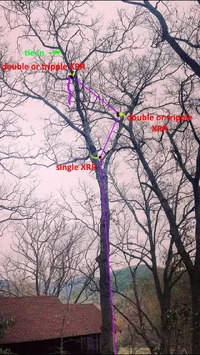
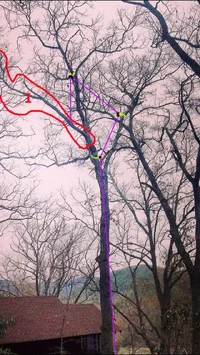
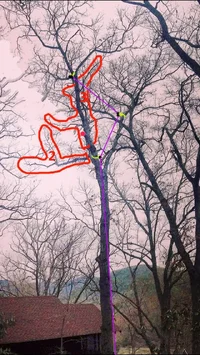
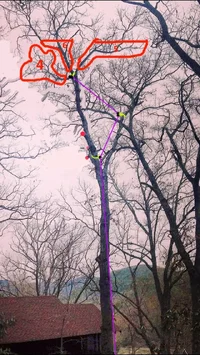
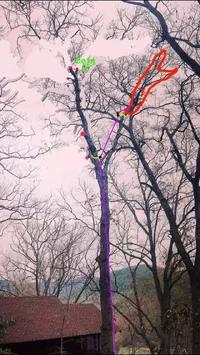
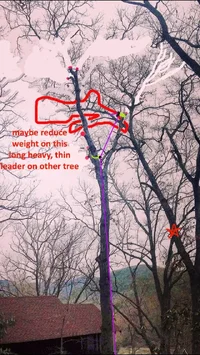
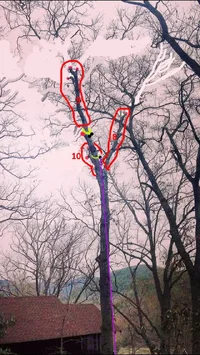


MikePowers321
Carpal tunnel level member
- Location
- Leeds, Ny
Niice

It's funny that X-man replied the way he did because I imagined him taking the time to do it just the way he did. Nice work, David. You're good like that! Something like that could be really helpful, but we don't know a few key things...importantly:View attachment 29577
Big, tall, Red Oak a friend of mine wants me to remove. Probly 20 ish more feet of trunk not pictured below. It's got a decent bit of weight over his cabin and he wants it gone. No crane access. Nothing really reasonably close to rig out of either. It's a lot taller and skinnier especially up to than what the photo Probly gives justice. Any suggestions from the well seasoned guys on this one?
- What do you have for equipment?
- What is underneath the tree?
- Can you bomb sections right out with good hinge cut technique?
- What's the pruning history of the tree?
Using a GRCS with a skilled operator is a completely different game than a port-a-wrap. Do you have blocks?
With a GRCS, you could lift out the entire leader on the right side all in one shot. Not as effective with a porty and mechanical advantage with fiddle blocks. Also, while Oak is very strong and awesome for hinging wood, defects can make any tree fail. It looks like some previous crown raising cuts were made at some point.
- Were large limbs removed long ago leaving any cavities?
- Was there construction that altered the roots or root plate?
- Are there signs of decay inside the main stem...long fissures, cracks, etc?
I also like how Boomslang and Guy responded. Preservation is a good thing in some cases, because high levels of exposure can result from the removal. That's something I've often thrown out as food for thought to a lot of clients.
Perhaps the BEST thing an "arborist" could do is a full evaluation of the site, that tree, and the others nearby. If the one in question is within striking distance, there are apparently some others as well. Pruning weight out and reducing wind-age might be better for the investment, and a much lower cost proposition overall.
I wish I could do what David did and draw in all the pruning cuts I would make.
Best of luck with whatever you choose.
Last edited:
guymayor
Branched out member
- Location
- East US, Earth
"Pruning weight out and reducing wind-age might be better for the investment, and a much lower cost proposition overall."
Yup. And removing entire branches in the middle of a tree makes it top heavy and increases risk.
Yup. And removing entire branches in the middle of a tree makes it top heavy and increases risk.




















