Reductions.. is 10% too much?

evo

Been here much more than a while
Location
My Island, WA
I’ve been pondering this for more than a few years. I’ve heard all kinds of arbitrary %’s recommended but the common one seems to come back to a NE coast study on ice loads and not wind. If a 10% reduction can reduce loads by 50% on the union, is a 5% worth 25%? I doubt the curve works that way, and my gut is feeling 5% reductions are in the mid 30’s or near 40% load reduction.

Sure there is going to be regrowth, possibly even thicker and heavier, but the other side of the equation is more green stuff removed is less wood put on. A lighter pruning dose can reduce loading and maintain wood growth. Can this be suitable as a one dose cure?

Sure we do occasionally get a heavy wet snow, or some ice loads. PDX when conditions are right and the gorge outflows with COLD dry air, and higher atmosphere rains from the wet and ‘warm’ pacific can accumulate ice. Yet this typically has to have the stars align to occur, but it happens.

I’ve been practicing avoiding cutting back into the heart wood as much as possible. Often WE recommend routine pruning every 3-5 years or at least an inspection that can push the pruning cycles out further as needed.

We should be discussing how little is enough! That and if more is needed, should other practices be incorporated such as cabling such as a looser dynamic system more akin to a backup?

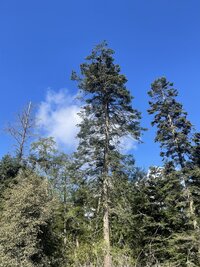
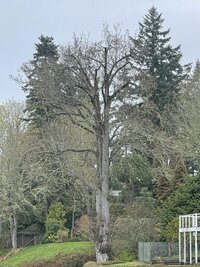
Photos of Alex my climber rocking it out as my shoulders still aren’t right.IMG_2839.jpegIMG_2837.jpeg
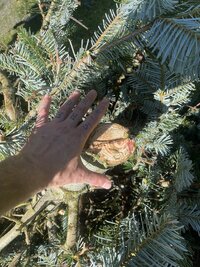
 
Last edited:
I think about this a lot too. Experience seems to be the key. There's times where more than 10% is necessary too.

Is the goal of this topic specifically related to snow/ice loads? Or is that just the aforementioned study?

I'd love to hear more people's observations regarding long term maintenance in reductions. Have you had good results with less? Is an arbitrary percentage valid to accomplish the goals?

This also varies (as mentioned) place to place. While I was in Georgia we were a bit less afraid of heavy load reduction because things grew so fast.

Proper cuts and training could be more impactful than percentages too.
 
This %cut to %load reduction came up at least in one other thread before I believe without consensus conclusion. Pics are PNW conifer with dense top configuration.

Any chance of finding that paper? Would give context. Math seems a little odd must be in the semantics or context.
 
Is the goal of this topic specifically related to snow/ice loads? Or is that just the aforementioned study?
I just brought up this study as like many things one situation doesn't fit all. Wind and pruning dose is a PITA to study, as every tree is different and wind has many variables. The 10% dose came from the ice load study more than a decade ago and I keep hearing that % being prescribed blanket for all reductions.
Most recently a 15% due to a garry oak that dropped a limb near highway 99. A non target recommendation just a buzz cut over the whole of the crown.
Best I can tell is static loading is easier to study, so assumptions are made for wind loads in areas that get little static loads but ample dynamic loads.

Thinning the tips can have a similar effect and we frequently will couple thinning along with smaller reductions.
 
This %cut to %load reduction came up at least in one other thread before I believe without consensus conclusion. Pics are PNW conifer with dense top configuration.

Any chance of finding that paper? Would give context. Math seems a little odd must be in the semantics or context.
It will take me a while to dig it up. As I recall it was sponsored by power companies in the NE specifically relating to ice storms.
 
10% of leaf surface area? 10% of the mass of the limb? 10% of the mass of the tree? I am curious what is meant by this number, and if there is a general consensus? I had heard that one can take up to 30% of the leaf surface off during dormancy without losing overall growth rates/wood production, but there was no mention of species when I was hearing that number thrown around.
 
30% total bud/leaf volume without significantly reducing wood volume of the part. Whole, limb, scaffold total tree. Aka the old school 30% rule

10% growing parts aka leaf or length of part off the ends for thinning (maybe more?)

10% of lever end of part
(Sometimes 15%)

Remember trees are fractals. Each part has to make more than what it requires for itself, for a net gain of woody parts below or inward and downward (root growth, stem etc). This is the part that doesn’t sit right about topping bluff trees. Sure the thing isn’t going to fall over, but there will be root loss mirroring crown loss.
Same with a secondary lateral, take too much and it’s the same of it getting shaded out (thus unproductive for the down stream).

What we don’t know yet is if total reduction detrimentally reduces stream lining in the wind. Or if the wind is a bullet hitting gel vs hitting a cinder block wall.
 
Last edited:
30% total bud/leaf volume without significantly reducing wood volume of the part. Whole, limb, scaffold total tree. Aka the old school 30% rule

10% growing parts aka leaf or length of part off the ends for thinning (maybe more?)

10% of lever end of part
(Sometimes 15%)

Remember trees are fractals. Each part has to make more than what it requires for itself, for a net gain of woody parts below or inward and downward (root growth, stem etc). This is the part that doesn’t sit right about topping bluff trees. Sure the thing isn’t going to fall over, but there will be root loss mirroring crown loss.
Same with a secondary lateral, take too much and it’s the same of it getting shaded out (thus unproductive for the down stream).

What we don’t know yet is if total reduction detrimentally reduces stream lining in the wind. Or if the wind is a bullet hitting gel vs hitting a cinder block wall.
Just making sure we're on the same page, and it sounds like we are. I think that the deeper answers are gonna be significantly species dependent, and at least as affected by phenotypic differences, similar to discussions of hinge qualities.
 
I was raised in the school of ewr, devout practitioner for a decade or so. I believed in it less and less as years went by. Eventually I realized my favorite trees were the ones that had been left alone. Targeted reduction over non moveable targets became my sop in the end.
 
I was raised in the school of ewr, devout practitioner for a decade or so. I believed in it less and less as years went by. Eventually I realized my favorite trees were the ones that had been left alone. Targeted reduction over non moveable targets became my sop in the end.
Please forgive my ignorance. EWR?

Edit: end weight reduction. Got it
 
Here is a heavy “reduction” boarderline retrenchment. We need a descriptor for that in betweenie.

I agree that reductions should be targeted and only rarely involve the entire crown. Around here prevailing winds and sheltered canopies need to be accounted for, we have about 60 miles of straight water due south, and NWW in the straight. Luckliy few storms come straight down the straight from that direction. The Olympics do weird shit to the weather, depending on the storm speed and direction we are getting whipped by the lash coming around the mountain, in the shaddow, or in the convergence where all hell breaks loose. Yet all that is normal, it’s the north winds that level shit when it pours out from the Fraser river valley.
Things will break in a 60-70 wind from the south but scale wise it’s not that bad (broad generalization). A 50 MPH wind from the north will do twice the damage as a higher wind from the south.

For the tree in the photo, its back when I was a employee workin the ground. I want to say its been about a decade since we pruned it.IMG_2744.jpeg
 
Here's my response from another post:

"The amount of branch reduction necessary is relatively small. The results of the test of
branch reduction under snow loading indicate that a reduction of 15% will reduce load-
induced stress in the Critical Fracture Zone by approximately 40%. This is significant.
However, the branch reduction testing done in this project was limited in scope. Simple
rules of thumb for branch reduction should be developed through an application of some
basic principles of mechanical engineering, and then validated by field-testing. It appears
very likely that a limited amount of reduction pruning of overhanging branches could
significantly reduce the risk of failure and subsequently the threat to reliability."

It looks like it was 15% of the length, but since foliage is typically more concentrated on the ends of branches, it's probably more than 15% of the total foliage on the branch.. it's called "Development of Risk Assessment Criteria for Branch Failures within the Crowns of Trees".
 

New threads New posts

Kask Stihl NORTHEASTERN Arborists Wesspur TreeStuff.com Teufelberger Westminster X-Rigging Teufelberger
Back
Top Bottom