Red Oak failure

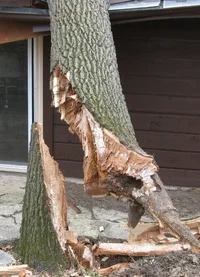
I WOULD have climbed this...There was no recent construction. There was white rot and brown rot all the way up the trunk. But no external damage. Only about an inch of proper wood all the way around. The only real clue was a small hole about 10 ft. from the top... In the interest of safety, I thought that I would share. Keep doing those pre-climb inspections.
 

Attachments

  • 80706-scaryoakstump.webp
    80706-scaryoakstump.webp
    483.6 KB · Views: 185
Whoa!!!

Can you explain how a tree fails by falling UP?! Did you pick that with a crane?

Did you do a thump test during your pre-climb inspection? Drill or bore cut?

Come on...spill the beans! :)
 
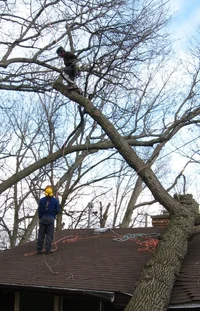
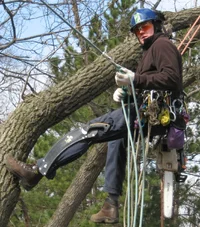
The tree failed in earlier in the morning during some fairly normal windy conditions. Resonance perhaps??? It blew the tree up on to the house. We stabalized it and then, I tied-in to two trees on opposite sides of the damage. There was one long lead that didn't just break off due to decay and there was enough wood in it that I wanted to rig it down and not just throw it down. It was still hung up in another tree and rotated considerably once it was free. I free up that lead and we slowly released the tension on the GRCS, allowing the trunk to turn until it was stablized by the branch that I had been cutting on. Meanwhile I was pulled out of the way by a coworker who had both of my tails.
 

Attachments

  • 80714-trimmeddoublecrotch.webp
    80714-trimmeddoublecrotch.webp
    578.1 KB · Views: 122
We had the tree secured to keep it from sliding off the roof by tying it off to a porta-wrap. We controlled the rotation by running a static line up over an adjacent white oak's large main crotch then down to the GRCS. There was a some rotation as the line stretched after freeing the tips up. I was held out of the way as the limb was lowered to the roof top to be bucked and rolled off. I just wanted to clarify because we did our utmost to be as controlled as possible.
 

Attachments

  • 80724-redoakfailuredoublecrotch.webp
    80724-redoakfailuredoublecrotch.webp
    386.6 KB · Views: 94
Good point, Tom. The roof had a pretty flat angle and there really wasn't anything else to be tied-in to other than where I was. The other two trees adjacent to the work site would only have put them in the path of travel of the large branch I was working on. Had it broken the static line during the releasing of the tips, the big branch would have rolled right into thier lines, or them.
 
So if you followed a standard such as the British one that says all workers aloft must be tied in, risk owuld have been higher. Does that mean that overkill in rules can kill?
 
In the Z133 it says that any treeworker who is off the ground shall be secured from falling. There are also OSHA standards that address working off the ground.

I know more people, who aren't in the tree industry, who have fallen off roofs and ladders than I know people who have fallen out of trees. Too often tree workers are on roofs without fall protection. This seems much more dangerous than a lot of other operations.

Could you have strung a rope between two trees and had the roofies clip a climbing system into that? A horizontal lifeline or floating false crotch sort of setup.
 
What a relief with other tall trees around; I love double crotching! A job well done. Scary how it failed. What did the rest of the tree look like (other than the roof photo)? Full crown, or was there not much left over the years?
 
Thanks for posting this one. Does anyone know of a "tree failure database?" I'm sure I heard of it, but can't seem to find it anywhere. That would be a perfect place to record these types incidents and learn from them.

TS

ps Tom... roofs always SCARE me.
 
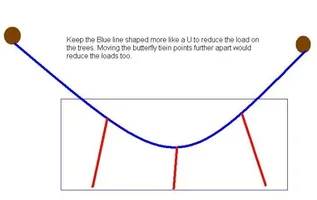
We could have set up a traverse line. I am wondering about loads on a line like that if three guys are tied in to the same line and they all have to load if fully and simultaneously? Assuming the trees used are structurally up to it, could three climbers tie to three alpine butterflys tied in the traverse line, and still be safe?
 
There is an international tree failure database that I sat in on a presentation about at the ISA conference in Nasheville. I may have some info that I could share if you are interested.
 
[ QUOTE ]
Assuming the trees used are structurally up to it, could three climbers tie to three alpine butterflys tied in the traverse line, and still be safe?

[/ QUOTE ]

With some calculations it could be setup safely I'm sure. Keep slack out of the roofies lines would reduce the possibility of shock loads. Using short lines would reduce the mess of ropes on the roof. Be sure to tie stopper knots in the ends of all the ropes.

In the end, balance the rigging time and cost against a fall off the roof.

This is how I visualize the setup.
 

Attachments

  • 80774-csTraverseline.webp
    80774-csTraverseline.webp
    15.6 KB · Views: 83
We are NEVER pressured to go fast, so we take our time and set up our rigs carefully and thoughtfully. We didn't think of your idea though...There are at least a couple o'ways to accomplish what you suggest, now that I think about it. Thanx for the suggestion.
 
When in Rome do as the romans do...

The worker on the roof can tie in the same way a roofer or carpenter should (not many do)... fix a safety line to secure structure on the roof and put a shock absorbing lanyard into the system between the worker and anchor. It's quick to set up and effective fall prevention.
-moss
 
I'd not like to climb on a highline that had other people tied into it. I guess you could do it, but you would have to have some good communication.

If I was out on a limb with a lot of tension on the climbing line, then you stand up and put a lot of slack into the system, then I am going to get lowered even MORE onto the limb...might just freak you out...but might do more than that!

I'd like my rigging for my climbing system to be just for me.

love
nick
 

New threads New posts

Back
Top Bottom