- Location
- NW Indiana

Navigation
Install the app
How to install the app on iOS
Follow along with the video below to see how to install our site as a web app on your home screen.
Note: This feature may not be available in some browsers.
More options
You are using an out of date browser. It may not display this or other websites correctly.
You should upgrade or use an alternative browser.
You should upgrade or use an alternative browser.
Radial trenching with air spade
- Thread starter treemann
- Start date
- Location
- NW Indiana

- Location
- Home of the New Jersey Devils
I woulda thought that it was done by those same aliens that like artwork in the crops too! /forum/images/graemlins/smirk.gif

- Location
- Macon Georgia, USA
What is the purpose of the work he was doing?

TreeCo
Carpal tunnel level member
[ QUOTE ]
What is the purpose of the work he was doing?
[/ QUOTE ]
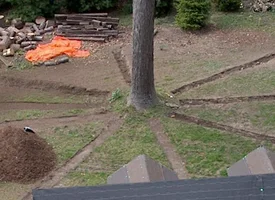
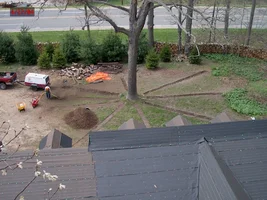
The purpose is to losen compacted soil and to add soil admendments. Only as much as shown in the picture is done each year. Next year other locations are trenched. The idea is that many new roots will grown in the new loosened and admended area. The air spade is not supposed to damage roots......but you do need to worry about doing too much at a time and roots dying out. I've never used an air spade so what I'm telling you is all second hand. I have seen one used at a demo. What a lot of noise. I can tell you that an air spade will remove soil at a rate 100 times faster than can be done by hand.
Dan
What is the purpose of the work he was doing?
[/ QUOTE ]
The purpose is to losen compacted soil and to add soil admendments. Only as much as shown in the picture is done each year. Next year other locations are trenched. The idea is that many new roots will grown in the new loosened and admended area. The air spade is not supposed to damage roots......but you do need to worry about doing too much at a time and roots dying out. I've never used an air spade so what I'm telling you is all second hand. I have seen one used at a demo. What a lot of noise. I can tell you that an air spade will remove soil at a rate 100 times faster than can be done by hand.
Dan

- Location
- Deltona, FL
joesoup...there's more to tree work than cutting 'em down.
- Location
- Macon Georgia, USA
Well sir, I am only asking because I am learning a lot about trees that i didn't know or care about until I started Rec. climbing. I have even found myself being concerned about how people in my area climb to do prunings, I have seen a few who use gaffs on pines, which I think is not to smart.
And I am fully aware that not everyone who climbs a tree is there to cut it down.
And I am fully aware that not everyone who climbs a tree is there to cut it down.

- Location
- Dallas, Texas
[ QUOTE ]
What a lot of noise. I can tell you that an air spade will remove soil at a rate 100 times faster than can be done by hand.
[/ QUOTE ]
My PPE for air spading includes a clean-room suit. It started off white. The Tyvec ones last a little while but if you can the bunny suits in surplus... Safety glasses and ear inserts BENEATH a hard hat / face shield / hearing protectors (that gap caused by the glasses becomes significant in noise reduction). Leather gloves since the compressor has hot breath.
Yes, under most soil conditions this thing works well. We have some compacted areas of good Texas gumbo that it will eventually wear through and leave the roots more intact than a shovel.
Good technique and attention to what works with soil types and condition and moisture require some experience. Changing the angle of the nozzle against the soil will vary results.
I'm interested in trying some radial trenching. How many years would the treatment span?
What a lot of noise. I can tell you that an air spade will remove soil at a rate 100 times faster than can be done by hand.
[/ QUOTE ]
My PPE for air spading includes a clean-room suit. It started off white. The Tyvec ones last a little while but if you can the bunny suits in surplus... Safety glasses and ear inserts BENEATH a hard hat / face shield / hearing protectors (that gap caused by the glasses becomes significant in noise reduction). Leather gloves since the compressor has hot breath.
Yes, under most soil conditions this thing works well. We have some compacted areas of good Texas gumbo that it will eventually wear through and leave the roots more intact than a shovel.
Good technique and attention to what works with soil types and condition and moisture require some experience. Changing the angle of the nozzle against the soil will vary results.
I'm interested in trying some radial trenching. How many years would the treatment span?
- Location
- NW Indiana
This particular case was close to the shores of Lake Michigan and the soil was very sandy. Also the compaction from the construction was only on one side of the tree. So my treatment plan inluded the radial trenching to loosen the soil. Then I put any soil that was blown from the trenches back into the trenches so as not to lose any mychorizae. I then covered the entire area underneath the dripline with 4" of hardwood mulch. And I also treated the tree with cambistat to incrase the fibrous roots.
- Location
- Dallas, Texas
[ QUOTE ]
Then I put any soil that was blown from the trenches back into the trenches so as not to lose any mychorizae.
[/ QUOTE ]
What approximate depth/width? Can you point me to more writing that has been done on the subject?
How long did it take (because I'd have to 4x it for here)?
And the customer's tree got several less yards of turf? Cool.
Then I put any soil that was blown from the trenches back into the trenches so as not to lose any mychorizae.
[/ QUOTE ]
What approximate depth/width? Can you point me to more writing that has been done on the subject?
How long did it take (because I'd have to 4x it for here)?
And the customer's tree got several less yards of turf? Cool.
- Location
- NW Indiana
The width of each trench was about 20 inches. You have to remove the sod before excavation because the air will not bust apart the grass roots. We use a sod cutter so that if this is being done in a yard you can lay the sod back over the trenches after you are done. The depth in this particular case was about 8-12 inches. I am not sure where I have read about radial trenching I think that there is some information on the air spade web site. Other that there I think that I have just picked up bits and pieces here and there. My thoughts are that we are just trying to get the soil loosened so that the fine roots can grow and that oxygen can penetrate the root zone. If the client will allow I alway recommend covering the area with mulch. If you want to discuss this further PM me and I will give you a call.

Mangoes
Participating member
- Location
- Greater Toronto Area
Was surfin' and I stumbled upon this.....http://www.bartlett.com/au710.cfm?ID=24
Now if I am correct, Bartlett is trying to make it so's they hold a patent on replacing root zone soil volume while using an airspade. To me it seems like a bit of a stretch, but if it's valid does that mean nobody can provide such a service without an agreemnet or license from Bartlett? At least treemann has documented evidence of providing the service before patent, if that's relevant.
Now if I am correct, Bartlett is trying to make it so's they hold a patent on replacing root zone soil volume while using an airspade. To me it seems like a bit of a stretch, but if it's valid does that mean nobody can provide such a service without an agreemnet or license from Bartlett? At least treemann has documented evidence of providing the service before patent, if that's relevant.
- Location
- Grand Rapids, MI
I work for a bartlett office in Michigan, and if what I was told is correct, they are essentially patenting the specific name of "root envigoration" and not so much the process.

In my Tree Structure and Function class we are learning about roots. Our professor rented an air spade and in lab today we used the spade to examin roots on a few trees on campus. We mostly looked at planting depth and how the roots grow and react to the depth. I found it very interesting how we were able to tell that one tree was a B&B (balled and burlaped) due to where the roots had been severd, and the other a containerized tree due to the swirling of the roots. Both trees were planted too deep, and both had SGR's (stem girdling roots). The air spade was very cool to see, I dont know how fun it would be to run one all day, but definatly very useful tool in our quest to keep trees happy!!

Names get Trademarks, things (and in some cases the processes used to make them) get Patents.
They don't divulge the patent number in that URL, so the patent cannot readily be inspected. If in the currently-insane way the U.S. Patent Office is rubber-stamping patents for processes which are "otherwise obvious" to practitioners in a field using readily-available tools has resulted in an actual patent in this case, it's most likely the patent isn't worth the "paper it's printed on".
It's likely the patent (if there is one) covers specific combinations of chemicals, and if they're not proprietary, it still probably doesn't mean much.
I wouldn't worry about it. If anyone has already been doing this they shouldn't worry either.
Glen
They don't divulge the patent number in that URL, so the patent cannot readily be inspected. If in the currently-insane way the U.S. Patent Office is rubber-stamping patents for processes which are "otherwise obvious" to practitioners in a field using readily-available tools has resulted in an actual patent in this case, it's most likely the patent isn't worth the "paper it's printed on".
It's likely the patent (if there is one) covers specific combinations of chemicals, and if they're not proprietary, it still probably doesn't mean much.
I wouldn't worry about it. If anyone has already been doing this they shouldn't worry either.
Glen
- Location
- Madison, Wi
[ QUOTE ]
... Both trees were planted too deep, and both had SGR's (stem girdling roots).
[/ QUOTE ]
We have maintenance on campus to thank for that, A large percentage of the trees on our campus were planted to deep, even a number of newly planted ones on the north side were left in the container when they were planted and had to be re-planted.
... Both trees were planted too deep, and both had SGR's (stem girdling roots).
[/ QUOTE ]
We have maintenance on campus to thank for that, A large percentage of the trees on our campus were planted to deep, even a number of newly planted ones on the north side were left in the container when they were planted and had to be re-planted.

- Location
- Retired in Minneapolis
New threads New posts
-
test2
-
-

-

-

-
Industry related Spanish language podcasts
- Latest: Mick Dempsey!
-


