quick splicing question

I liked it. The positioner is very smooth and intuitive, it did not take long for me to get used to it. I did find it easier to advance my lanyard when using it as a second climb line, due to the steel snap instead of the aluminum carabineer that I used on my last lanyard. I used it in all of the configurations, a long lanyard, double lanyard, a 20' SRT positioning system...

The downfalls that I have seen is: I can see the cover swell up just a little bit from milking, so far only an inch or two of slack. As of now it does not create an issue as the adjuster is all the way up by the splice before it creates even that much slack. When I spliced the second eye I milked about a foot of cover off of it before the splice. The only other issue was when using it as a double lanyard, at one point it did create a twist between the adjusters. this was only a problem when I used the entire length of rope, and was easily remedied by unclipping one end from my harness once I was done using it.

I'll have to let you give it a try the next time we are working together @kiteflyingeek , it may give you some insight on what you do and do not want in your next lanyard.
 
I've done the 20 mm sirius with no issues, turned out great. I think I used standard double braid instructions with a different taper pattern
Hi NE Tree I'm looking at splicing an eye into 20mm Sirius. I've never spliced a rope so big though. Could you recommend a taper pattern for me? Also what would the fid length be for this size? Thankyou
 
Hi NE Tree I'm looking at splicing an eye into 20mm Sirius. I've never spliced a rope so big though. Could you recommend a taper pattern for me? Also what would the fid length be for this size? Thankyou
So you have direct instructions from NER/Teufelberger you can follow to splice this 20mm Sirius, you just have to do some digging to find the exact one I'm referencing. There are also fid length charts available all over the net. You just need to do the mm to inch equation as most are referenced as inches.

New England Ropes call for
a 5,5,5,5, pattern to the end of the rope.. but there are a number of different options out there. Some complicated some not... 55555 being easiest...

Heres a fid chart..
4778b82bdff6123021a6e2b28dfb9819.jpg


Here's the guide. Wasn't as hard to find as i thought it was.
https://www.teufelberger.com/pub/me...loads/Splicing_instructions_rigging_ropes.pdf

Sent from my Pixel 2 XL using Tapatalk
 
Last edited:
I'm not sure about the modified splice integrity. I Do know that stable braid splices very easily and I think that with just a little use, you could still splice it with the class 1 db splice. I dont think you'll have much problem at all

If I remember correctly Samson says (somewhere) their modified for used rope splice instructions are good for 80-90% of REMAINING ROPE STRENGTH. Obviously this can vary greatly...

Besides taper the big difference is that "Point Z" for the core exit doesn't exist. The core is buried from the crossover at "T" to the original core exit point at "X" then trimmed off there. This makes the splice easier to complete on old dirty rope as the core doesn't exist in the throat, and instead ends at the end of the eye.....which also creates the slightly reduced strength of the modified splice.


After saying all this I really wish I could find where I read it all... I'll keep searching.

EDIT: here you go... up to 90% of remaining strength
http://www.baileysonline.com/PDF/ClassI_DblBrd_Used_EyeSplce.pdf
 
If I remember correctly Samson says (somewhere) their modified for used rope splice instructions are good for 80-90% of REMAINING ROPE STRENGTH. Obviously this can vary greatly...

Besides taper the big difference is that "Point Z" for the core exit doesn't exist. The core is buried from the crossover at "T" to the original core exit point at "X" then trimmed off there. This makes the splice easier to complete on old dirty rope as the core doesn't exist in the throat, and instead ends at the end of the eye.....which also creates the slightly reduced strength of the modified splice.


After saying all this I really wish I could find where I read it all... I'll keep searching.

EDIT: here you go... up to 90% of remaining strength
http://www.baileysonline.com/PDF/ClassI_DblBrd_Used_EyeSplce.pdf
Ironic i come across your post here.. i literally just got done reading the full set of instructions for Used DB after recently referencing them for a couple odd ball specs i wanted to try on new rope. I was really left scratching my head afterwards hearing that they do away with the core tail bury.. & in the attempt to get clarification on a certain topic I'm only left with more questions..

Like..

If you don't have to involve that core tail in a bury past the original extraction point, then what's the point having to do it with new rope? Is it because it's slippery? Considering it that core tail is just cut off before things get tight, i would imagine you could bury a pretty fat cover taper into that throat as there's nothing already in there too cause construction/bottle neck..

Considering some manufacturers of just regular run of the mill class 1 DB want a full fid bury with that core tail, how is it you can get away with none..

& When is it considered used? Does it have to be all grimy & dirty to be considered? Or can it be considered used by just messing around running hitches & gear over it while you indoors..

Deff a mindfuck there..

Sent from my Pixel 2 XL using Tapatalk
 
Maybe the soaking in water does something magical to the rope. A lot of commercial spliced dock lines are done without that final bury.
 
Maybe the soaking in water does something magical to the rope. A lot of commercial spliced dock lines are done without that final bury.
Are they? No kidding..
I would imagine not having that bury makes certain "hard to splice" ropes fairly easy to do.

I have a few Splices where I've gone very slim with that taper. Haven't done one completely without though. I think I'm going to make 3 eyes up & have them broken.
One will be Normal Manufacturer Instructions.
Second will be Heavy Tapers (like i would for flexibility).
Third will be the Modified Used Rope instruction without the bury.

You have a chance to mess with that 8mm Epi yet? I'm curious as to what methods your going to use & how easy it buries for you with those..

Sent from my Pixel 2 XL using Tapatalk
 
Last edited:
Yeah, those dock lines would be fast and easy to make. It seems that they are maybe ten percent less in break strength than the regular splice.
I stopped splicing for awhile just after the tight double braid cords and rope came out. I've only done two of the Ocean Polyester eyes, so I don't have any insights on the normal splices. I'll probably will do a different double braid that I came up with that only has the final bury of everything in the cover, that's challenging.
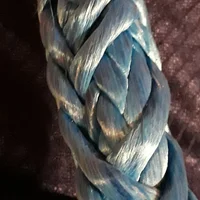
 
Yeah, those dock lines would be fast and easy to make. It seems that they are maybe ten percent less in break strength than the regular splice.
I stopped splicing for awhile just after the tight double braid cords and rope came out. I've only done two of the Ocean Polyester eyes, so I don't have any insights on the normal splices. I'll probably will do a different double braid that I came up with that only has the final bury of everything in the cover, that's challenging.
You stopped splicing for a bit after the tighter DB covers came out? I'm not following.. Haven't they been out forever?

You've only done two OP eyes... In your personal opinion, do u think those were tight?

Cover only bury - without trying to open up a can of worms in terms of trying to explain it via text, what are you doing with that scenario? Are you marking the tail through the extraction point, like in the NER DB instructions, pulling it out & tapering all the way back to that mark somehow?

If it's too difficult to explain via text, you can just give me a yea or nay on that last question.

Sent from my Pixel 2 XL using Tapatalk
 
Not cover only, I meant the last step of of a double braid splice. I lock brummel the cover and core, bury them in the core, and then bury it all back into the cover. The only hard part is the final step.
When I first started splicing, the only high tech cord was Ultratech, and Blaze, the first double braid arborist rope, hadn't come yet. Not saying I'm old, but I can remember when they first came out with dirt.
 
I've run into another splicing issue, and I'm wondering just how badly I've messed it up. 20190706_221112.webp

In splicing an eye in some 1/2" amsteel, I did not notice that my wire fid exited and then re-entered the outer part of the bury until after I finished the bury. I know it's not hard redo the bury and make it correct, my question is will this cause a strength loss or lead to failure?

Just trying to understand splices better as I go, thanks again for the help.
 
@Jehinten, I'm glad to see I am not the only one bumping older splicing threads! I am curious to hear the answers to your question as well being new to the splicing game!
 
That would probably be the weak spot, but it is only one strand. It might tend to try to push the tail out of the bury when loaded, as it straightens.
 

New threads New posts

Back
Top Bottom
