Question

Whcih do you prefer, a half-hitch in the same direction as the anchoring knot or the opposing direct

  • Same

    Votes: 0 0.0%
  • Opposite

    Votes: 0 0.0%

  • Total voters
    0
This thread has made me wonder about this again and I have a few questions.


Mark C. wrote:

What I saw was that, when the two were tied close together, they would slide closer to one another when tied in the same direction. This could be bad.


How close together were they tied?
How much did they move?
Did the half hitch move towards the bowline, the bowline towards the half, or both towards the middle?
Did the half hitch or bowline twist around the piece? That is, before you made your final backcut was the part of rope that runs from the pulley to the half hitch centered on the notch (as in the attachment that Kevin provided). If so, was the half hitch still centered when the piece had come to rest or was it twisted to one side?
What happened when you tied the half hitch and bowline close together with the rope going in the opposite direction between the knots?
How were you able to tie off the piece and observe the knots after the piece had fallen? Were you in a bucket truck or did you have someone else looking at the knots after the piece had been cut and was lowered?

I played around with both configurations on a 2" diameter, horizontal piece of sycamore. When pulling at a right angle to the tree, I could get the knots to slide togethor with either configuration, but it seemed a little more secure when the knots were tied with the rope going in the same direction. Like you though, I am not 100% convinced and will try to look at this again in the field.

It may also be worth noting that, if tied in the same direction, but with no bowline at the end a clove hitch is formed
If tied in opposite directions, but with no bowline at the end a girth hitch is formed.

I think it is good to look at details like this. These are the things that can make the difference between preventing and causing an accident in extreme situations. 'Extreme' need not be big, tall, dead or hazardous, just something that is not part of the day to day routine. In this case it could be something as simple as removing a sycamore limb on a rainy day.

Mahk
 
Mahk,

Thanks for the thoughts. I will try to look at this when I can and try to answer your questions. I first noticed that they seemed to pull closer together when they were tied in the same direction, were close (maybe 12" or a little more) and we pulled the stretch out of the line with a winch. That is what really got me thinking about the topic.

I'm still going to spend some more time looking at this.
 
i think turns depend on pulls direction

Sorry i missed this! Very good question about a simple basic thing that we decide many times each day. i think if there is a better way to engineer this easily (choice of direction of turn for best result with equal time and materials spent) is up to the rigger/inspector as a craftsman to maximize the strength and security of every point to max, to develop best, seamless habit, on some days that habit blindly saving the day for some other error maybe. Like the best SWL the task could easily get. This is the best i've come up with and why:

i definately say best that each restriction is to the opposite side of the pull; and assuming the half hitch is right, then for sure in the same direction turn the line (as if to make extended clove and not girth/Lark's from half hitch running bowline).

If the support pulls to the side, the primary pulls of single lines should be to that side in both the half hitch and the susequent running bowline; and the restriction of the cross in the hitch and the eye of the bowline, come then from the opposite side of the pull, so that the pull locks into it.

If the support for the rig is right above or below the load (neutralizing the above), i follow the same theory, calculating pull side on the heavy side of the load, and run the half hitch/marl around the heavy side first on the spar, around and cross so that the heavier pull to the opposite side locks into this cross. The running bowline should be towards the C.o.B. from the half hitch to close it properly; as everything is about getting the pull to lock into the restriction. If using a sling, Cow etc. for pulley support mount over or below, i work the same strategy that all the pulls lock into the restriction of a cross, bight or eye in the line coming from the opposite side of the pro-jected pull.

i then calculate that the line going to running bowline will also be pulled to the heavy or steering side as the restriction it just offered was pulled in that direction, so again lace down that side(heavy/control pull side), so that temporary eye of bowline restricts positively the direction of that pull, by being opposite it's pull/ in the most leveraged direction of resis-stance. Thereby, by that exam-eye-nation, both rings of grip (half hitch and running bowline) turn in the same direction.

i choose this configuration in liking the more positiveness of 2 grabs on the load, eving with round slings. In examples of converting a TH to a Killick with a preceding half hitch, it is said that the load pulls straighter from a cross isntead of an eye; my budroe Stretch says the longer length of the tightened line between the 2 points of half hitch and running bowline pushing against the side of the spar is kinda stabilizing (ok i stretched, Stretch's theory over the years!!), sometimes i think i see that in a rig. i think the preceding half hitch in anything gives almost positive security and takes the pressure off the joint/weakness of the line in the bowline etc., protecting it.

i like using 'loop runners' for most things and keep a carabiner in the end of each one; i throw the carabiner around from agianst the pull side where the loop of the sling will restrict the pull from the carabiner side as it is choked through. so slinging it around from the wrong side, makes the carabiner end up on the pull side.


But...... if by that theory the first grab of the preceding half hitch was set 'backwards/wrong' by the theory, then possibly i could see where having the 2nd grab of the running bowline grabbing backwards from the first might help in that extreme example!

Orrrrrrrrrrr something like that....
 
Re: i think turns depend on pulls direction

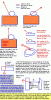
This sounds important, but I just can't grasp the logic without some visual aids. Any chance of posting some diagrams or pics to help my feeble brain comprehend?
 
Re: i think turns depend on pulls direction

The power to me in the grip is the line pull seating into the restriction, be it eye or line cross. An eye, whether permanently weaved in the form of a splice, or a temporary weave of a knot/hitch only has to 'worry' about fortifying against the pull from opposing restriction to opposite side of line pull. The cross of a hitch is more like an open hook, so must 'fortify'/set against pulls from both the C.o.B. down the lenght of the spar, as well as it's or the support pull to the side as eye's only have to do. So you set a hitch pull as if to the back of the throat of an open hook IMLHO.

Set like that the restriction line flows down and becomes the pull line to running bowline; that restriction line turned pull line is pulling in the same direction as red part of line pulls, so set running bowline etc. in restriction of pull strategy, so naturally wraps in the same direction, to set the restrictions in the same direction.

Had to shrink file and downgrade to .gif to squeak by file size limits; you might have to spin mouse pointer around lower R.hand corner of pic to get the enlarge button to show up, it is as a ghost down there till you pass over it making it appear from nowhere. Clicking it 1x will enlarge the pic. The buttons that show up in the upper L-Hand corner allow you to save, print open pictures folder on your drive etc.

You always lock into the back of the deepest throat of the hook. Even with Channellocks, pliers, vice-grips crescent wrench, even own hand spinning on high bar in gymnsatics etc. all turn the direction of the point of the small jaw(minor)/thumb, to lock into the larger stronger, deeper hook of the rest of the tool, even your hand.

Orrrrrrrrrr something like that!
 

Attachments

  • 9267-Setting Restriction by Pulls smaller.GIF
    9267-Setting Restriction by Pulls smaller.GIF
    223.6 KB · Views: 69

New threads New posts

Back
Top Bottom