Question

Whcih do you prefer, a half-hitch in the same direction as the anchoring knot or the opposing direct

  • Same

    Votes: 0 0.0%
  • Opposite

    Votes: 0 0.0%

  • Total voters
    0

Mark Chisholm

Administrator
Administrator
Here's a simple poll I'd like to try.

I've heard reasons for both ways (one more than others), but am still wondering what others do and prefer (and why). I would like to know which direction you place your half-hitch when butt-tying peices?
 
I'm not sure I understand the question. Where would this half hitch be located?
 
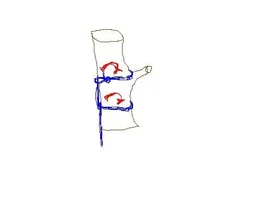
Sorry, no, what was asking is when you use a half-hitch in conjunction with an anchor knot (like the running bowline) do you start each by wrapping in the same direction, or do you wrap them in opposing directions.
 
Opposite, why? That's the way I saw it tied in ArborMaster training, if you tie it in the same direction you get Z in it not that I think it has any ill affect.
 
Your drawing is better than mine.

I see what you're saying. I've heard people say that it is neater to run them in the same direction. I find that, if you place them in opposing directions, you can pre-load the anchor knot better.

I was just wondering what everyone else likes to do.
 
Ahhh, now I see what you are talking about. I run them in opposing directions. You cannot tighten them up well when running them in the same direction. I don't like my knots shifting between the time I tie them and when the cut is finished. T.D.S. A loose knot will slip and slide when loaded until it tightens.
 
I'm with the group who ties their hitch in the same direction as the the primary knot or hitch.

A good question to accompany the original post would be, why does 1 use a half-hitch or marl in conjunction with the primary knot or hitch?

Joe
 
(Ten??--more??) years ago, I posed this same question to Ken Palmer, and, separately, to Don Blair. Both shrugged and said that they hadn't really thought about it. My thoughts then were the same as they are now. I wrap in the same direction. If you change direction, then, as the half hitch tightens, the running bowline loosens.


Kevin;

When did you see ArborMaster teach that the knots should be tied in opposite directions? In The Art and Science of Practical Rigging video series (filmed in 2000-2001), the half hitch (or marline hitch) with running bowline configuration is tied with the rope going in the same direction around the tree to form both the half hitch and the running bowline. At the end of the segment that shows these knots, Ken even emphasizes that the turns should be made in the same direction for both knots. Have they changed their procedure?

Mahk
 
I always do same direction. It has a good visual if anything. You can tighten it goin same way, use more elbow grease. Either way to me is irrelevant, as long as the main anchor is set.
 
Mahk;
After reviewing The Art & Science of Practical Rigging you are correct.
I had it in my mind they went opposite in their illustrations.
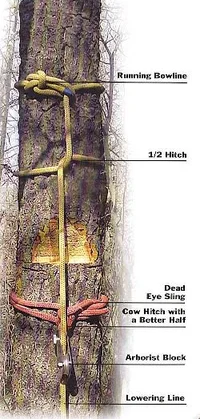
They tie it in the same direction as in this image from the Samson catalog.
I find it easier to dress when it's tied in the opposite direction.
 

Attachments

  • 8502-half hitch.webp
    8502-half hitch.webp
    46.1 KB · Views: 58
So this is debatable. I used to consistantly perform them in the same direction. I tried them as opposites to see how it would be affected.

What I saw was that, when the two were tied close together, they would slide closer to one another when tied in the same direction. This could be bad.

When I tied them in opposite directions, they wouldn't. That's the reason for this discussion. Maybe we should all look at it some more in the field?
 
Mark, did you tie them with a bit of distance between them?
I hear what your saying when they are close together. It could be a problem. I hope most of us either find a nub, stub or put distance between knot and half hitch. For short pieces you could tie a clove hitch,to grip,then a regular bowline.(I guess that would be a clove hitch bowline, or something like that ). Anyway, it grips good and unties easy. Has this been a prob. of pieces falling out? 2 had fallen out for me before, but did not have the half on there. I think dist. between knots helps.

Later
 
Looking at things in the field is easy. I think we find these reactions as we gain experience. We stick with what seems to make the most sense. For me, it means tieing them in the same direction. I can see where it would make sense to tie the half-hitch in the opposite direction, but, I need to stick with what I think works better.

Joe
 

New threads New posts

Back
Top Bottom