Question for Mark on srt

Mark,
I am still trying to figure out you're set up from the TCIA show when you had the single line set up with your floating false crotch and how on earth you backed up your srt ascenders with the rope from your drt set up off the floating false crotch. I've been trying to figure this one out for a while but I have yet to figure it out. I know you used the kong dual ascenders but how did you get the drt rope stationary in one side of your ascenders? I liked the idea that you could back up your single line with a totally separate line. Anything to feel a little more secure for long ascensions is a fantastic idea. I was intrigued by this but can't figure it out.
 
Sorry for not replying before.

I think you are mixing 2 ideas- teh floating false crotch and the dual ascender back-up. I don't use the Kong's for the FFC setup. Only for ascending. Which one are you interested in?
 
Well it was for the ascension using the kong ascenders. You did something if I remember correctly running your drt rope up into the tree. You were using the line from the drt to back up the srt line somehow for the ascension.
 
It is actually quite simple. Install the access line pull the rope over the union (I bring back to the ground) Tie an inline knot (Alpine Butterfly) Clip a caribiner with your climbing line and any tools you may need and pull it up to the union.Anchor back to the ground. Now the ropes are anchored indipendently so the cams back each other up, (great idea Mark).
 
Thanks Todd.

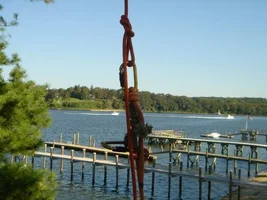
PUClimber, do you follow or do you need a pic? Here's one anyway
smirk.gif
 

Attachments

  • 69653-twoline.webp
    69653-twoline.webp
    42.4 KB · Views: 305
So in other words you have both lines anchored to the base of the tree at ground level? And you have your floating false crotch running off of the access line clipped to the carabiner attached to the alpine butterfly?
 
[ QUOTE ]
And you have your floating false crotch running off of the access line clipped to the carabiner attached to the alpine butterfly?

[/ QUOTE ]

No sir. There's nothing really floating about this technique. It is simply an ascending backup that creates a doubled static ascent. (hmmm, maybe a good name for it?)
 
Since I bring the access line back to the ground one can be lowered from the ground, I've been calling it a dynamic static asscent.
 
Mark C. wrote:

[ QUOTE ]
There's nothing really floating about this technique. It is simply an ascending backup that creates a doubled static ascent. (hmmm, maybe a good name for it?)

[/ QUOTE ]


Good! One thing though--'doubled' (with a 'd' at the end) implies that a rope is 'doubled over', like DdRT, Doubled Rope Technique in which one rope is doubled over a limb. 'Double' static ascent implies two (2) lines that are static. This might be a good name for when the line is tied off at the ground (vs. setup so that the climber can be lowered, see below).


Tod K wrote:

[ QUOTE ]
Since I bring the access line back to the ground one can be lowered from the ground, I've been calling it a dynamic static ascent.

[/ QUOTE ]

Nice Tod (and welcome back). Dynamic because the climber can be lowered in an emergency, and static because the line is stationary when the climber ascends. But, the same could be said for an SRT system that is set up that way, so, using Mark's suggestion, maybe it could be a 'dynamic double static ascent'.

I know the names seem to be long (dynamic double static ascent), but the systems are getting more complicated and those four words (dynamic double staic ascent) are a lot shorter and more precise than 'you know...the system where you pull one rope through, then tie a midline attachment knot and clip another rope to that and then..."

Double static ascent, and dynamic double static ascent.
Sound good?


Any good ways to judge where you put the midline loop so that the climber's end of the ascent line is just on the ground when the loop is at the top?
 
[ QUOTE ]
Yep, My access line is 220', do'nt forget trees are not as tall around here.

[/ QUOTE ]

Gotcha. Here, a 200' line is many times off the ground a little. That is where I came up with the whole "loop" trick. Still working on that though.

Double Static Ascent and Double Dynamic/Static Ascent is alright with me. I used to call it the "Y" ascent. What do you think of "Y Ascent" and "Dynamic Y Ascent"? The idea is that the ropes look like a Y (upside down of course) when set.
 
Thanks Mark for expalaining your technique i have been looking for a safe and effiecent way to ascend using the kong doubles and footlocking. I tried it out today and it worked a treat. Leaving the line in place as a rescue line is an added bonus.
 
Hi all. I have been lurking here for a while trying to soak up as much information as I could, but never had a chance to post. I don't think I am quite sure on how this technique works, so wanted to verify it.

I think I understand how ascending works with the static line and using the DRT climbing line as the backup. I am assuming that after you reach the top and tie in, you would switch the system to a floating false crotch using a single ascender on the line that is attached to the ground. I am also assuming that you would be working from a pulley attached to the single ascender on the single line. I believe this is how I interpreted the pictures. Is this correct? Thanks,
 
The system if for acsending only. You get to send up all of your equipment including your climbing line. The main purpose of the system is to easily back up a pair kongs. Once you get to the top you abandon the access line and the kongs, then work off the climbing line you pulled up.
 
[ QUOTE ]
The system if for acsending only. You get to send up all of your equipment including your climbing line. The main purpose of the system is to easily back up a pair kongs. Once you get to the top you abandon the access line and the kongs, then work off the climbing line you pulled up.

[/ QUOTE ]

Thanks for the clarification. I guess I was trying to make it more complicated than I should. I think I was trying to merge the concept with another technique I saw where someone would climb on a single rope and work off of a pulley attached to it. Thanks again. I am always amazed at the wealth of infomration I find here. Later
 
Your climing line is one of the access lines, you just unclip it fron the butterfly knot and start working.
the other line can be lowered to the ground or left in the tree as a rescue line.
 
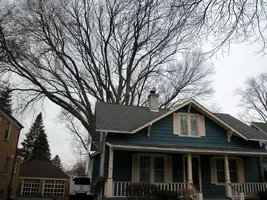
You got it. Yesturday we pruned these large Elms, I used this technique for access.
 

Attachments

  • 70320-DSCN3458.webp
    70320-DSCN3458.webp
    372.7 KB · Views: 153

New threads New posts

Back
Top Bottom