pulling an uprooted tree back to vertical for remo

Re: pulling an uprooted tree back to vertical for

Okay, lets get this straight here. People are saying different things and the diagrams are getting mixed up.

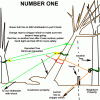
Here is diagram NUMBER ONE, it's labled now too. (See attachment)

Which is how we did it.

I'm sure it must have given us mechanical advantage, because I doubt my skidloader would have been able to move the tree on a straight pull.

1. What is the mechanical advantage here? (Well, Not being picky about the skid loader location being directly in line with the other lines anyway).

What I'm very interested in, is:

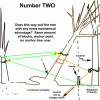
2. Diagram number TWO. With the same amount of blocks, but anchor point of the other tree.

Is the mechanical advantage on the tree the same? Or is it better this way? I thought it was better this way when someone suggested it. Now looking again, shouldn't it be just the same? Still has two "ropes" going to it... if you know what I mean.
 

Attachments

  • 85039-TulipPoplarPullNUMBERONE.gif
    85039-TulipPoplarPullNUMBERONE.gif
    56.1 KB · Views: 105
Re: pulling an uprooted tree back to vertical for

Here is diagram number TWO.

Does it have an advantage over diagram ONE, or do they pull the same amount?

What mechanical advantage is diagram number TWO (again, assuming pull is in line).
 

Attachments

  • 85040-TulipPoplarPullNUMBERTWO.gif
    85040-TulipPoplarPullNUMBERTWO.gif
    52.7 KB · Views: 97
Re: pulling an uprooted tree back to vertical for

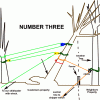
Here is diagram number THREE.

clearly more mechanical advantage. One more block added.

1. What is this mechanical advantage?

2. If I pulled with 1000 lbs of force, what force would be put on the tree?
 

Attachments

  • 85041-TulipPoplarPullNUMBER3.gif
    85041-TulipPoplarPullNUMBER3.gif
    45.9 KB · Views: 94
Re: pulling an uprooted tree back to vertical for

in diagram two instead of going to the neighbors yard could you have set up a redirect to the neighbors tree and the pull from the clients prop. Also if you are using a pice of machinery how do you know just how much force you are applying to the 4:1 system or any other ma for that reason. What Ive done is install a short piece of lower tinsel in line to kind of get a better guestamation for how much force is being applied. If the segment breaks I knowIM pushing my boundrys for catistrophic failure of a 3/4" bull whip.
 
Re: pulling an uprooted tree back to vertical for

We must not be looking at the same drawing. I have not seen any drawing which shows 5-1 mechanical advantage.

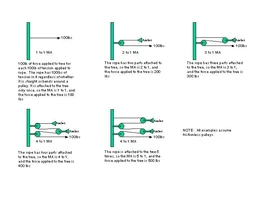
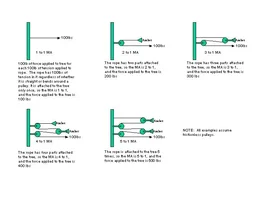
Calculating MA for simple systems(one rope moving through pulleys) is as simple as counting the number of times that the rope attaches to the tree being moved. It doesn't matter if it is attached with a pulley or a knot.
 
Re: pulling an uprooted tree back to vertical for

Ya I have to say I have seen no pics yet with a 5:1 MA. The most I have seen is a 4:1, unless I am skiping a pic??. I think some of use are forgeting that if you have the rope anchore to the tree, it is a dead part. Meaning it is not part of the MA. It cant be if it doesnt move, the line has to move to give MA.Only count the moving parts of the MA. A great place to read up on this is in On Rope ( book ).
 
Re: pulling an uprooted tree back to vertical for

There still seems to be some confusion about standing parts attached to the tree and their effect on the tree. They do get counted when calculating MA. Hopefully, my attachment will clear this up.

Dennis
 

Attachments

  • 85494-MechanicalAdvantage.jpg.webp
    85494-MechanicalAdvantage.jpg.webp
    29.3 KB · Views: 72
Re: pulling an uprooted tree back to vertical for

I'm not going to be able to break a 3/4" bull line with a skid loader.

Besides, you just know after a while how far you can pull a certain size rope without it breaking.
 
Re: pulling an uprooted tree back to vertical for

so is treeko's diagrams right? Would be nice if they are, that is simple.

never have taken the time to go to the website Tom suggested to read up on this.
 
Re: pulling an uprooted tree back to vertical for

treeko, that didnt clear anthing up your last example you write in your note it is a 5:1, but yet right below the pic it states 4:1?? Dont get me wrong I agree it is a 5:1.

What I have been saying is the part of the line connected to the anchor alone will not count, how can something that doesnt move provide MA?
 
Re: pulling an uprooted tree back to vertical for

First, I apologize for the typo on the last example. It should have read 5 to 1. It is corrected in this attachment.

Second,

The statement that a "line that does not move does not add to MA" is potentially confusing, therefore I don't use it when explaining MA. The line that attaches only to the anchor, does in fact move, just on the other end, at the pulley.

The reason it contributes is as follows: If you pull on the rope with 100 lbs of force, it creates 100 lbs of tension in the rope at all points. Therefore the rope attached to the anchor pulls on the anchor with 100 lbs of tension, or force toward the tree. At the same time, the tree has to be applying 100 lbs of resistance (force), or either the tree or the anchor would move.

I find that most people can understand the concept of "How many parts of the rope attach to the tree" easier to understand. The end of the rope(standing part) tied to the tree (standing part)counts as 1. A pulley attached to the tree adds 2 more parts because it has a rope(part) on each side.
 

Attachments

  • 85508-MechanicalAdvantage.webp
    85508-MechanicalAdvantage.webp
    29.7 KB · Views: 66
Re: pulling an uprooted tree back to vertical for

[ QUOTE ]
I'm not going to be able to break a 3/4" bull line with a skid loader.

Besides, you just know after a while how far you can pull a certain size rope without it breaking.

[/ QUOTE ]

XMAN,

You are correct that you won't break a 3/4 bull line with the skid loader, as you will typically lose traction long before you reach the ultimate strength of the rope. You can however easily generate forces great enough to break your rigging (Carabiners, slings, screw links, etc) as they are where the magnified forces generated by the mechanical advantage are applied.
 
Re: pulling an uprooted tree back to vertical for

Sorry about that I was looking at it wrong inn my head. I see it now.
bangtard.gif


Lets keep in mind that counting the times it touches the object only counts in simple MA systems not complex. Although I dont think many of us use complex systems.
 
Re: pulling an uprooted tree back to vertical for

[ QUOTE ]
the winner is..... Kevin, I would say the same thing

[/ QUOTE ]
--couple of losers!
wink.gif


[ QUOTE ]
Ya I have to say I have seen no pics yet with a 5:1 MA. The most I have seen is a 4:1, unless I am skiping a pic??. I think some of use are forgeting that if you have the rope anchore to the tree, it is a dead part. Meaning it is not part of the MA. It cant be if it doesnt move, the line has to move to give MA. Only count the moving parts of the MA. A great place to read up on this is in On Rope ( book ).

[/ QUOTE ]
As is again demonstrated, by the responses to this fairly simple situation,
figuring theoretical MA can be challenging; it gets much more so once the
pulleys start pulling each other, and you can't tell which is moving how much
when (e.g., a Poldo Tackle--not a practical system, really).

Here, though, a way to see clear is to put oneself at the nearest-to-sheave
part of the fall line and see how far one will have to move in order to bring
the load to the anchor. In the 5:1 system, one can revise this figuring a bit
by placing this haul-the-line point AT the anchor tree (adding to the
confusion is the fact that anchor & load are both "tree"s)-: at this point,
one can easily count the length of rope consumed in the system as 5 x Dist.
to load, and to pull load to anchor one will clear all of that rope out of the
system--i.e., will move 5D while the load is moved D, ergo, 5:1.
(One might hear a spectator remark "Look at 'ergo!".) (or not)
smirk.gif


If you're using something other than good pulleys, the friction will take a big
bite out of the TMA and yield a much lesser ActualMA. --most of the hype
of rope-through-rope systems ("trucker's hitch") greatly exagerate the AMA,
with TMAs of 5:1 being actually 1.7:1, say. Carabiners have an efficiency of
roughly 2/3 (60-66%), so one can see how fast TMA is lost into AMA.

The Spanish Burton is neat in that it creates TMA w/fewer friction-point
sheaves, though at a cost of distance per-rope able to move a load.

--------

Athough it was asked to NOT be considered in the deliberation, it's worth
noting that practical circumstance might lead to there being increasingly
large angles between sheaves, and this will diminish the AMA as the load
came nearer to the anchor. Choosing one of the anchors to be farther away
might help mitigate this loss.

*kN*
 
Re: pulling an uprooted tree back to vertical for

[ QUOTE ]
[ QUOTE ]
the winner is..... Kevin, I would say the same thing

[/ QUOTE ]
--couple of losers!
wink.gif


[ QUOTE ]
Ya I have to say I have seen no pics yet with a 5:1 MA. ...

[/ QUOTE ]
As is again demonstrated, by the responses to this fairly simple situation,
figuring theoretical MA can be challenging; ...

[/ QUOTE ]

Okay, major oops & apologies: ONE loser here, MOI !! (egads)
blush.gif


=> 4 : 1

Somehow, in a quick glance at the diagram my mind registers "5" ... .
(Or maybe I was counting from point to point of attachments incl. haul point,
and getting "5" w/o realizing this. geeesh)
As I noted, though, a way to figure is:

"... see how far one will have to move in order to bring the load to the anchor. "

And upon this latest 5:1-doubter's prompt, I did the counting and ... found
myself wrong, and 4:1 is it. There are the 4 lines spanning the distance from
anchor to load, and pulling all of that rope out to bring the load to anchor will
be pulling 4xD to move load D, ergo ('ere 'e goes agin) ... 4:1.

I will now go back to see if I've tied my shoes correctly, though will not even attempt
to figure the TMA for all that lacing (both sides moving), or I'd be barefoot!

*kN*
 
Re: pulling an uprooted tree back to vertical for

in Kevin's pic i might weigh the options of placing the anchor pulls lower; at some loss of leveraged angle on the load; and or bracing anchor from top in opposite direction of load's pull. kN is right about keeping closed angles for most 'pure' power return on the pulls.

In Treeko's i might consider having the single line pull on load lower; trading it with a double line pull. And since friction will decrease force in real situation, i'd make that highest pulley on load the 1st pulled by the input line. Of curse i'd float that pulley with an over the top lacing too.

A Spanish Burton will compound 2 systems; and use the pulley part and the end of the line both; to input 2 different pulls at 2 different positions of the outer system. Thus increasing the pull with pulley by inner/primary system and instead of anchoring the other end for the 2/1; it uses what would be the anchor force too; to work on the target load. The same 3 pulleys as Kevin's drawing could give 5:1; as a Spanish Burton(or reduce Treeko's to 3 and still get 5. i think kN means that SB, reduces available distance to pull(becasue of the floating pulley seating early at one end of system; and not increasing the amount of distance required to get same power.

Where N is the power of the rig on load; anchor load without a final redirect on anchor will be (N-1)/N; but with a redirect as final pull on anchor(where your first pull goes to anchor and not load) will be (N+2)/N. System is only as good as weakest link; one of which is the anchor.

Olde Pulley Force Patterns Drawing

This Pulley Puzzle exemplifies how a Spanish Burton type strategy can help dramatically increase power.

After lines are linearly loaded; they are stiffer, then this resistance to bending can be leveraged with perpendicular force, rather than inline for very high potential inputs into system.

i'd consider prussik safetys, and maybe even another pull and lock off line in target direction; especially if might have to adjust pulley angles on anchor to keep most perpendicular pull/rotation on load.


We found ourselves facing this 1 day; didn't pull it up straight; but did pick it up and pivot over fancy wall, tile at the back of this 1 house. i hung high and 2 handed the inner 5:1; while 2 guys also pulled me down. i figure an inner input of 8:1 on my muscle effort, 5:1 on my bodyweight and their pull, into the 3:1.
1 shot over wall
 
Re: pulling an uprooted tree back to vertical for

It's rather timely that this thread should be on the Buzz.I stood up a wind thrown pine yesterday afternoon that was tipped last winter.

I used a 1" nylon rope by way of a big snatch block anchored to a sugar maple about 200 feet away.
 

Attachments

  • 85887-PoullanS-25001.webp
    85887-PoullanS-25001.webp
    119.2 KB · Views: 55

New threads New posts

Back
Top Bottom