Pulley One

Wouldn't the friction on a larger bend radius equally add friction across a larger area, not change the location of the friction? Different way to ask this........Increasing bend radius puts more material in contact over a larger surface area changing the amount of friction across the bend......not changing where but adding more across the "where"? I get what you're saying but in terms of bend radius of rope across a surface there is no change to the location of where the friction is applied. Rite or am I missing something?
 
Wouldn't the friction on a larger bend radius equally add friction across a larger area, not change the location of the friction? Different way to ask this........Increasing bend radius puts more material in contact over a larger surface area changing the amount of friction across the bend......not changing where but adding more across the "where"? I get what you're saying but in terms of bend radius of rope across a surface there is no change to the location of where the friction is applied. Rite or am I missing something?
I'm not sure I follow you.
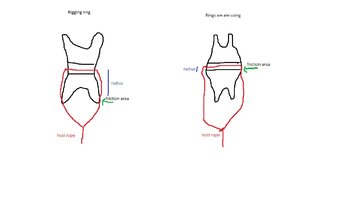
My point was, the ring, not having contact with the rope holding it near the outer edges reduces the force applied to the ring through friction. Contact only being made near the center of the ring.
It really is not worth the time and effort being put into this conversation, but for those who are truly bored...
Okay, I re-read your comment. You are correct. We are just talking about different things.
 
I'm not sure I follow you.
My point was, the ring, not having contact with the rope holding it near the outer edges reduces the force applied to the ring through friction. Contact only being made near the center of the ring.
It really is not worth the time and effort being put into this conversation, but for those who are truly bored...
Okay, I re-read your comment. You are correct. We are just talking about different things.
It's probable I misunderstood what you were saying. Thanks for the clarification.
 
My point was, the ring, not having contact with the rope holding it near the outer edges reduces the force applied to the ring through friction. Contact only being made near the center of the ring.
I understand that's what you believe, but it's false.

If you don’t have an old physics textbook laying around, you can easily find many online resources on the topic.
 
I understand that's what you believe, but it's false.

If you don’t have an old physics textbook laying around, you can easily find many online resources on the topic.
You are confusion friction area with leverage. Also in the physics book.
Give me a two foot lever arm on the shaft of a 10 hp engine and I can keep it from turning. Grab the shaft itself and it will wrap you around there and beat your body to a bloody pulp. The greater the radius the more the friction effects the forces. Friction remains the same, its the force that friction creates that changes.
 
Can you draw me a force diagram showing the torque or lever arm forces applicable to this ring situation?

If a ring has straight, parallel sides, the rope may be in full contact with the sides when bending the rope through 180 degrees, but with (ideally) zero pressure resulting in zero friction. With a real life compressible rope, some pressure will be exerted on the sides of the ring, adding friction there while reducing friction across the round section by the same amount. It's a net zero proposition. If you add friction in one place, you reduce it in another.

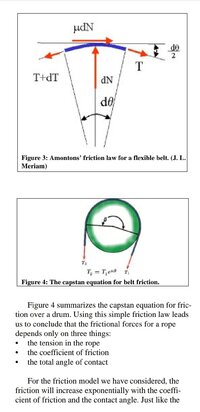
A little on the capstan friction equation:
Screenshot_20230225_221738_Drive.jpg
Screenshot_20230225_221820_Drive.jpg
The bend radius does not affect friction.

Maybe a knife edge with a near zero contact area would provide near zero friction.

(If you haven't noticed, I enjoy this type of conversation. Though I majored in chemistry, I always enjoyed and excelled in physics.)
 
Can you draw me a force diagram showing the torque or lever arm forces applicable to this ring situation?

If a ring has straight, parallel sides, the rope may be in full contact with the sides when bending the rope through 180 degrees, but with (ideally) zero pressure resulting in zero friction. With a real life compressible rope, some pressure will be exerted on the sides of the ring, adding friction there while reducing friction across the round section by the same amount. It's a net zero proposition. If you add friction in one place, you reduce it in another.

A little on the capstan friction equation:
View attachment 86679
View attachment 86680
The bend radius does not affect friction.

Maybe a knife edge with a near zero contact area would provide near zero friction.

(If you haven't noticed, I enjoy this type of conversation. Though I majored in chemistry, I always enjoyed and excelled in physics.)
Stand by, I have to go draw a crappy diagram. What you are saying is correct. But that is not what I am talking about. Hold on a minute.
 
Can you draw me a force diagram showing the torque or lever arm forces applicable to this ring situation?

If a ring has straight, parallel sides, the rope may be in full contact with the sides when bending the rope through 180 degrees, but with (ideally) zero pressure resulting in zero friction. With a real life compressible rope, some pressure will be exerted on the sides of the ring, adding friction there while reducing friction across the round section by the same amount. It's a net zero proposition. If you add friction in one place, you reduce it in another.

A little on the capstan friction equation:
View attachment 86679
View attachment 86680
The bend radius does not affect friction.

Maybe a knife edge with a near zero contact area would provide near zero friction.

(If you haven't noticed, I enjoy this type of conversation. Though I majored in chemistry, I always enjoyed and excelled in physics.)
 

Attachments

  • Untitled 1.jpg
    Untitled 1.jpg
    29.3 KB · Views: 19
I see what you're getting at as far as the radius of where the friction is applied to the ring with regards to retarding the rotation of the ring. I was considering the rigging ring arrangent where the ring is anchored by (for lack of better terminology) the "sheave" rather than the "hole" and the ring is stationary, thus no torque. From the pictures, it appears that a recovery ring is anchored by the "hole" not the "sheave," so we were kind of apples and oranges. I think I can agree that with a rotating ring, the father from the center of rotation a braking force (friction) is applied, the greater the effect.

I found a video showing a recovery ring in use. Even though the ring had straight sides, it appeared to rotate with no slippage of the moving rope. So in practice, the anchor rope (a soft shackle in the video) rubbing the rim of the ring doesn't seem to really affect anything. I'll have to ponder this some more.
 
I see what you're getting at as far as the radius of where the friction is applied to the ring with regards to retarding the rotation of the ring. I was considering the rigging ring arrangent where the ring is anchored by (for lack of better terminology) the "sheave" rather than the "hole" and the ring is stationary, thus no torque. From the pictures, it appears that a recovery ring is anchored by the "hole" not the "sheave," so we were kind of apples and oranges. I think I can agree that with a rotating ring, the father from the center of rotation a braking force (friction) is applied, the greater the effect.

I found a video showing a recovery ring in use. Even though the ring had straight sides, it appeared to rotate with no slippage of the moving rope. So in practice, the anchor rope (a soft shackle in the video) rubbing the rim of the ring doesn't seem to really affect anything. I'll have to ponder this some more.
The one Muggs bought has straight sides. I opt to spend 4 extra dollars and get the ones that have a definitely wide area at the hole. I don't think it makes any difference, but it makes me happier.
Have yourself a good night.
 
As the tests have shown, there is very little resistance for a ring turning on the rope.
But I am getting off track from Tom's post, which was about the Pulley One. I seem to have highjacked his thread, and for that I am sorry, Tom.
Time to butt out.
 
For simple minds like me, Shadowscapes rings are used as pulleys with the rope eye being the axle/bushing. The ratio of groove diameter to axle diameter is a gain for reduction of pulley rotation friction i.e. the torque loss created at the bushing gets derated in how much it affects the moving rope by how much larger the radius out to the rope is.

So a high performance Shadowscape ring would have a larger groove diameter and a smaller doughnut hole. But that could lead to stability issues of the ring tipping sideways so there's a compromise. The At height bearing rings look a little tippy to me. Unless the doughnut hole is big (thin ring profile) like the bearing ring appears. Immutable gotchas always rear their head in designing gizmos. :)

It was always beaten into me that bearings live and die by their supporting structures, to keep the bearing geometry correct. But if the loading is derated plenty and the lifespan expectation isn't huge, you can do unusual things.

Kind of cool especially compared to the huge losses in a DMM Revolver. Remember when those were new and cool?
 
Sum Thoughts:

Some of best threads take on life of own.
.
i prefer a gentle giant clean machine model of having overwhelming force readily available, and only part of this spice employed. No redline to capacity necessary to work, always plenty of available 'headroom' to overtake if needed.
.
Linear frictions are by distance, of byproduct(sine) only not path(cosine) travel .
By contrast radial frictions are by degree not distance, and of byproduct(sine) and load path(cosine)both! Arcs are as magical in rope frictions as bridge support, for same geometric reasons of using cos and sine working as one instead of separately. Only deformities from simple linear directional can use load force to power frictions and arc is this deformity over a flowing range.
.
Linears are simplest equal/opposite force connectors, sometimes with loss/inefficiency as a small conversion. Radials are the real force converters, giving much more friction than linears. Core load force in linears tend to run parallel to host, but arcs into host more powering more frictions. Direction is a most important force component even linear force thru arc like in bridge.
.
Larger sheave is greater leverage over same axle/pivot size frictions that bearings etc. reduce. The last few silkiest percentages of efficiency are the most costly. Nothing can be 100% efficient (or Kennedy bullet would still be flying theory).
.
You can 2hand a zRig ends of 3x2x1 to 4x4x1powers just as an open 5x4x1 to a closed 8x8x1powers system. There is only 1 sheave between your hands moving in opposite directions. The friction of each arc is a loss against inline force increase thru the 'rolling levers' of a system, but then can help in perpendicular sweat/swig to capture 'purchase' to work thru system. Then same frictions can be helpful in lowering, paying rope out of slack 'bank'.
 
Last edited:

New threads New posts

Kask Stihl NORTHEASTERN Arborists Wesspur TreeStuff.com Teufelberger Westminster X-Rigging Teufelberger
Back
Top Bottom