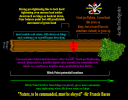
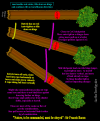
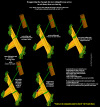
proper cut for a piece that is tip-tied

Great video @Jehinten , makes it clear about settling the piece into the rigging as a first part of the cut.

shows what @TheTreeSpyder describes in getting the hitchpoint over toward the rigging for the moment of tearing off.
I always appreciate your posts. the deliberate use of terminology, the anatomy of a rigging operation in this case, making clarity through ways of thinking, above simple exact technique.
As each cut is truly it's own orchestration. What could be achieved in one type of wood grain, impossible from another.

I didn't fully see these two :
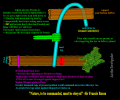
Sweat for remote Round Turn on overhead support for heavy loads
Another great sweat point is midway thru a Round Turn(RT) /single bottom arc on support grabbed with carabinier and leash. If need all that RT brake force this can really be great as also reduces support 2xLoad effect. If can take the heat/move slow, carabiner pull can be great magic to sweat/swig (while end of RT anchored)very tight, and aid in removal of RT also. So, can be installed and removed very remotely before climb. Can be awesome.
.
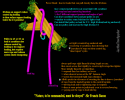
Sweatpoint of Prusic between hitchpoint and support
Another great sweat point can be Prusic midway on load leg , that also can sweat/tag to rig as coming down and delivery, sometimes that alone makes trickiest part easy to immediately simplify clean movement.

I appreciate the attention on the ability to help with sweating the line from in the tree. Of course I do sometimes; yet in these cases where I am stacking my odds, I shouldn't overlook my chance to help there.

And I see the patterns in how we approach using the felling cut to steer the piece, first allowing weight into the system, then toward the rigging, and ultimately away from us as and into the tear-off.

Thanks again everyone, this came up strong removing a multi-stem Ash with wires on two sides, and then again with some meaty oak stem and limbs over the house. I was cautious enough to make it through safely in moments of following natural sense where the methodology in my head was running short! Even with all the reading and rigging experience. the depth of ways to guide these logs safely to the ground is a true orchestration.
 
Will draw those 2 out of myself to increase the deck of cards have to offer, ty.
>>more cards, the more ways to play the hand as dealt.
>>usually each exercised well enough to be able to quickdraw them like slick gunsman; otherwise sleep silently holstered once polished clean.
Usually allow inner 'kid at Christmas' to run free, unreigned fascination with new tool or technique, to let that energy take us to polished clean; and then holster until needed.
.
On any of these trickier orchestrations, they are NEVER the first cut of the day.
Always and all ways have a few preceding, to see how the saw, wood and i are interacting at that temperature, that day.
Always read s(h)ituation like this first before step up to command.
>>how does this feel today? >> not something scripted.
>>sometimes may bluff a bit beyond what feel as done X enough times,
>>but not many times and not by much.
.
To really command; i find can see down to the cos/sine as base pivotal points, every time.
@Jehinten : nice example, ty
Can't tell ya how much i have learned with handsaw on veridical and horizontal sprouts etc. even in tree. Can make face in vertical and pull different angles like CoG pulls, push back open, adjust face and see how it takes, try different backcuts etc. Very simple machine that we generally use highly loaded. But down to handsaw baby limb or sprout places it in safezone to really examine.
With more weight, the action is more smooth when get it just right.
Turning weight from feared master to slave that does work for you.
Knowing what must happen, 'simply' walk scenario to the edge of cliff and tip; allow Nature to take over predictably, cleanly, smoothly is what try to draw to i think..
 
Last edited:
if i have any doubt in my rope man’s ability to let it run away from me and the structure then i like to control the butt also. as mentioned above, mid tie that slightly favors the tips is one of my favorite places to tie
 
With hitchpoint near CoG, butt tie tag line gives very good control as the sides ballast each other some and have a lever to command rest. Tag line Prussic to the load leg is more center mast , near CoG and bends that line only , not so much tipping heavy end up over something etc. But, Prussic on load leg has advantages in 3 stages of rigging: pretension sweating, turning on hinge when rope hard loaded (not before), and then as a tag line, but to more center; but still useful toy at right time.

remote-sweat-tight-and-leveraging-rig-prussic-on-load-leg.png
Another very flexible/multi-use setup is a Round Turn(RT) on support with a carabiner (w/leash) thru the lone/bottom middle Turn. Carabiner allows sweating the RT tight, can even sweat/swig this as also sweat out the purchase from a bent load leg etc. This is for higher loading, that have enough force to get the RT into it's powerband to really shine. Other wise can be like trying to lower a twig with a 3/4" long rope over a support branch. (much better than 90's msPaint drawing on this, embarrassed to show ! ). This can be remotely set high/wide 40' or more above work w/o going that far personally to install or retrieve.
remote-sweat-tight-and-leveraging-rig-round-turn.png

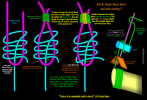
In all rope leveraging sweating/swigging i always tighten along rope length as much as can in phase1, then shear across those most rigid/least rubbery levers at 90degrees/Samson Angle against the rope now rigid/less rubbery rope columns from linear tightening. Then take purchase, this leaves rope even more linearly tightened more rigid for more leveraging response if can sweat/swig again in cycles etc. Wrenching across leg(s) of line is a strong leveraging mechanic, not just used in sweat/swig. Like binding (to show the same science applied of leveraging across rope columns as own science) :

triple-sheetbend-siezed-vs-racking-bend-part_1.png
ABoK shows this Triple Sheet Bend for drawing large 'hawser' ropes thru 'hawser pipes'/ports from inside to outside of ship, sometimes drawn to shore. Then does show seizing the end if cant make eye splice after Triple Sheet Bend (ABoK Lesson#1461)!
BUT, then shows all this care and effort not needed if simply use a Racking Bend(ABoK Lesson#1462 not shown here) !
Not ever had problem with double or triple(rare) Sheet Bend, prefer them slipped.
But by this measure Ashley lends, that puts a lot of faith and science in Racking Bend!
 
Last edited:
Thanks for the illustrations, makes a clear picture from what was a bit foggy. I was missing that the prussik loop was becoming a tagline for the ground to work with. (or climber) that's a great idea to work with.

In 2nd example, Neat thoughts about incorporating the pulley there to balance bigger loads. Combining of a lot of friction without crazy speeds by increasing the amount of rope to move.

Funny enough I just got called to remove a big splitting maple in very tight quarters... good thing I have a new batch of cards up the sleeve.
 
I like to slightly tip-tie a dependable species, and aim the facecut at about 4:00. Gravity will want to pull the limb into the face-cut, loading up the rope gradually. Rope stretch can help to support the limb as the length from rigging point to tie-point gets longer. Introducing more rope increases control as the piece swings.


If it's a removal, it might be a flush- cut from 10:00 towards 4:00, then maybe 5:00 , using the wood fibers to hang the butt, and reduce load on the rigging point.

I cut and lower most of my own pieces, sometimes simply using enough friction on the tree or LD not to need to hold the rope, as it slowly slides.

If caught by surprise, the chainsaw is on a lanyard, and a hand saw can be dropped to the ground, if needed to have more control, sooner.

I can read the situation and feather the rope well from my position, adjusting the tensionas needed, as the piece moves.


Butt tie when in doubt.

When the butt tie is no longer needed, if it's simply using a stub wrap, the butt-tie can be flicked free from the ground and become a tag line.
 
Card magicians may practice in front of camera for years until so smooth/slow motion perfect even camera cant catch the obvious; let alone the eye.
You can watch the silky smooth ballet of moves and swear the slow is fast, as is sooooo clean...
.
This thread is titled tip tied, as drifts into wider scope of what give up with that.
>>i see as southsoundtree says for facing and some of
backcutting angles i think.
Keep longer vertical column in hinge as pillar against more leveraged weight of load
>>but still press shituation into the magic twilight between fall and hold grey area of f(h)old
>>tipping the balances of downward force evoking sidewards pressure from rope to get the draw across.
Hinge strength will be a response to this draw across
>>more tension side force giving thicker hinge just like pulling a tree over w/rope
>>only to Dent's model down is the sideForce and more across is the target
>>so 'offside'(Dent) for fat side of Tapered Hinge is upwards, w/down as the sideForce against horizontal path target.
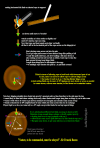
slanted-rope-rig-cutting-horizontal-limb.png
Still have a preference for not butt tying, rather 'choking up' hitch towards CoG
>>giving more preTighten reaction from rope as load drifts down on hinge
>>and also better support as more leverage against load/closer to CoG
hitch position choices:
self-tightening-rigs_1of2.png
Then how more mid tie than butt/tip tied hitch draws more tension at same angle drift down
to give more lift/support and at a better position.
Also, butt/tip tied hitch point needs more vertical clearance
>>vs horizontal sweep needing more horizontal clearance,
>>but more of the vertical length on hang is above hitchPoint than butt/tip tie as tradeoffs
(Also, tag line on endpoint gives more leverage on load if hitchPoint towards CoG)
self-tightening-rigs_2of2.png
Another tweak is maximizing the rope angle from the cards dealt;
>>to then give greater sidepull around on horizontal limb as purposefully press it down into rig
(knowing cant go very far because rope is so tight and at good position of minimal CoG leverage against rope)
All to get sidepull, to force greater hinge thickness, to then have lighter loaded, but stronger hinge as folds
>>for handling lightly and smoothly on hinge as pivots around on it
exaggerating-the-rig-angle-for-more-sidepull-sweep-across.png
To me, as always and all ways this is just watching the 90's of cosine(vertical force axis) and sine (horizontal target axis).
Usually cosine is the work needed against load in my models,
>>and the sine as an extra co$t to that work, more than what is nominally needed for support as a baseline.
>>but here that sine is employed as a force for the turn sideways
>>as the cosine continues to provide support upwards.
Still staying with the model of ALL displacements against space( or force as reciprocal/co$t of space displacement)
>>can be decoded down to pivotals of cos/sine.
Here is what can get/change as exaggerate the rope angle more w/above tweaks etc.:
(this is all about putting as many chips on your side as possible to play strong)

minutes on clock rope angle
sine across
actual rope angle
0@12/noon​
00% xTension​
00degrees​
1​
10% xTension​
06degrees​
2​
20% xTension​
12degrees​
3​
30% xTension​
18degrees​
4​
40% xTension​
24degrees​
5​
50% xTension​
30degrees​
6​
59% xTension​
36degrees​
Sine impact starts lessening after this, to sine 70.7% at the midpoint of 45degrees/7.5 mins on clock and then slows down sine value expansion more until is 100% @ 15mins/90degrees/1season on Babylonian clock..
>>But at start, right off of pure vertical load, the sine jumps ~10% every 6degrees/each minute on clock
as the most reactive range to the deflection sideways of the rope.
While the sine drops very minimally in contrast at the start, to drop from 100% (noon)to 86% (5th minute)
>>only 14%loss in same time sine JUMPS from 0%(noon) to 50%(5th minute).
The cos/sine decoded on clock give rhyme and reason to what are watching to better understand, predict and even command the repeating number pattern.
Tweaking the slant of the rope while in the most reactive angle range for sine response can give high payoff if line is already tight enough to command things.
Settling load down into line to let Nature set balance, makes sure support is correct, as also evokes sine..
>>handing off most force to rope before tearoff gives lighter handling on hinge and thus at tearoff impact lessened too.
 
Last edited:
Still have a preference for not butt tying, rather 'choking up' hitch towards CoG
>>giving more preTighten reaction from rope as load drifts down on hinge
>>and also better support as more leverage against load/closer to CoG
hitch position choices:
View attachment 80453
Then how more mid tie than butt/tip tied hitch draws more tension at same angle drift down
to give more lift/support and at a better position.
Also, butt/tip tied hitch point needs more vertical clearance
>>vs horizontal sweep needing more horizontal clearance,
>>but more of the vertical length on hang is above hitchPoint than butt/tip tie as tradeoffs
(Also, tag line on endpoint gives more leverage on load if hitchPoint towards CoG)

This is such a great drawing - and the whole conversation. Bringing some profound understanding and more nuanced choices.

I also really appreciate the drawing showing rotating the hitch around the log (away from or toward the rigging point, etc), it's something I have played with a little bit, that clicked into place. I really dig your drawings for that. 9 times out of ten it's something I have experienced, played with, and then the identification of all the elements at play, within the lens of a focus on each element, syncs it in for me. Thank you!
 
he's not asking about what's best most of the time. He's asking what happens when you absolutely must tip tie for clearance.

I've criticized the widespread and needless use of tip tying on youtube videos by well-respected YouTubers for many years. I've seen Reg and August and others tip tie pieces when there was plenty of room to have the pieces swing down and away. SO no need for tip tying. IN these cases they were either out of the potential swing of the piece or they had a rope man that ran it safely away. They knew what they were doing, but it was still needless, and a bad example to set.

Of course, the most famous blunder was when Human (corey) came about 6" away from death when he tip tied a huge walnut limb that helicoptered around the back side of the tree and grazed his hard hat. IMO he had watched Reg and August tip tying their pieces and was trying to do the same. That's what I mean by setting a bd example. He had trimmed the side limbs off this large horizontal limb, so he easily could have taken the end off when he was out there. So there was NO NEED to take a pice this big. And if the groundman had lowered it 6" it would likely have killed him. there was also no clearance to allow the piece down as I recall. Maybe a shed at risk.


To me the ONLY TIME I tip tie is when there isn't room for the tips top drop. The most notable in recent memory was on a large white oak from the maxed-out bucket at 75'. There was one big limb out over the wires that I had rigged up to drop tip heavy. It just so happened that Asplund had sent their ace two-man crew for line clearance that day, on the same tree. We agreed to work separate sides of the tree with them taking lower limbs over the street off, and me taking out the top since my bucket was higher than theirs.

After setting up the rigging I was ready to make the cut and it looked like the tips would clear the lines, but it wa going to be close. I asked the ground guy from Asplundh if he thought the piece would clear the lines, he was like "NO WAY". I thought it was good but couldn't take the chance. SO I reset the lowering line through another crotch on a different lead that was offset from the bucket. That crotch might have even been lower than the one I was going to rig from originally. And in order to ensure that the piece was going to be butt heavy, I had to drop down at least 15 feet to make the cut. It may have been 20'.

The key here was to have the overhead rigging point far enough offset to the side that there was no way the butt could swing around and come back anywhere near me. At that point, there were a lot of options for the cut. Don't remember but I probably used a narrow notch, aimed to the swing side which allowed the piece to swing a little under the rigging point and then have the but drop quickly, as the tips lifted away from the wires.

It worked as designed. You could tell the Asplund guys who had stopped and moved out of the way for the cut were a little incredulous. Like there is no way they would ever be able to use that kind of rigging. It's not in their playbook.

The bottom line is you better understand exactly what the but of that piece is going to so when you make the cut. I've also had the tops swing straight up and back: right at me. The way to handle that is to make sure you are protected behind the stem of the tree, but that can be risky. I think I only had that happen once or twice. I personally would almost never count on a ground man to run a piece to keep me safe. Early on when my rigging experience was lacking, I would have to rely on the groundies from time to time, But as time went on it became very rare, maybe once or twice a year, and not just for tip tying. That was any kind of rigging that required a groundie to let the piece run.

Here's a clip of taking out a large pine limb that had no room to drop because it was right over a maple. Again I set the rope to make sure the pice was going to swing sideway and have zero chance of coming back at me.
 
Last edited:
Here's another one where I set the entire rigging system from the ground, and again the important thing is that the overhead rigging point is well away from the climber so that the movement of the limb cannot carry anything back at him, in this case even the deadwood that started flying as the piece began to move.

 
maybe they are tiptying to keep forces down (more static)? i use tip and midtying alot but when in doubt...well.. like mister schultz said: i like big buttlines and i'm not gonna lie about it.
friedrich
 
i used tip tie much more for crane lift up, than rig down.
usually only when the nose/tip was locked or going into lock position.

For me this was just about always from storm/hurricane.
Not a fan i guess.
But am fan of pre-set rig from ground, but more to the mid tie, sometimes from right side under load, over load to right to get more of a torqued right turn as it was drifting down on hinge setting own tension. Taken some negative comments on that, but made it work.
 
Last edited:
Great videos @Daniel . And your comments make a lot of sense. You understand correctly, this was for cases with no room to allow the pieces to swing away and down.

A main takeaway I have is how setting the rigging point very intentionally is a primary point of control for this technique. Having the piece swing to a side, away from the climber, is another element that seems standard if possible.
Keeping the point tied near the C.o.G does sound good for reducing the shocks, yet having had one good oak log flip as a miscalculated; I will likely still cheat toward the zone where I am fully confident it's butt-heavy.

I am also glad to hear the warnings against this technique. It keeps it in it's box. It creates potential of fitting a longish branch down when it can't swing out, but other than that, butt-tying provides much more control and less chance of coming back at the cutter.

Appreciate all the discussion and enhanced awareness.
 

New threads New posts

Kask Stihl NORTHEASTERN Arborists Wesspur TreeStuff.com Teufelberger Westminster X-Rigging Teufelberger
Back
Top Bottom