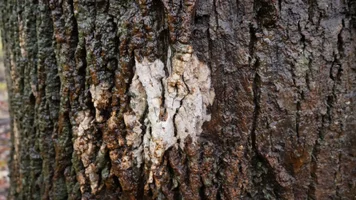
Powdery Mildew?

Hello Everyone,
Our backyard here in Maryland has some beautiful trees but I'm concerned about one of them. It's a Tulip Poplar which is probably 100+ feet tall, maybe 110 and possibly 3' in diameter. It's part of a dense canopy of red oaks, hickories and other poplars. Beech trees make up the understory so we don't get much sunlight near the ground.

Anyway, I've been noticing some white fuzzy patches on the poplar's bark. At first it was just a few patches near the ground, then today I found a patch 2' by 10' several feet up. From what I can gather doing Google searches, what's growing on the bark is powdery mildew, probably caused by all the extra rain we've had this year. Otherwise this tree is magnificent - arrow straight trunk and 70' to the first branch. Should I be worried?

Thanks in advance,
Jim
 
It's been raining all day and I decided to wander out back and see if the rain washed all the "crud" off the bark. Unfortunately no. If anything it's standing out much more against the wet bark, so here are some pics taken by flashlight.

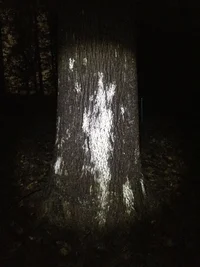
1tulippatch.webp
This is a pic of the big tulip poplar.

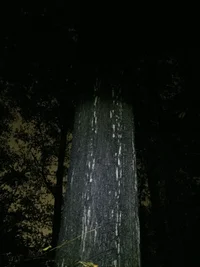
3tuliptrunk.webp
This one shows the fungus(?) stretching upward, growing only in the bark furrows.

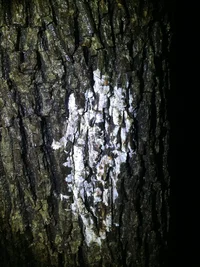
4redoakpatchclose.webp
Here is the best closeup of a patch growing on a medium sized red oak. The fuzziness I saw yesterday is matted down by the rain (I guess).

All and all I found 6 trees infected: 1 hickory, 2 beeches, 2 red oaks and the poplar. That's out of about 40 trees in the back yard.

5redoaktrunk.webp
This last pic is of a massive red oak trunk. Oddly enough, most of these pics are of the south sides of the trees but it does grow on some north sides, too. Have you guys seen this before? Is it going to eat holes in the bark or is this nothing?

Thanks,
Jim
 
Thanks Jim G, that helps a lot. As I often say here, only a fool identifies fungi from photos...and these are rain-washed and flashlight lit ones!
Still, I'd go with Aleurodiscus, the "white patch" disease most commonly seen on oak bark, but it does hit other hardwoods as well. The fungus is degrading the outer bark layers. However, it isn't killing or interrupting the usual function of the tree very much if at all. We (or at least I) used to lump them all as Aleurodiscus oakesii, but those rascally molecular mycologists have erected a score or more of new species.
I'd be happy to hear alternative explanations!
 
Thanks KT. So let me get this straight; the fungus will eat the bark almost to where the bark is still growing and then stop?

Cool! :)

What about treatment; can it be stopped?

Thanks again...
 
Yes Jim, that is my understanding. That fungus will digest and "erode" the dead bark that will eventually exfoliate anyway. I don't believe that it progresses to the bark or cork cambium, the new bark generating cells.
To my knowledge, there is no treatment other than education on the wonders of nature. The reproductive structures of this ascomycete are very small cups, the biggest of which are the size of a thumb or even pinkie nail. The fruiting structures are usually not present, but they are fun when they are visible.
 
Thanks fellas, I feel smarter already. It stopped raining and I got a chance to see the backyard in the light. This last picture is from the backside of the tulip poplar. To the right of the fungus is what appears to be an old "smooth patch". If that's all there is to it, piece of cake.

scar.webp
BUT... we might be looking at a new species. Behind our property is a large park full of oaks and tulip poplars. Everywhere you look you can find evidence of the fungus growing or having grown on the poplars and most of the oaks are clean. Even on my property the big oak I thought was infected turned out to be lichen in the daylight, and that closeup above was from a hickory. Maybe Aleurodiscus tulipesii?

Thanks again. I really appreciate it!
 
Ha! yes, good joke about tulipesii as the species epithet. The deeper joke is that the epithet of "oakesii" is named after the botanist William Oakes (1799-1848), and not any genus of trees. Anyone who wants more of the story should check his Wikipedia(!) page. If that's not enough, drop me a line.
What you show in the photograph does look to be the smooth patch disease. Like I said early in the thread, the real experts usually don't just fire off species determinations from snapshots, but there you go.
 

New threads New posts

Kask Stihl NORTHEASTERN Arborists Wesspur TreeStuff.com Teufelberger Westminster X-Rigging Teufelberger
Back
Top Bottom