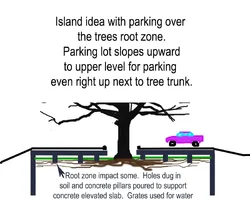
Pondering tree saving with grade changes & parking

this is related to the 250 yr old black oak in Maryland.

Pondering some ideas I had and others have.

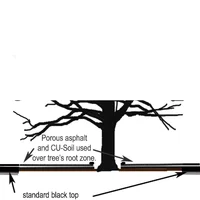
253105-PorousAsphaltCUSoilcopySmall.jpg
 

Attachments

  • 253105-PorousAsphaltCUSoilcopySmall.webp
    253105-PorousAsphaltCUSoilcopySmall.webp
    38.7 KB · Views: 44
Good ideas.

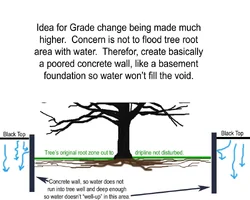
I think that the concrete wall won't be able to prevent water from "welling up". I think it will be like having a drinking straw in a cup and adding water to the cup. Some saying about water will always try to reach its own level, or something like that.
 
Lorax,

I like the plans.

I think the well would work fine. I grew up in a 175 yr old house, it had a dirt basement for many years and did not fill with water.

yes, i think moisture would wick up a bit, but not kill tree roots if the concret wall was deep enough.

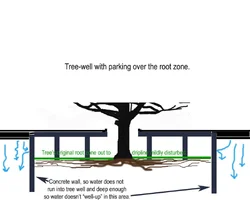
Now, an idea of the elevated parking over the root zone: What about making it out of wooden boards instead of concrete. plenty of bridges were made out of wood and the pillars could be wood poles as well. Like a heavy duty deck. Cheaper and better for the tree likely.

the benefits of this are the rain water would drip on the ground evenly and if the boards are close enough together, no acorns would make it through and sprout.

Yes, it would have to be replaced after a while. but so does blacktop or concrete. Wood, maybe 20- 30 years? I don't know.

no need for grates, waters evenly.
 
hey Guy, I think most of us know it's much wider than that, but if it was taken to the dripline on a spreading crown oak, wouldn't that likely be enought to keep it alive and healthy enough?

putting this out there to learn more...

Is that why Lorax showed to the dripline?
 
[ QUOTE ]


I think the well would work fine. I grew up in a 175 yr old house, it had a dirt basement for many years and did not fill with water.

yes, i think moisture would wick up a bit, but not kill tree roots if the concret wall was deep enough.


[/ QUOTE ]

I'm not arguing here, rather I think that it makes for good discussion.

I think that it could be fine, depending on the soil profile. If you have good porosity from the surface down to a point below the wall, it would be different that if you hit a clay or other impermeable layer...I think, but I'm no hydrologist/ agronomist.

We have a lot of clay down a bit, and our winter water table is about 1.5' feet down, from what we saw when digging post holes.

I imagine that a factor that would play into it would be how the soil is excavated and refilled. If an impermeable layer is disturbed, it might change things a little or a lot.

I think having some educated ideas about the local soil layering would be an important thing to know before implementing such a plan. It gets pretty complex to do it right.

 
Southsound, I think that is a great point bringing up the soil profile.
Could really "make or break" a project like that
Easy to get a hold of as well
 
Soils are critically important in any of this, always get some geotechnical advice on development sites (they people planning on building have to get that information anyway..only they are looking at the soils for slightly different-construction- reasons).

Guy is right to make the point about going for more ground...I know the diagram was just that but ALWAYS start from the maximum area for the tree then if (and there always are) there are arguements to encroach that is less problematic than if you begin on the edge of what is sustainable in the beginning.

There are a great many approaches to building around established trees, retro fitted root cells, structural soils, suspended pavements etc...

If the levels are to be so dramatically altered then perhaps sheet piling might be a more economic option for the developer than concrete walls...remembering of course that the piling rig demands big vertical clearances.

Screw piles are quicker to install less impact and can be cheaper than poured piers depending on the engineering specs.

Some basic points to remember...

Always look to reduce/minimise negative impacts even when they are temporary impacts (site access etc).
If the levels are to be so different....Maintain optimal gaseous and water exchange in the rhizosphere.
Maintain organic cycling through the existing soil profiles.
 

New threads New posts

Back
Top Bottom