rfwoodvt
New member
- Location
- This side of eternity.
Hey All!
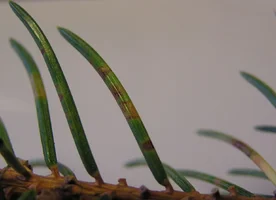
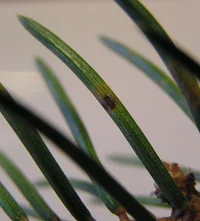
A cust has a group of 3 Picea pungens in thier front yard and all have spotting/banding of the needles with necrosis and chlorosis.
Though the entire tree has the problem, the overall appearance of the tree, at least at the moment, does not indicate that there is something going on.
The Customer simply noticed a slight change in appearance and called us in. The overall change is so slight I wasn's sure anything was happening until I looked closely at the needles.
Anyhow, I have looked into the "big books" and searched online but have found nothing that looks quite like what I am finding.
Several descriptions seem to come close, until I look at the pics and find no resemblance to the client's needles.
Tree itself has full foliage with the typically expected no foliage in the interior. Since the outer canopy is so dense, virtually no light penetrates the beyond the outer 8 to 10 inches or so of the canopy. Anything interior to that layer has no needles.
Anyhow, I'll post some pics showing what we have.
Any help would be appreciated!
A cust has a group of 3 Picea pungens in thier front yard and all have spotting/banding of the needles with necrosis and chlorosis.
Though the entire tree has the problem, the overall appearance of the tree, at least at the moment, does not indicate that there is something going on.
The Customer simply noticed a slight change in appearance and called us in. The overall change is so slight I wasn's sure anything was happening until I looked closely at the needles.
Anyhow, I have looked into the "big books" and searched online but have found nothing that looks quite like what I am finding.
Several descriptions seem to come close, until I look at the pics and find no resemblance to the client's needles.
Tree itself has full foliage with the typically expected no foliage in the interior. Since the outer canopy is so dense, virtually no light penetrates the beyond the outer 8 to 10 inches or so of the canopy. Anything interior to that layer has no needles.
Anyhow, I'll post some pics showing what we have.
Any help would be appreciated!