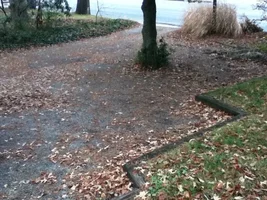
Pavers and tree roots

I have a customer with a very special holly tree. Not huge, probably only 15" dbh, but her favorite nonetheless. She is renovating the parking lot, and possibly putting some handicapped (is that pc these days?) parking spaces beneath the tree.

That type of parking requires solid surface - no stones allowed for wheelchair access. Thus, permeable pavers are her choice, rather than solid asphalt or concrete.

She brought me in to advise her on how the tree would best be treated during renovation. I'm worried mostly about the installation of said pavers, due to the fact they'll have to dig out a lot of material underneath, thus all the roots too.

I can attach the sheets for the pavers as well, but I'll start with the tree photos. Any ideas or things to share would be highly appreciated.

I do have an air spade, so maybe that helps something?
344689-holly1.jpg
344689-holly2.jpg
 

Attachments

  • 344689-holly2.webp
    344689-holly2.webp
    89.8 KB · Views: 20
When I was down in Medford, Oregon, I did one driveway, part of it, with pavers. Only one I did. Probably went 2" less deep than I should have, but it worked okay for a car and 1 ton pickup with camper.

There can be a lot of root cutting. There was for me.

Another option is to go more shallow and angle the surface slightly, adding more material on top. In which case the roots just get buried more.

...
 
Yep, I was afraid of that Mario. She is still in the planning phase and may move the whole spot if necessary. But that would require new plans.

Another factor to consider is that the branches may have to be pruned up substantially to let a van underneath. Right now, it may be 7' to the lowest branches, but that's it. Those disabled vans are taller than that, and add to it the higher surface when the pavers are installed, especially if they are installed shallow, and this tree is going to be in bad shape.

But I'm still looking for more opinions, if anyone has them.

Thanks for contributing, Md.
 
Are you going to pave right up to the tree? Cause if that's the case I foresee other problems like cars hitting the trunk. I would just move the holly out of the way. Seems like a fun project. With an airspade even more plausible.
 
Hollies VERY hard to move in general. tree in fair condition at best so change the plans.
zoning regs idiotic. if handicapped spots really needed put them elsewhere
 
They are putting pavers up close to 2/3 of the tree. The other side will be mulched. The mulch will help, but half of the tree may die if we dig out all the roots or cut them, then limb the tree up to permit clearance.

The tree is too big to move at 15" (for me, now, I'd love to be on a project sometime to move something this large or larger), and she likes it where it is because it screens some ugliness behind it - this is primarily why she likes it so much.

Kind of sounds like Guy has the solution, which we did talk about. I'll probably let her know I've been having this discussion and suggest the same.

More ideas always welcome. Thanks for contributing, all.
 
Cut that one down and replant it with one of the same size. It will adjust to the conditions better than the existing tree under shock. Might be hard to find one that size but there out there.

Or do the excavation of the roots with another in the waiting in case that one fails.

Just prune just enough roots to lay the pavers with an inch of stone dust. Water it the whole time while working in the area.

I see more damage being done by traffic than work to be done.

I agree with Guy hollies are not the easiest tree to tree to transplant in general. But they survive complete dieback. Root pruning I don't have any experience with on holly. But I would think you could carefully prune off a couple of inches off the top on one side.

Or just slope the pavers upward towards the tree. Might also be an incentive to keep cars from coming in too close.
 
If you must place pavers under this tree than consider:

1) do not excavte, build up
2) use a permeable geotextile fabric as the base, this can aid by reducing need to excavate and compact bedding material
3) use the coarsest bedding layer possible (I have seen pea gravel used)
4) use the pavers with the largest gaps or holes.

Remember that you want to are reducing water penetration and oxygen flux. By leaving the largest holes possible you are have a smaller impact.
 

New threads New posts

Back
Top Bottom