Orchard Pruning

We recently had a NC extension agent come to the Estate to give us a lesson on pruning orchard trees. That is to say, we got a lesson on how to prune apple orchard trees that have been left to their own devices for too long.

I am going to attempt to embed a bunch of photos showing the before, during, and after stages.

In this first photo, you can see the two pink ribbons down near the bottom of the tree. Those are where the finishing cuts will take place.

217428-217428-apple1resize%5B1%5D.jpg
 

Attachments

  • 217428-217428-apple1resize[1].webp
    217428-217428-apple1resize[1].webp
    90.1 KB · Views: 40
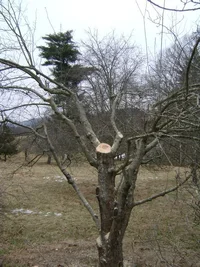
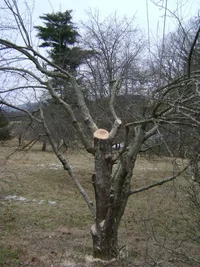
The next several photos show the pruning cuts taking place - I cut several times rather than twice so that the falling wood wouldn't damage the fruit-producing buds on the lower branches. A small crane would make this job easier and more efficient - these trees are sometimes as difficult as pin oaks to remove the sticky branches from.
217429-apple2resize.jpg
217429-apple3resize.jpg
217429-apple4resize.jpg
 
The following pictures show the nearly-finished tree (for this year). What the pictures don't show is the application of a sprout inhibitor - active ingredient, Ethyl 1-naphthaleneacetate, trade name "Tre-Hold RTU Sprout Inhibitor" - which we applied with a paint brush, gloves, and bucket.
217431-apple10resize.jpg
217431-apple11resize.jpg
217431-apple12resize.jpg
 

Attachments

  • 217431-apple12resize.webp
    217431-apple12resize.webp
    98.8 KB · Views: 44
those are nice pics, someone really let those go for awhile... i would love to see some more pruning on the fruit trees, i think it takes alot of patience, so i like to see the finished product. i am investing in agood camera for pics this year.
 
Good job, Royce. I've got two similar projects (though not as old) planned for next week.

Any idea how much the growth regulator is? Who was you supplier?
 
Winch,
Thanks for posting! Can you please tell me why one would reduce the main stem that much?

I have got a similar job at an old castle here, the fruit trees have been abandoned for years and the owner has asked me to do some work on them. I was thinking of working the trees quite differently, as in selecting branches over the whole canopy and try to work with light on different levels.

Cutting the trees main stems down like you did would induce shoots and most of all the big wounds on all ready vulnerable fruit trees worries me.

i do not want to criticize you work, i really would like to understand.
 
My grandfather owned a large orchard and frequently bought old over grown ones. We would really prune them back hard. The first year it wouldnt look the best but by the second year after a easy follow up prunning you would have a big increase in fruit production.Many of these trees are still producing some thirty years later.
 
"Any idea how much the growth regulator is? Who was you supplier?"

Mike - I will get back to you on this one. A manager from another department bought the stuff. I will email him presently and get back to you. Btw, do you know Eric Wardwell of Carolina Hemlock Arborists? He's a firefighter/arborist in Asheville as well and I used to work with him. Great guy, definitely missed here.

Maarten - The cuts that were made had to be big to bring the tree back down to a manageable size, increase light penetration, and redirect the growth potential in the tree. The growth inhibitor we applied should stop sprouts.

As always there are going to be differing opinions on this as any other arborist issue. By no means am I saying to prune your apple trees this way. I was learning from an Extension agent, this is the way he believes in, and we took his advice. He was very confident, and I did some backup research to confirm his strategies. They checked out. Some sources say to remove 1/3 of the canopy when fruit trees like these have been neglected. Our guy never came out with that figure, but it sure felt like 1/3 in some of the trees.
 
I am getting more fruit tree customers as time goes by, and have been working on some multiple times now. Many are decades old and producing well. I've done research and observed the trees.

We've started an orchard at home, and we have had a few fruit trees established and producing. Some of the following can apply to more than apple trees, but I will try to stick to what I believe to be true for apples.

You can skip to the OR state extension for some good pruning and training info
http://extension.oregonstate.edu/catalog/html/ec/ec1005/ , starting with restoring a neglected apple tree. I think that various fruit trees can be found on the OR Extension site.


Somewhat counter-intuitively, we tree apple trees a bit like shrubs-ish, and a bit like bonsai. Think of the pruning as significant crown reduction. As Winch said, 1/3, can be in the ball park, unlike what people frequently hear for most trees, 20-25% on vigorous trees.

As well, bending/ training limbs horizontally can reduce age to production, and increase yield. These are being by tying down branches or placing spreader sticks.

Production apple trees are headed/ topped, severely pruned, and often forced away from a central leader and apical dominance.

Apple trees are shaped for convenience of pruning (accessible with an orchard ladder), picking, and producing smaller numbers of higher quality fruits. Some people train a central leader, others use an open vase for apples, and it also varies by species.
A customer has apple trees with a 30-35' spread on three main branches, and only 8' high.
We have to keep ours at home, and some customers a bit taller because of deer, and we don't want to put plastic deer netting over the whole tree.

Light penetration and air flow are important for us in western Washington due to the climate, so we avoid more fungal problems.

Neglected apple trees will often have columns of decay from the heading cuts. If they are not trained right, from the beginning, or at least a young age, it is a bit unavoidable. They still live on quite well.

Trees trained from a young age can be central leader, open vased, or espalier-ed (grown along a wall or trellis. This is cool, and provided fresh fruit in small spaces, which is good for urban areas, maybe even in a huge pot on a balcony.

Grafting is another aspect of apple/ fruit trees that is an interesting thing. I always have heard that the Chinese developed grafting, maybe 5000 years ago--or some old time ago.
You can one hardy rootstock, with a head stock grafted onto it, say Gravenstein, then graft on Johnagold, Red Delicious, and whatever else, kinda like connecting plumbing-- get the sizes of PVC connectors right, glue together, then the tree takes over from there.
Usually a short branch of one tree is cut and shaped like an ax-head on the end, and the parent tree is notched to accept the ax-head shaped "scion" (I believe). Some "glue"/ grafting compound is wiped on , and the grafts are sometimes splinted, maybe tied a bit, too.
I haven't done this yet, but I will hopefully in the future.

Something that I recently read is that you can cross-species graft. Stone fruits like cherry, apricot, and peach can all be grown on one tree (I believe).
Apples, pears, and that type with a central cluster of seeds can be grown together on another tree (I think).

I really don't know all the details on this, so take it as a research jumping-off-point, not scholarly publication.

 
Great work, and nice writeup. That stem cut does make one cringe but i've gone lighter on apples and regretted not being harder; yes there will be rot and sprouts but a tree with highvitality should overcome that.

very nice cut, saving that bump/node facing the camera.
 
[ QUOTE ]
do you know Eric Wardwell of Carolina Hemlock Arborists?

[/ QUOTE ]
Yup. He was a student of mine in the fire academy last year. Great guy.

Thanks for checking on the supplier for me!
 
Pretty good size tree.

Were your pics from just one brief operation, or spread out over time?

I generally spread out a reduction like that over 2 years. Maybe 3 years if there is no urgent urgency.

Just presented an outdoor pruning class last January, showing a group how to renovate in phases.

Like the contrast in your photos between your bright uncoated cuts, and what looks like wound-sealer painted pruning cuts from past years.
 
That is a nice reduction, but unless that sprout regulator is incrediblly effective, a huge maintenance can of worms has been opened, hasn't it?

With apples that big and neglected, I often recommend pruning them like a shade tree, with basic thinning instead of reduction, to limit maintenance costs.
 
[ QUOTE ]
With apples that big and neglected, I often recommend pruning them like a shade tree,

[/ QUOTE ]well that works well IF the harvest is not the main use and purpose of the tree.
 
[ QUOTE ]
That is a nice reduction, but unless that sprout regulator is incrediblly effective, a huge maintenance can of worms has been opened, hasn't it?

[/ QUOTE ]

Hence the nature of production fruit trees. You have to prune them every year, sometimes twice a year.
 

New threads New posts

Back
Top Bottom