- Location
- Chattanooga
Not an actual traveling crane like you'd see at a construction site, but a tree rigger's version of the concept.
I realize this may be common knowledge to you guys, but I hadn't seen it before and didn't quite know how to search to see if it had been posted before, so enjoy if it's a first, forgive if it's been posted before.
Here's the situation. I needed to remove a good sized limb from my neighbor's tree. I suspect the same lightning bolt that killed the top third of my maple tree got his limb just across the fence from my tree. Anyway, I like to squeeze everything I can out of an opportunity to learn more about limb removal techniques like you guys do as easily as putting on your climbing boots.
First, this constriction for me - I have no groundies; so if I'm up the tree and need something to be done on the ground, I have to go down and do it and if necessary climb back up.
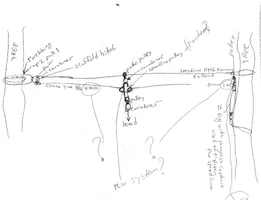
My plan was to pull the limb upward with a block and tackle with as much of the limb in tact as possible. I would then speed line it down to a 'clean' spot. Then I came up with the crazy idea of what if I needed to stop it somewhere along the speedline and lower it straight to the ground??? That's where the traveling crane concept came into play. I realize there are other ways to accomplish this, but remember, it's just me; nobody on the other end or on the ground to do anything. So it is quite advantageous to me to be able to do everything from the tree - control the position on the speedline and the vertical hight. The following pics illustrate the rigging I came up with and it worked great.
The pre-thinking paid off big! I rigged all of the ground ropes, and the traveling crane arrangement while on the ground. I attached a control line and the thing was ready to install in the tree. Sounds easy when you just say it.
What you’ll be seeing in the following pics is a combination of the actual limb removal and a demo set up I set up yesterday, specifically for pics. The real thing was too high off the ground, etc. so a lot of the details, esp. the rigging, couldn’t be captured very well by the camera. Pics with the long limb is the actual thing; with the short log is the demo set up.
Here’s a couple of pics of the ground work, both are of the demo setup:
traveling crane rigging takes a lot of gear, rope, and a good dog:

rigging done on the ground:

In the above pic, the ropes to the right are anchored to a tree with a 1” tubular webbing in a W2P1, a small Petzl Paw and three biners. The ropes were attached to the biners via scaffold hitches.
Maybe a word or two about the crane concept. Because of the pulley arrangement and the fact that one end of the crane line is attached to a fixed ground anchor and the other end is fixed via a pulley, the load can travel along the speed line with no change in elevation other than the speedline’s change in elevation. If the speedline were tight and horizontal, the load could be moved full length of the speedline without a change in elevation except for speedline sag. The load could be stopped at any point, and lowered or raised by releasing or pulling on the crane line.
The speed line is PMI 11mm EzBend (EzB) and the traveling crane line is 5/16” KMIII. The control line is also 5/16” KMIII. The crane line has to be longer than either the speed line or the control line because when the load is lowered, it requires double the line for the distance dropped.
It would be somewhat helpful if the control and crane lines could be a different types or colors of rope, but it’s really pretty easy to keep track of what’s what by the position of the ropes in the tree.
The demo is unique in that I didn’t have a limb already in the tree so I went ahead and attached a load limb from the ground. The thought being that once everything is installed, I’d pull up the load log to the crane pulley and then pull the control line to move the log up to the tree where I’d be.
FWIW, the crane part is a theoretical 2:1, meaning that theoretically you would only have to pull the crane line with half the force the log weighs to raise it. However, pulley efficiency it is very significant - even moreso for the 'trolley' travel down the speed line.
With that much done, the next step is to shoot a throwline over a convenient limb and pull up each end of three ropes. It really doesn’t matter a whole lot where the limb is, just so you can access the ropes when you get in the tree. Here’s the three ropes tied to the throwline ready to be hauled up and over a limb.
throwline and ropes ready to pull:

From the ground, I’ll pull most of the slack out of the lines so it starts to look like this:

Now it’s time to climb.
When all the rigging in the tree is done, it looks like this:

It’s difficult to see in the pic, but there’s a Z rig on the speed line to tension it. I used 8mm 3WP to attach the upper pulley of the Z to the speed line, and another 8mm 3WP to the lower pulley to act as a progress capture. The 8mm is the green cordage and it’s pretty hard to see in the pic. The control line and the crane line are 5/16” lines so they have a 7mm 3WP. Each line is run through a separate pulley and anchored to a common anchor. All the anchors are 1” tubular webbing girth hitched around the tree. Everything worked, as they say, just like the book said it would.
Here’s some pics of the demo log in various locations and at various heights:
In the tree near me:

About half way down the speed line:

And finally from the same location on the speed line as above, but lowered to the ground.

Ok, so much for demo stuff, on to the actual removal. The setup is basically the same as seen in the demo pics. Unfortunately I don’t have a pic of the block and tackle I used to pull the limb up and free of the lower limbs. I took several pics, but the camera I took the pics on is not connecting to my computer for some reason. Anyway, I set up a 3:1 using a Petzl Twin and a CMI single pulley with a becket. Pretty much a big overkill, but it worked fine, it was just a bit heavier duty than it needed to be. Two Petzl Gemnis would have done job just as well, but hey, you use what you’ve got.
So lacking pics from my other camera, here’s some my wife took from the ground. While she’s taking the pics, I’m up in the tree, manipulating the control and crane lines. Here’s the limb about midway down the speed line:

And lowered some at the same spot:

And in it’s final resting spot:

One more thing I learned about the crane setup – the Tandem, while it looks like the ideal tool for the job, has a problem. The Tandem slants almost to the same angle as the crane line, while the load ropes come down vertically. This causes the rope to rub on part of the frame, actually a frame edge which creates friction, wear on the pulley frame and rope. I’ve got a new system worked out to fix that and hopefully I can post a few pics of the newer version sans the Tandem.
I realize this may be common knowledge to you guys, but I hadn't seen it before and didn't quite know how to search to see if it had been posted before, so enjoy if it's a first, forgive if it's been posted before.
Here's the situation. I needed to remove a good sized limb from my neighbor's tree. I suspect the same lightning bolt that killed the top third of my maple tree got his limb just across the fence from my tree. Anyway, I like to squeeze everything I can out of an opportunity to learn more about limb removal techniques like you guys do as easily as putting on your climbing boots.
First, this constriction for me - I have no groundies; so if I'm up the tree and need something to be done on the ground, I have to go down and do it and if necessary climb back up.
My plan was to pull the limb upward with a block and tackle with as much of the limb in tact as possible. I would then speed line it down to a 'clean' spot. Then I came up with the crazy idea of what if I needed to stop it somewhere along the speedline and lower it straight to the ground??? That's where the traveling crane concept came into play. I realize there are other ways to accomplish this, but remember, it's just me; nobody on the other end or on the ground to do anything. So it is quite advantageous to me to be able to do everything from the tree - control the position on the speedline and the vertical hight. The following pics illustrate the rigging I came up with and it worked great.
The pre-thinking paid off big! I rigged all of the ground ropes, and the traveling crane arrangement while on the ground. I attached a control line and the thing was ready to install in the tree. Sounds easy when you just say it.
What you’ll be seeing in the following pics is a combination of the actual limb removal and a demo set up I set up yesterday, specifically for pics. The real thing was too high off the ground, etc. so a lot of the details, esp. the rigging, couldn’t be captured very well by the camera. Pics with the long limb is the actual thing; with the short log is the demo set up.
Here’s a couple of pics of the ground work, both are of the demo setup:
traveling crane rigging takes a lot of gear, rope, and a good dog:
rigging done on the ground:
In the above pic, the ropes to the right are anchored to a tree with a 1” tubular webbing in a W2P1, a small Petzl Paw and three biners. The ropes were attached to the biners via scaffold hitches.
Maybe a word or two about the crane concept. Because of the pulley arrangement and the fact that one end of the crane line is attached to a fixed ground anchor and the other end is fixed via a pulley, the load can travel along the speed line with no change in elevation other than the speedline’s change in elevation. If the speedline were tight and horizontal, the load could be moved full length of the speedline without a change in elevation except for speedline sag. The load could be stopped at any point, and lowered or raised by releasing or pulling on the crane line.
The speed line is PMI 11mm EzBend (EzB) and the traveling crane line is 5/16” KMIII. The control line is also 5/16” KMIII. The crane line has to be longer than either the speed line or the control line because when the load is lowered, it requires double the line for the distance dropped.
It would be somewhat helpful if the control and crane lines could be a different types or colors of rope, but it’s really pretty easy to keep track of what’s what by the position of the ropes in the tree.
The demo is unique in that I didn’t have a limb already in the tree so I went ahead and attached a load limb from the ground. The thought being that once everything is installed, I’d pull up the load log to the crane pulley and then pull the control line to move the log up to the tree where I’d be.
FWIW, the crane part is a theoretical 2:1, meaning that theoretically you would only have to pull the crane line with half the force the log weighs to raise it. However, pulley efficiency it is very significant - even moreso for the 'trolley' travel down the speed line.
With that much done, the next step is to shoot a throwline over a convenient limb and pull up each end of three ropes. It really doesn’t matter a whole lot where the limb is, just so you can access the ropes when you get in the tree. Here’s the three ropes tied to the throwline ready to be hauled up and over a limb.
throwline and ropes ready to pull:
From the ground, I’ll pull most of the slack out of the lines so it starts to look like this:
Now it’s time to climb.
When all the rigging in the tree is done, it looks like this:
It’s difficult to see in the pic, but there’s a Z rig on the speed line to tension it. I used 8mm 3WP to attach the upper pulley of the Z to the speed line, and another 8mm 3WP to the lower pulley to act as a progress capture. The 8mm is the green cordage and it’s pretty hard to see in the pic. The control line and the crane line are 5/16” lines so they have a 7mm 3WP. Each line is run through a separate pulley and anchored to a common anchor. All the anchors are 1” tubular webbing girth hitched around the tree. Everything worked, as they say, just like the book said it would.
Here’s some pics of the demo log in various locations and at various heights:
In the tree near me:
About half way down the speed line:
And finally from the same location on the speed line as above, but lowered to the ground.
Ok, so much for demo stuff, on to the actual removal. The setup is basically the same as seen in the demo pics. Unfortunately I don’t have a pic of the block and tackle I used to pull the limb up and free of the lower limbs. I took several pics, but the camera I took the pics on is not connecting to my computer for some reason. Anyway, I set up a 3:1 using a Petzl Twin and a CMI single pulley with a becket. Pretty much a big overkill, but it worked fine, it was just a bit heavier duty than it needed to be. Two Petzl Gemnis would have done job just as well, but hey, you use what you’ve got.
So lacking pics from my other camera, here’s some my wife took from the ground. While she’s taking the pics, I’m up in the tree, manipulating the control and crane lines. Here’s the limb about midway down the speed line:
And lowered some at the same spot:
And in it’s final resting spot:
One more thing I learned about the crane setup – the Tandem, while it looks like the ideal tool for the job, has a problem. The Tandem slants almost to the same angle as the crane line, while the load ropes come down vertically. This causes the rope to rub on part of the frame, actually a frame edge which creates friction, wear on the pulley frame and rope. I’ve got a new system worked out to fix that and hopefully I can post a few pics of the newer version sans the Tandem.