Oak Wilt? Something Else?

Reach

Been here much more than a while
Location
Atglen, PA
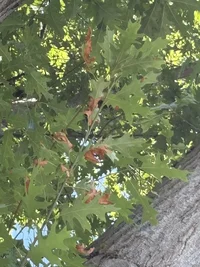
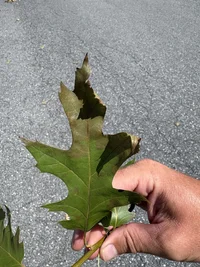
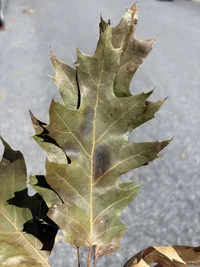
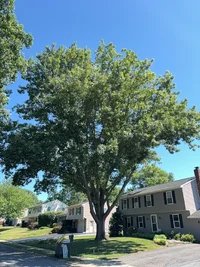
IMG_0144.webpRed Oak in front yard, customer called and said it is dropping small clusters of leaves after the turn brown; sometimes quite a few fall at once, he says they're falling daily.

The leaves that are falling appear to be dying back like Bacterial Leaf Scorch, except it's the wrong time of year for BLS symptoms. The tree looks a little thin up top, but I can't get a good angle to see the top real well.

Also, I can see a few small cracks that appear to be leaking sap. I didn't get any decent photos of those, but did get some good photos of the fallen leaves and tried to zoom in on one patch of the leaves that are turning colors.

Oak Wilt has not been confirmed this far east in PA, but it's not too far away, so is it possible this could be the first confirmed case? Or is it (hopefully!) something else?IMG_0147.webpIMG_0146.webp
 

Attachments

  • 96579E10-E40A-4257-9549-0199B018C298.webp
    96579E10-E40A-4257-9549-0199B018C298.webp
    372.8 KB · Views: 3
The splotchiness makes me think yes, Oak Wilt but I’m inclined to check some references. I’ll try to help diagnose.
Thank you. I am afraid that's what it is from some internet searches, but I'm hoping it is not. If we can find something else to blame I will try to push the customer to keep the tree, otherwise I will recommend removal as quickly as possible. And report it to the state, for them to confirm.
 
  • Like
Reactions: ATH
I recommend sending samples ASAP.

Do you have a good Extension service there (or Bureau of Forestry or Department of Agriculture???)? They probably would want to know if Oak Wilt is in a new area, so they may help with samples.

If the lab only runs cultures, it can be difficult to get them a good sample. Ideally it would get there the same day you cut it. Otherwise figure how late in the day you can get it to USPS/UPS/FedEx and expect next day delivery. Cut the samples at the end of the day and get them shipped as fresh as possible. Apparently the pathogen is hard to grow and dies quickly once removed from the tree so its easy to get a false negative...which is crazy for how aggressively it spreads in the landscape.

Or, send to a lab that uses DNA testing. Not sure if Penn State does or not...worth asking. I send samples to Research Associates Laboratory. (I'm guessing they started in the veterinary field because their website is vetdna.com) Horticulture form: https://www.vetdna.com/application/forms/horticulturesubmissionform.pdf for $20 might even be worth a second sample even if you send samples to another lab that cultures for the test (which is really the "gold standard" for diagnosing). You can send completely dead branches...just make sure they were likely killed by whatever is going on. I'm guessing they can tests leaves too? Maybe call and ask that. I've only sent them bark samples from the trunk off of suspect pressure plates on trees that were already dead.

Tricky part: We don't want any pruning on oak trees this time of year. I'd paint the wounds as soon as the cuts are made.

Next questions:
Are you familiar with oak wilt management (on a landscape scale)? Are there other oaks within root-grafting range? That'd be the big reason to jump in it now...you have to go after it hard or it keeps spreading. "let's not remove this tree that's 8' away because its asymptomatic", or "root graft cutting is too expensive" are recipes for losing more trees. If its just one more tree that doesn't spread into a larger population, might be worth cutting root grafts and treating instead of removing - as long as they understand it may already be infected but not showing signs.

 
Reach,

Did you notice any "Pressure pads" on the trunk?

Here is a guideline to help further: https://www.dnr.state.mn.us/treecare/forest_health/oakwilt/identification.html

I would get a properly taken sample as mentioned in the above link, and send it to the Rutgers lab to confirm what you are dealing with.


I have a "red oak group" that had pretty bad BLS last season, and this season some leaf dropping. Not Oak Wilt as all leaves would drop in short time, and pressure pads would be present.

I would send a sample to confirm.
 
I recommend sending samples ASAP.

Do you have a good Extension service there (or Bureau of Forestry or Department of Agriculture???)? They probably would want to know if Oak Wilt is in a new area, so they may help with samples.

If the lab only runs cultures, it can be difficult to get them a good sample. Ideally it would get there the same day you cut it. Otherwise figure how late in the day you can get it to USPS/UPS/FedEx and expect next day delivery. Cut the samples at the end of the day and get them shipped as fresh as possible. Apparently the pathogen is hard to grow and dies quickly once removed from the tree so its easy to get a false negative...which is crazy for how aggressively it spreads in the landscape.

Or, send to a lab that uses DNA testing. Not sure if Penn State does or not...worth asking. I send samples to Research Associates Laboratory. (I'm guessing they started in the veterinary field because their website is vetdna.com) Horticulture form: https://www.vetdna.com/application/forms/horticulturesubmissionform.pdf for $20 might even be worth a second sample even if you send samples to another lab that cultures for the test (which is really the "gold standard" for diagnosing). You can send completely dead branches...just make sure they were likely killed by whatever is going on. I'm guessing they can tests leaves too? Maybe call and ask that. I've only sent them bark samples from the trunk off of suspect pressure plates on trees that were already dead.

Tricky part: We don't want any pruning on oak trees this time of year. I'd paint the wounds as soon as the cuts are made.

Next questions:
Are you familiar with oak wilt management (on a landscape scale)? Are there other oaks within root-grafting range? That'd be the big reason to jump in it now...you have to go after it hard or it keeps spreading. "let's not remove this tree that's 8' away because its asymptomatic", or "root graft cutting is too expensive" are recipes for losing more trees. If its just one more tree that doesn't spread into a larger population, might be worth cutting root grafts and treating instead of removing - as long as they understand it may already be infected but not showing signs.
Thank you! I picked up some samples of the leaf clusters that fell, but Penn State wants 6" long, 1/2" diameter sticks. And the lowest twig on this tree is 30' above the ground, so that means climbing to obtain samples.

The street is of course full of Oaks, there's another Red Oak directly across from this one, so almost certainly root grafting.

I believe the Penn State lab is good, but I'm not certain. I may try to call them tomorrow, see if they answer and see if I can send them pictures to look at. Maybe they will want to send someone out themselves? Worth a call at least.

If it is Oak Wilt, I've read enough on here to know how serious it is, and how aggressive the measures are to prevent spread. More to learn and fast though, if we can confirm that's what's going on.
 
  • Like
Reactions: ATH
...

I believe the Penn State lab is good, but I'm not certain. I may try to call them tomorrow, see if they answer and see if I can send them pictures to look at. Maybe they will want to send someone out themselves? Worth a call at least.
.....
The OSU lab is good too....but those leaves won't be good for a culture test, as best I understand it (having talked with the folks who run the lab). If PSU cannot DNA test, just mail them to RAL (call first to see if they can expect to get results from a leaf). If you put them in a regular envelope with that form I linked, the leaves will mail with a stamp. You'll have that answer by next week at least.
 

New threads New posts

Back
Top Bottom