
Negative rigging

Mitch, you're getting sloppy with your terms and concepts. Dan's equation is the impact force equation. Google it. And it doesn't matter if the deceleration value is less than one: you aren't suddenly multiplying instead of dividing.

For simplicity, say the mgh term (potential energy) = 10 and d = 2, then F = 5. Now reduce d to 1 and F = 10. Now reduce d to 0.5 and F = 20. Now reduce d to 0.1 and F = 100. Which all makes sense, because the smaller the deceleration distance, the higher the force will be.

Speaking of force, the cut piece doesn't gain force during the fall; it gains velocity (at least until another force - aerodynamic drag, rises to the point of equalizing the force of gravity). The force acting on a horizontal limb that is suddenly freed from the tree by a chainsaw is gravity (otherwise it would hang there in free space) and the force of gravity isn't changing or increasing during the fall. What is increasing during the fall is the limb's velocity and momentum. What seems like an increase in force to you is the increase in deceleration force required by the groundie to remove the kinetic energy from the piece.
 
Mitch, you're getting sloppy with your terms and concepts. Dan's equation is the impact force equation. Google it. And it doesn't matter if the deceleration value is less than one: you aren't suddenly multiplying instead of dividing.

For simplicity, say the mgh term (potential energy) = 10 and d = 2, then F = 5. Now reduce d to 1 and F = 10. Now reduce d to 0.5 and F = 20. Now reduce d to 0.1 and F = 100. Which all makes sense, because the smaller the deceleration distance, the higher the force will be.

Speaking of force, the cut piece doesn't gain force during the fall; it gains velocity (at least until another force - aerodynamic drag, rises to the point of equalizing the force of gravity). The force acting on a horizontal limb that is suddenly freed from the tree by a chainsaw is gravity (otherwise it would hang there in free space) and the force of gravity isn't changing or increasing during the fall. What is increasing during the fall is the limb's velocity and momentum. What seems like an increase in force to you is the increase in deceleration force required by the groundie to remove the kinetic energy from the piece.
Tuebor, I think you need to re-read my posts. In my last I admitted to being sloppy with the interchanging use of energy/force. I am not arguing against the equation, just its interpretation.
Much of what you are saying about the physics agrees with my arguments. I am arguing that the kinetic energy should never exceed potential, which it can with a certain decimal placement In the denominator when applying deceleration to the equation.
This is a friendly discussion, please take the time to read both sides before weighing in.
 
To be honest, discerning between impact force and kinetic energy in this situation is arbitrary as force is what is what is measurable.
 
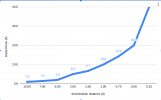
Ok, but in regards to the decimal point, just do the math and keep changing the denominator, decimal point or not, and see what happens. (edit) Here is a chart from a spreadsheet using the formula F=mgh/d with the value of mgh set to 10. Notice on the horizontal axis, as d goes below 1.0, the force just continues to rise.

Screenshot 2021-09-01 17.53.43.png


Discerning between force and energy is like discerning between weight and mass or velocity and speed. They are different.
 
Last edited:
I'm at a loss on:

"I am arguing that the kinetic energy should never exceed potential, which it can with a certain decimal placement In the denominator when applying deceleration to the equation."

Kinetic energy can never exceed potential energy. The formula does not have anything to do with kinetic energy. The formula gives deceleration force as a function of mass, height and deceleration distance. The "when applying deceleration to the equation" doesn't make sense to me. Any decimal in the denominator is what it is for the given value of d; it can't be arbitrarily moved or changed. And you always divide by d. Division by a number less than 1 is not multiplication. Maybe you're thinking of division being equivalent to multiplying by the reciprocal? Or that division by a number less than 1 results in an increased value?
 
The graph says it all to me as well- when we get below a value of 1, kinetic energy exceeds potential. How is this possible in real life? Potential energy is the perfect theoretical energy in the fall and potential of force in impact, in real life it will never be achieved due to drag and deceleration, yet your graph shows kinetic energy exceeding it below a value of 1. Calculator thinking.
 
The graph says it all to me as well- when we get below a value of 1, kinetic energy exceeds potential. How is this possible in real life? Potential energy is the perfect theoretical energy in the fall and potential of force in impact, in real life it will never be achieved due to drag and deceleration, yet your graph shows kinetic energy exceeding it below a value of 1. Calculator thinking.
The graph is a graph of force, not energy.
 
If newtons to joules is 1 to 1, how is it different?
Newtons to Joules is not one to one. Newtons is a unit of force, Joule is a unit of energy.

Don't get defensive; we're just clarifying and keeping information correct for others to follow. You started off disagreeing with the idea of a deceleration distance less than one unit being somehow different. We're just trying to explain how that doesn't matter.
 
Sorry, that was defensive! I feel a little nitpicked, and it has been 12 years since this was fresh to me at college.

Since the point of impact is a single point, would it’s distance for the purpose of converting joules to newtons be negligible and thus a 1:1 conversion?
 
If so, and we are expressing energy in joules (per dan), kinetic energy is greater than potential when deceleration is at a value under 1, which doesn’t make sense.
 
Now I'll mess up the works with a concept or rule of thumb that uses one number and the least brain power possible. I've posted this before in detail somewhere.


If the CofG of the log falls "fall distance" and then the rope starts catching it, and stops it fairly uniformly in another length equal to "fall distance", you stopped it with 2 G's. Doubled its weight in rope tension. So you have to remember equal fall and stopping distances and x2 weight/force.

If you stop it quicker the forces go up. If you let it run longer you lower the forces but it's a game of diminishing returns because the whole time you're also having to dissipate more mgh energy to further down the log goes. Do I get points for least math required?:)

If you want to glaze your eyes over find the thread on the HSE report. What's your vector Victor? - Leslie Neilson in a comedy scene from Airplane.

p.s. I'm a fan of Dan's physics stuff
 
A graph that includes neither potential energy nor kinetic energy cannot show that kinetic energy ever exceeds potential energy. To me, the distinction between force and energy is important.

In the F = mgh / d equation, the mgh term is energy. The units work out to kg • m² / sec², which is joules. It's the potential energy of the object due to it's mass, height and the acceleration due to gravity. A joule is the energy required to apply a force of one newton for a distance of one meter. When the object falls, the potential energy is converted to kinetic energy, but it's the same amount of energy if we ignore aerodynamic drag, etc. We know energy is conserved. We just convert potential energy to kinetic energy when we make the chunk fall.

For a given fall (such as in Tuebor's graph), the impact force is solely determined by the deceleration distance, with an inverse relationship. When you consider the definition of a joule, I think this all seems more logical.

[FWIW, is been about 40 years since I had a physics class but I was a good student.]
 
Last edited:
Now I'll mess up the works with a concept or rule of thumb that uses one number and the least brain power possible. I've posted this before in detail somewhere.


If the CofG of the log falls "fall distance" and then the rope starts catching it, and stops it fairly uniformly in another length equal to "fall distance", you stopped it with 2 G's. Doubled its weight in rope tension. So you have to remember equal fall and stopping distances and x2 weight/force.

If you stop it quicker the forces go up. If you let it run longer you lower the forces but it's a game of diminishing returns because the whole time you're also having to dissipate more mgh energy to further down the log goes. Do I get points for least math required?:)

If you want to glaze your eyes over find the thread on the HSE report. What's your vector Victor? - Leslie Neilson in a comedy scene from Airplane.

p.s. I'm a fan of Dan's physics stuff
I like your simplication.

With the F = mgh / d formula, if the fall distance is twice the deceleration distance, we can substitute 2 for h and 1 for d, and ignore the units since they cancel out:
F = 2mg
Which tells me the object pulls 2g's decelerating.

IMHO, that's worth at least 5 bonus points.
 
Deceleration is the inverse of “work”.

I will take my issues with this to some physicist friends, you guys have endured enough of my hard-headedness! I still have some disagreements, but I have reached my limit with the knowledge of how these figures convert to be able to have a solid argument. I appreciate the debate, and respect the collective knowledge here.
 
The crux of the simplification is that to decelerate at 1G the rope has to apply 2G because the 2nd G is just opposing constant gravity. If you put 3G's tension into the rope you get two for kinematic deceleration. So it doesn't go directly ratiometrically with rope tension.

I figure d=d0 +vt + 1/2atsqrd makes the d and t relationship messy and we like to use d's i.e. fall length, stop length. But target the answer v=0. At a specific d. Maybe if you work with net deceleration (e.g. 3 G's tension but do math using 2G's net available) some simplicity will ensue, like for a horizontal motion analysis. But in vertical, stopping up short like half distance reduces the net energy involved by 1/2m G. Thus throwing an oddity into energy equations "1 1/2 fall length total..." or 1 1/4 etc Doh!

Thinking too much makes my head hurt :) Especially solving math.

Horizontal - work = (constant) force x distance, so stopping up in 1/2 the acceleration distance would use double the force. 1/3, triple force etc. So maybe the net concept can work as long as you add the 1G gravity canceller tension in afterwards. i.e. triple force plus 1 G, where the accel force was indeed 1 G gravity and loose rope. A sort of superposition solution.
 
Thanks for all of the replies, most of it is way over my head.
Just wanting something real simple to explain to other.
Say a 100kg block drops 2 feet before the rope takes tension, it now weighs x
Same block falls 3 feet it now weighs z

understand there is huge number of variables in the rope, stretch, elasticity, sudden or let it run.
Something real basic to base rigging and anchor forces off
 
I wonder if you are thinking of Don Blair's rule of thumb. From the HSE report:

Blair used a method of assessing dynamic forces resulting from a mass being suddenly stopped by rigging, in relation to short fall distances. He subsequently explained that the peak force is not a linear function of the weight, but depends on the distance of fall:​
“A rough rule of thumb that probably does more good than harm is: For every foot a falling object falls it gains a unit of weight plus one. EXAMPLE: 500 pounds falling four feet will hit the rigging at about 2,500 pounds.”
The origin of this rule is not stated, and Blair warns that it does not mirror the actual physics equations that are required to assess peak loads. It is also unclear from what point the distance of fall is to be measured...​
The limitations of such rules of thumb become obvious when they are applied to safety assessments in scenarios that do not necessarily match those from which the rules were derived. Shock loading may result in greater force magnification than letting a log run. Stronger rope will have greater stiffness, and its use will increase peak forces when a log is snatched (i.e. not slowly decelerated). Shorter rope length, as the stem is topped down, may also result in greater peak forces if it is not compensated for by shorter sections.​
Advice on how to adapt any of the above-mentioned rules of thumb to a specific rigging scenario is not provided, which would seem to imply an assumption that they fit a wide range of situations. This is certainly not the case, because the underlying mechanics are far too complicated to be summed up in a simple rule of thumb, that errs on the side of caution yet still allows for cutting practicable sizes of wood. There are many parameters that cannot even be determined by arborists in the field (e.g. rope stiffness or a tree’s damping effect), but which significantly affect the magnitude of forces during rigging operations.​
 

New threads New posts

Kask Stihl NORTHEASTERN Arborists Wesspur TreeStuff.com Teufelberger Westminster X-Rigging Teufelberger
Back
Top Bottom