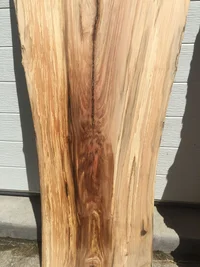
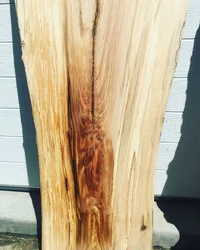
Needing a bigger saw.

Sounds like you need to go work with a pro faller/bucker and learn how to properly buck logs Colb. Alway go get that far side wood first, then work your saw over the top, and then work your kerf to create space for you bar. Right on through without ever pulling your saw out or pulling a bunch of wood fibre, which is a real no-no in my world. Eazy parcheezy!!


Dang that's pretty, rico.

Quick question: is that the 'reaming' technique Beranek mentions in 'Fundamentals'? I really want to learn to do this. How do you know when to begin stroking? As the top kerf begins to close?
 
Dang that's pretty, rico.

Quick question: is that the 'reaming' technique Beranek mentions in 'Fundamentals'? I really want to learn to do this. How do you know when to begin stroking? As the top kerf begins to close?
I have to admit that I have never completely looked through Beranek's Fundamentals, but "reaming" is an appropriate term. Its just one of those simple, essential techniques that any good logger or tree-man picks up along the way.

If you get as much of your far side wood cut as you can first, then you have decreased the depth that you need to "ream" or "stroke" your kerf, making the process much easier. I like to begin cleaning out my kerf before it starts to close, and by staying in front of your closing kerf you make it much easier and smoother. I will also add that the bigger the wood, the better this method works.
 
Is the operating principle that top of the bar is essentially cutting the closing kerf above it as you 'bore' back in each stroke, effectively keeping the area of the kerf where the saw is presently cutting open? Does the top of the kerf end up completely closing and stalling any more pinching action until the holding wood at the bottom is completely severed?
 
This style of bucking works on anything. Softwoods, hardwoods, bucking for lumber or firewood, top binds or bottom binds. You just have to read the binds and adjust accordingly.

You ever get to talk to your gramps or great gramps about the old days Colb? I love hanging out with legit old-timers and talk logging. It seems I always walk away with some extremely useful long forgotten tip or trick.

I didn't, and I regret it. I think my pops wanted a fresh start, so I did not have tree work on my radar until late in life, by which time my grandfather was long dead. Pictures of them materialize occassionally that make more questions than answers... The first time I felled a tree I had this out of body experience where it almost felt like I had plugged in to all of that, and I hadn't really been thinking about them in the lead up. I'm not sure what to make of it - whether I have "roots", or what's up with it all. I hope I get to go through things a bit with my dad and some of those pictures before he passes, but it's hard to bring it up...
 
Rarely would the wood size around here qualify as 'big', but if it'll help me stop pinching the bar (edit: or make me less reliant on wedges), I definitely want to learn this.
 
Last edited:
I didn't, and I regret it. I think my pops wanted a fresh start, so I did not have tree work on my radar until late in life, by which time my grandfather was long dead. Pictures of them materialize occassionally that make more questions than answers... The first time I felled a tree I had this out of body experience where it almost felt like I had plugged in to all of that, and I hadn't really been thinking about them in the lead up. I'm not sure what to make of it - whether I have "roots", or what's up with it all. I hope I get to go through things a bit with my dad and some of those pictures before he passes, but it's hard to bring it up...
Sounds like this shit is in your DNA. Embrace it bro!
 
Is the operating principle that top of the bar is essentially cutting the closing kerf above it as you 'bore' back in each stroke, effectively keeping the area of the kerf where the saw is presently cutting open? Does the top of the kerf end up completely closing and stalling any more pinching action until the holding wood at the bottom is completely severed?
You are basically opening up your kerf as it is trying to close. It you look closely you will see that sometimes I will bore, then quickly cut in an upward direction to help keep the kerf as open as possible
 
You are basically opening up your kerf as it is trying to close. It you look closely you will see that sometimes I will bore, then quickly cut in an upward direction to help keep the kerf as open as possible

I noticed at a certain point late in the process that you stop doing the reaming at all - is that because the top kerf has closed completely and no more closing action will take place?

Also - yeah, I think I see the small upward stroke you are talking about, right at 0:40. Yeah? I only see you do this one time. Maybe one time after that, just before you circumscribe the holding wood and come up on the bottom to sever it.

Thanks for kicking this ball back and forth - I've never been able to find any description of the process near to the level of detail you are providing here.
 
Like many things in this occupation explaining and talking only goes so far. This technique is very much a feel thing and every cut is gonna be different, so you respond according to what each individual cut is telling you.
 
I had noticed the technique previously on some of your other videos (the two fer and the 215ft redwood), and it seems like it works well in just about any scenario. The other thing I think I noticed/learned watching your vids is how efficient you are with utilizing the dogs to save energy handling the saw.
 
I had noticed the technique previously on some of your other videos (the two fer and the 215ft redwood), and it seems like it works well in just about any scenario. The other thing I think I noticed/learned watching your vids is how efficient you are with utilizing the dogs to save energy handling the saw.

Big Dogs, Wrap Handles, & Long Bars are for utilizing the saw & making it do most of the work.

Us on the East Coast could learn a lot from the Left Coast Guys.


Sent from my iPhone using Tapatalk Pro
 
I had noticed the technique previously on some of your other videos (the two fer and the 215ft redwood), and it seems like it works well in just about any scenario. The other thing I think I noticed/learned watching your vids is how efficient you are with utilizing the dogs to save energy handling the saw.
Dogs are our best friend always. Never forget it. They are not a fashion statement.
 
What I want to know is why the these saw manufacturers can't put some real fucking dawgs on their smaller saws? A fella spends $600-$700 for a new Stihl 201 and they can't be bothered to put some useful dawgs on it? Fucking thing is worthless once you get into any wood as the lack of dawgs forces you to push the saw through your cut. No thank you!!
 

New threads New posts

Back
Top Bottom