- Location
- Northwest PA
My old collage professor had me out to his house today to look at his elm trees. He has two beside his driveway, a big one and a massive. I need advice on if the big one has Dutch Elm Disease, and if so what I should do to protect the massive one. I'm in Northwestern Pennsylvania.
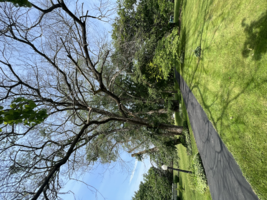
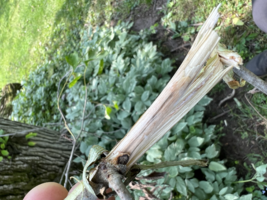
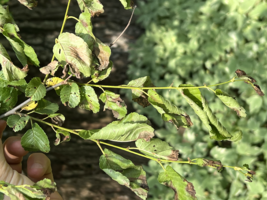
The big one barely has any leaves left. The power company made a heading cut about a foot in diameter last year for no good reason and would have been an easy access point for the beetles. Theres what looks to me like brown streaking under the bark. But I'm not 100% its DED just because I haven't seen that disease much in my career and I expected the leaves to turn yellow before falling off, and the home owner didn't remember ever seeing yellow leaves, and I didn't see any either, just green and brown leaves and bare branches.
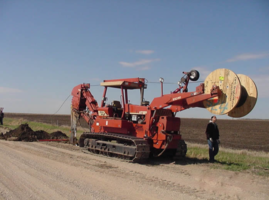
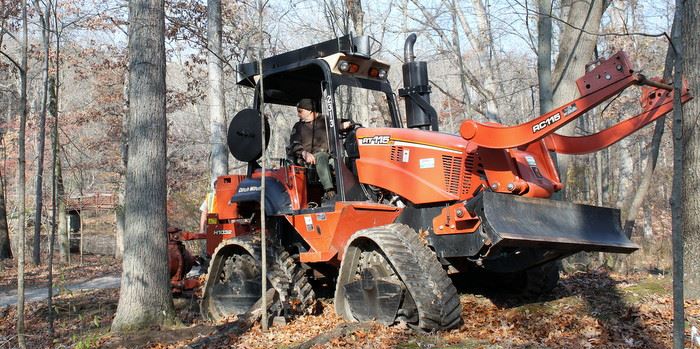
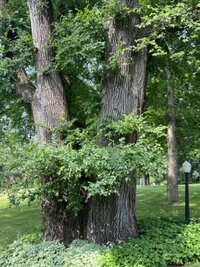
The massive one is 30 feet from the other dying elm. At first glance it looks healthy but a close examination of the tips suggest that theres some tip dieback. I'm concerned thats an early symptom of DED. When I have my lift there to remove the other tree I was planning on going to examine, and cut some of the tips to look for streaking. I believe the correct protocols are to cut any tips with streaking back to 10' below any visible streaking and make a root trench before removing the mostly dead tree. How deep and how long and how far from the infected tree should the trench be? I was thinking I would use my RX100X stump cutting to cut a trench as deep as I could (about 18") in the middle of the two trees for about 30 feet. Do you guys think that would work? And can anyone advise me on if I should be considering using a fungicide products and if so which one? It would be shame to lose that big old tree. I've got my BCMA but I don't have a pesticide application license. I would go and get an application license if I needed to though.
I've attach some photos. Thanks in advance for your help!
Ben
Smaller elm thats mostly dead beside giant elm:
Streaking photo from smaller elm:
Foliage from smaller elm:
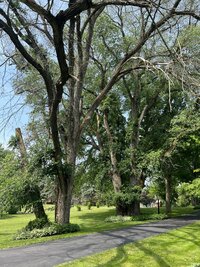
Giant elm:
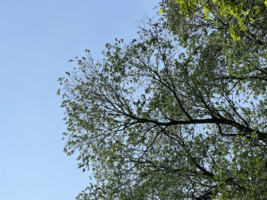
Lower foliage from giant elm:
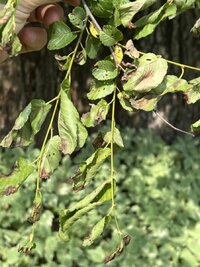
Tip dieback from giant elm:
The big one barely has any leaves left. The power company made a heading cut about a foot in diameter last year for no good reason and would have been an easy access point for the beetles. Theres what looks to me like brown streaking under the bark. But I'm not 100% its DED just because I haven't seen that disease much in my career and I expected the leaves to turn yellow before falling off, and the home owner didn't remember ever seeing yellow leaves, and I didn't see any either, just green and brown leaves and bare branches.
The massive one is 30 feet from the other dying elm. At first glance it looks healthy but a close examination of the tips suggest that theres some tip dieback. I'm concerned thats an early symptom of DED. When I have my lift there to remove the other tree I was planning on going to examine, and cut some of the tips to look for streaking. I believe the correct protocols are to cut any tips with streaking back to 10' below any visible streaking and make a root trench before removing the mostly dead tree. How deep and how long and how far from the infected tree should the trench be? I was thinking I would use my RX100X stump cutting to cut a trench as deep as I could (about 18") in the middle of the two trees for about 30 feet. Do you guys think that would work? And can anyone advise me on if I should be considering using a fungicide products and if so which one? It would be shame to lose that big old tree. I've got my BCMA but I don't have a pesticide application license. I would go and get an application license if I needed to though.
I've attach some photos. Thanks in advance for your help!
Ben
Smaller elm thats mostly dead beside giant elm:
Streaking photo from smaller elm:
Foliage from smaller elm:
Giant elm:
Lower foliage from giant elm:
Tip dieback from giant elm: