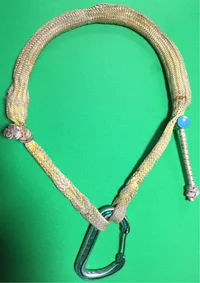
Neck Tether

I used a neck tether in the past, then a bungee connected to the back of my harness thru tubing over my shoulder to get maximum effect from the bungee.
Currently I am very content with the Petzl Secur, very easy to adjust with one hand to the need at the time, ie, tending the RR or whatever I'm using, I use a lobster clip for attachment and it comes in handy as a third hand (rather then my teeth). After I've made my ascent, I secure it to a loop on the front of my harness basically making suspenders. Very handy when the chain saw wants to pull my harness down. My SAKA is tended low on my harness at the bridge.
 
I recently encountered what I feel is a real safety concern with neck tethers. During aerial rescue practice I set up a scenario that involved rescuing a climber who was incapacitated during ascent. I made my way up a free hanging rope using a roperunner , haas, foot ascender, and a borrowed neck tether. ( I typically use a weaver/ swing style chest harness) I hung limp in my system, with all ascenders /tethers still attached. The neck tether slid up, and tightened around my neck. It quickly became apparent that a climber stuck in this position would have the blood flow to their brain severely restricted, if not cut off completely. By comparison, a climber in a chest harness would be held in a fairly safe, stable and upright position.
Hi Jake, this is a concern for sure but how realistic of one I'm not so sure. It is very easy to point out obvious lines of movement within design, both good and bad and for all things. That misuse can take place doesn't negate the quality of design and more importantly for this discussion, the efficiency of it.
I have tried many chest harness designs over the years and always steered clear of neck loops, for the reasons that you mentioned. Arborist SRT is forming it's own niche and tools need to be designed for it. Most chest harnesses hold the tether point low down because they have been designed for traditional SRT ascent with a low down chest ascender attachment but we need our tether point much higher up to gain efficiency when using multi-scenders and long pendulous bridges. The Secur is a rock solid tether that covers both ideas but is far from sleek.
I have been on a neck tether of my own design for the past 6 months and like Jon mentioned I absolutely love it. It hasn't shown itself to be anything but a compact work-horse so far.
Finally and because you made the point, can you really imagine a scenario when a climber suddenly passes out while ascending?
 
I recently encountered what I feel is a real safety concern with neck tethers. During aerial rescue practice I set up a scenario that involved rescuing a climber who was incapacitated during ascent. I made my way up a free hanging rope using a roperunner , haas, foot ascender, and a borrowed neck tether. ( I typically use a weaver/ swing style chest harness) I hung limp in my system, with all ascenders /tethers still attached. The neck tether slid up, and tightened around my neck. It quickly became apparent that a climber stuck in this position would have the blood flow to their brain severely restricted, if not cut off completely. By comparison, a climber in a chest harness would be held in a fairly safe, stable and upright position.
Good point, but can't a ground guy lower the climber, fast?
 
Oh, and I tried the Petzl Voltige Chest Harness, it is a true chest harness, it was just too much for me.
There is also the PetzlTorse Strap 24.00, almost identical to the secur.
The Secur costs about 37.00
 
I have been using the Petzl Torse for years. It is easy to adjust with a large adjustment range. I find it much better than a bungee neck loop.
 
Hi Jake, this is a concern for sure but how realistic of one I'm not so sure. It is very easy to point out obvious lines of movement within design, both good and bad and for all things. That misuse can take place doesn't negate the quality of design and more importantly for this discussion, the efficiency of it.
I have tried many chest harness designs over the years and always steered clear of neck loops, for the reasons that you mentioned. Arborist SRT is forming it's own niche and tools need to be designed for it. Most chest harnesses hold the tether point low down because they have been designed for traditional SRT ascent with a low down chest ascender attachment but we need our tether point much higher up to gain efficiency when using multi-scenders and long pendulous bridges. The Secur is a rock solid tether that covers both ideas but is far from sleek.
I have been on a neck tether of my own design for the past 6 months and like Jon mentioned I absolutely love it. It hasn't shown itself to be anything but a compact work-horse so far.
Finally and because you made the point, can you really imagine a scenario when a climber suddenly passes out while ascending?
Hey SoftBank, I certainly understand the appeal of the neck tether. It's simple and effective, the criteria I tend to use when choosing a piece of equipment are safety, simplicity/ease of use, and effectiveness. For me, a simple chest harness checks all these boxes. I agree that the chance of a climber losing consciousness during ascent seems fairly remote, but a few scenarios do come to mind. The first would be a dead or broken limb becoming dislodged and sliding down the climb line, striking the climber. Second would be heat stroke, or some underlying medical condition. Are the chances of any of these things very high? Probably not. Should we do our best to try and account for such rare occurrences? I certainly think so.
 
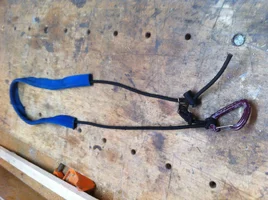
My addition to the mix...the pic is at the bottom.

Here's the description.

Plain old black bungee...diameter about 1/8" or so.

The biner is girth hitched

The shiny metal piece is a slider from a camera neck band like one of these:

http://www.strapworks.com/v/vspfiles/assets/images/flat-metal-slide-group-5-9-12.jpg

The bungee is tied to one side with a double fisherman's. The other threads through the other side of the slider acting as a slack-tender.
after clipping my multicender I pull the end of the bungee then hold the tension with the toggle.The toggle holds the tether as tight or loose as I like.

A piece of tubular webbing to pad the bungee around my neck.

Total cost...zip...all parts were scavenged from worn out or discarded gear.

Years ago when I showed this setup on another forum there was an uproar about showing how a climber could get choked or garrotted. I've never had a branch snag the bungee...not saying it might not happen. Even with the tether snugged up tight enough to do it's job I can still hook my finger under the bungee and pull it wayyyyy over to there--->>> I'm aware of the possibility of choking but not that concerned.

Something that I've thought of doing is to dismantle the toggle and clip off turns of the spring to reduce it's grab strength. In essence, weakening the spring so that the toggle would slip and not choke me.
 

Attachments

  • IMG_2127.webp
    IMG_2127.webp
    573.2 KB · Views: 107
I'm having trouble trying to see someone choking to death on a piece of this bungee. Mine is in the rope sheath and there isn't any tension on my neck, it just hangs there. When you ascend there's a slight amount of pressure on the back of the neck, but it's not uncomfortable or anything. The thing is, the first thing I checked when making the prototype was... can I break this bungee cord? I can easily break it with my bare hands, so I can't imagine that it could collapse your trachea or cut off blood flow. I can spin it around backwards and have my wife pull on it, and it's not even very uncomfortable, let alone life threatening. Any more force, and she would have broken it.

I've got to be missing something here, because I'm not seeing a scenario where being unconscious would make any difference. Unless we're talking about using some bungee cord rated for 75 pounds, or something. Maybe we're not talking about the same kind of bungee cord. The stuff I used is nowhere near the strength of the stuff used on the SAKA.
 
The tether I was using was made from a hollowed out piece of arbormaster, the type of bungee used, I'm not sure. It did seem thicker than many versions I've seen posted here. I weigh 185 and was surprised at the amount of pressure placed on the sides of my neck . A quick on rope test should tell you all you need to know about your personal setup. It seems using the lightest possible bungee makes good sense.
 
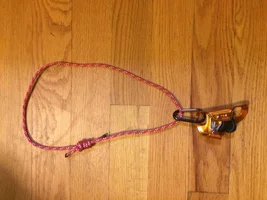
I took accessory cordage (like 6mm or something), pulled the core, buried the ends and girthed it around an accessory clip. Cordage gets flat, unlike using hitch cord, so its a little kinder on the neck. Tends my wrench or bone pretty smooth.
Short is nice, but too short can be a pain sometimes when your leaned away from the rope a little, like if your stepping up into a crotch while the other foot is in the foot ascender
 
You all have real nice builds. Jeff Gu yours looks like it has a patent! Very nice. Mine is bare bones, super simple. Thinking about ordering a HUT ... image.webp
 
Jeff Gu yours looks like it has a patent!

LoL.. hardly... but you splicing buzzers are to blame. You start playing with that, and the next thing you know you're fiddling with all kinds of ideas. Yelling at the dog to get his sorry ass away from that box of rope.. "That is not a chew toy, you worthless, overpriced doorbell!" or trying to explain to the wife that it's a fine line between living room and splicing room and she's merely arguing semantics.
 
LoL.. hardly... but you splicing buzzers are to blame. You start playing with that, and the next thing you know you're fiddling with all kinds of ideas. Yelling at the dog to get his sorry ass away from that box of rope.. "That is not a chew toy, you worthless, overpriced doorbell!" or trying to explain to the wife that it's a fine line between living room and splicing room and she's merely arguing semantics.
If the room in question has a solid anchor for splicing, it's a splicing room, allbeit with a couch and loveseat.
 

New threads New posts

Kask Stihl NORTHEASTERN Arborists Wesspur TreeStuff.com Teufelberger Westminster X-Rigging Teufelberger
Back
Top Bottom