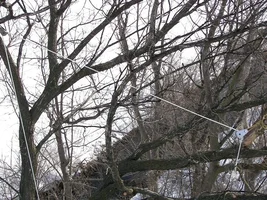
Natural crotchin'

Re: Natural crotchin\'

What is natural crotch rigging?
grin.gif
If I was going to go that route, I would use the 3 and 12 strand ropes.
 
Re: Natural crotchin\'

3 strand twists under load.

Most 12 strands are hollow and will flatten or become square with use.

16 stand glazes easily.

That being said, NER's Safety Pro 12 is a 12 strand with a core. Stands up well to abrasion, holds its shape, forms and holds knots, doesn't twist, has a good hand, and is splicable.
 
Re: Natural crotchin\'

I love the smell of bullrope smoke in the morning.

(Somebody elses rope, of course!
aaf_shifty.gif
)
 
Re: Natural crotchin\'

You name it we use it but we tend to use the hivee lines with the blue core. They definetely glaze. A fellow buzzer cameron uses true blue. When I worked with him it worked great
 
Re: Natural crotchin\'

i'll agree with Mahk that know, no lines are really suited to this. But, rather; then try to control the loading, to not get to the glazing and smoking point(s).

i'll keep loading lower when i can, and on good supports that i don't have to run the line to lighten the support loading. Going more for overhead rigging, on pretightened lines. Pretightend by hanging on them as ground control pulls too, swigging the load side upwards (across giving leverging upwards giving 2:1 - friction of the effort), sometimes using foot cam; using wide open faces that we work the hinge hard to dampen the forces switching over to rope fiber from wood fiber.

i do this by not dutching (for sure not both sides) to keep the open face sweep; sometimes pushing on, standing on the load, wedging or leverging with semi trailer tire spoon as i push also(another 2:1 for effort the push goes into the lever with right hand and to the load with left) - anything to work the hinge fiber harder and avoid free fall into rope; but rather contain a soft handoff of load into rope. The open face assures i don't limit how long i can do this; for i'm done when face closes/ it functions as the mechanical stop. Then the actions switch to either seize or tearoff.

Also, as the rig point on the load, moves away from the support point; i use this distance of movemeant on the hinge, to further pretighten the line. Sometimes even flexing slightly left with load, against the right pull of the line (for the farther rig point moves from support the tighter line gets); to keep a tighter line on load; and then let line pull load around on hinge to the real target right direction. For in low shock loading and direction rope pulls; "Play don't work!" "Rock Around the Clock" is one thing i've called it; because you go left around, to go right.

This all depends on the tension, you can get in the line, so we pretighten, get friction of support close (so that there is less line to take the relief of stretch from, so therefore must support/ limit movement), use less dynamic line (or line set like a 2:1 is less dynamic, but control line lowers at 2x speed but half loaded so have to watch that end of it) etc. Sometimes the amount of firction is increased by using a Round Turn on the support, rather than a Simple Turn.

A Round Turn on support does give some complications: Retrieveal, pretightening and too much friction. Most can be solved with a remote re-lease. i place a krab on rope on the bottom Turn, this allows the Turns to be worked individually, thus allowing easier retrieval. But also, allows pretightening, it allows this even by a perpendicular swigging/sweating action of high leverage. Even on lowering you can sometimes pull this Turn 'open' (if too much friction to slide) for more free travel, but that can get jerky and impacting if you have to segment the action and it just doesn't travel smoothly, with the bottom Turn 'closed' or 'open'. Remote Round Turn Sweat and Removal

 
Re: Natural crotchin\'

Here's a video from a White Oak removal using natural crotching. Sorry the video is sideways, probably wanted to take a picture and the video mode was on. I was recording while lowering the branch. The rope made some noise.

lowering oak limb
 
Re: Natural crotchin\'

I like 3 strand Safety Blue. That's all I use for NC rigging. Extremely durable, inexpensive, stretchy, easily spliced. Seems to 'twist'more when it's running through a sheave. I've tried all 3, 3 strand, 12 strand, 16 strand and 3 strand gives you more bank for your buck. Plus, it wouldn't be mistaken for a "climbing line".

Keep in mind, (most) double braids share the load 50/50, cover/core. They were designed to run through a pulley.
 
Re: Natural crotchin\'

Good points Norm, but what about hockling?? Maybe that only happens when dealing with extra large loads, in which case maybe you'd use a pulley?
 
Re: Natural crotchin\'

Cory, we really haven't had a 'hockling' problem, just twisting. Although it is a concern with 3 strand. Try running the rope around the Porty in oppposite directions, alternating with each drop. It definitely helps.
 
Re: Natural crotchin\'

I only use 16 strand rope because of their superior strenth, if their's a chance of glazing i would distribute the load through multipule forks.
my rope last a long time until the groundie get a hold of them.
 
Re: Natural crotchin\'

[ QUOTE ]
I like 3 strand Safety Blue. That's all I use for NC rigging. Extremely durable, inexpensive, stretchy, easily spliced. Seems to 'twist'more when it's running through a sheave. I've tried all 3, 3 strand, 12 strand, 16 strand and 3 strand gives you more bank for your buck. Plus, it wouldn't be mistaken for a "climbing line".

Keep in mind, (most) double braids share the load 50/50, cover/core. They were designed to run through a pulley.

[/ QUOTE ]

norm, not to get this thread off topic but what are the advantages of using a spliced rope for rigging? im always reading about folks splicing them but never thought of what that might do for them

feel free to pm me or answer on the thread, i dont want to take this thing off topic
 
Re: Natural crotchin\'

We use a 'knotless' lowering system. Splice a locking ladder snap onto a line and splice lengths of rope into fixed loops (3', 4', 5', your coice of length). Choke the loop onto the limb you're lowering and link the locking ladder snap to it and cut away. Once on the ground, the groungy unsnaps the snap off of the girth hitch, resnaps at the bight of the girth and it's on it's way back to the climber. Great for conifers with obstacles beneath. Multiple limbs can be cut in 1 lowering process. No knots to tie and untie. Some guys prefer a 1/2" DB, but I like the 3 strand. Just made myself a new one and used it for the 1st time yesterday on a diseased Amer. elm removal.
 
Re: Natural crotchin\'

got a picture of your rope handy norm? im interested in your rigging style, i often use a cmi daisy chain to get the same results for lowering multiple pieces at once, or i zip line a lot of them out at once
 
Re: Natural crotchin\'

When using 3 strand for a novel idea as a Blake's spit tail; in daze that now seem of olde; i all ways thought that they wore longer than a braided tail. i figured this could be because of the intermittent contact of the 'fluted' footprint; versus the constant footprint contact of a braid. Another factor inherent in the construction, perhaps; is that the individual strands that make up the 3 strands, then run inline to the loading; whereby the strands of the braids are always cocked/leveraged(?). i found better seating (for less leveraged loss?) like the flexibility was ruled by individual strands of 3 diameters; than their total diameter as a line. But in rigging, especially around pulleys, i did start to wonder if the 3 strand needed a larger diameter to sheave ratio to maintain. But, all in all i found the mixed materials of 3 on braid friction hitching very interesting and unique. Different things seen, in the intensity of our operations and with your life on the line. That is why the knudeNoggin shows up here; not because he is a tree climber, but because we take our things further and thus; sense them deeper!!

They seemed to wear longer rigging too, which i figured could be from the same reason(s). Also, i think a 3 strand construction can inherently alter it's length more to give more buffered distance of absorption, than the locked braids(this is more noticeable in higher impacting ranges, where braids 'lose' more of their elongation and the 3 strands stay more consistent with their lower ranges absorption ratios IMLHO). Ground men sometimes found the rougher texture easier to grip. But, the occasional hockling (from running the loading counter clockwise to the clockwise lay especially around Porty etc. IMLHO) dropped it from favor (and because of twisting/ spinning) wit'me (actually i think lower loading -over longer length if impacting, for dissipation- should be run counter clockwise for balanced pull, less shortening/stiffening; then higher loading and impacting -especially into short 'rubber band'- should be run clockwise(?)for balanced pulls over the lifetime of the line(?)).

Rope and knot choices can't be maid statically across the bored IMLHO; but rather chosen to fit and orchestrate. i think that True Blue is a better line, wears longer, but a fresh stick of Arboplex absorbs more and is cheaper. So, if i treated rope rough, and charged off fresh line to each job i'd go with ArboPlex(just a thought in reference to the legendary Graeme's smoke rope comment; i don't know if that is how he does it; but in observing some municipality boys uses and practices for a few daze one hot summer...)
 
Re: Natural crotchin\'

[ QUOTE ]
got a picture of your rope handy norm? im interested in your rigging style.....

[/ QUOTE ]

Here is a pic of the rope I used last Saturday. 1/2" 3 strand with a small Buckingham locking ladder snap on a teardrop thimble, spliced to the rope.
 

Attachments

  • 119891-re-directedrigging3strand.webp
    119891-re-directedrigging3strand.webp
    132.1 KB · Views: 212

New threads New posts

Back
Top Bottom