Re: Natural crotchin\'
Thanks; sometimes it is not the efficiency of a single move that counts, but the orchestration of all the moves together. More polished ways to choose from; give more ways to go.. As illustrated by this timeless
animated .gif of speedlining by Dave Spenscer.
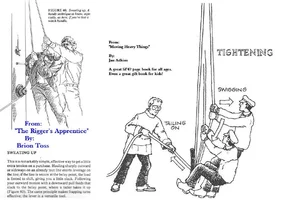
Sweating & Swigging are the same thing. Sir Brion Toss tells it best with swashbuckling stories and imageries of men out at sea for months; with no electricity, motors very little food etc. in ancient times. Literally trusting their lives to the wind; to ever make ground again and survive. Sometimes a key piece of gear; the crank for the Capstan wench would get lost, broken or washed over board etc. To survive, the mens would sweat what they could out of the rope; by pulling sideways to increase the tension in the line; then snatching the line through the capstan to take 'purchase'/ leave less line on the loaded side of the frictions of the capstan. which would leave more tension or lift on said side. Itr is totally befitting he bring these stories to us to understand ropes; for 90% of rope and knots knowledge comes from the worlds of shipping and docks! And as tree folk; putting it on the line alone in a sea of clouds and leaves; rigging loads; whom else more closely pairallells us than those that put their lives on the line alone at their sea and moving loads??
Usually, we think of rope as a flexible device, as we find it. Leverage is obtained by more of a perpendicular force on a non-flexible device. This then gets an amplified return of force from the resistance to bending from the perpendicular force applied as an input. So, as we usually see rope as not resisting bending; the powerfull strategy of sweating/swigging is not realized, because it is so counter-intuitive.
But, a rope under tension already; does resist bending; so can give a leveraged return from perpendicular force applied; not the usual inline force applied to pulley systems for amplified return. It is all in the angles. Each leg of a pulley system has an inline force of theoretically Zer0 deflection; so has theoretically unamplified/unchanged force per leg, but the sum of the legs of pull on the load make the difference. But; as the angle of deflection changes/widens, the pulls on the load(at bend in line) is lessened; as the lines/legs of pull now have less leverage over the load/ and the load has increasing leverage 'over' the input. But still; the end of the line; has leverage over the bend(pulley) of the line; so we input force at the end, and take our increase at the bend.
At 120 degrees spread (each leg 60 degrees deflected off inline) the pull on load is equal to the input pull(in half x 2legs); this is the only angle of such equality in a 2 leg system. The secant(reciprocal of cosine) of 60 is 2; 2/number of legs(2) X load at bend=load at end. Flatter than 120; we have an inversion of the relationship of our 2:1 pulley system; now, instead of the end of the line having leverage over the bend; the bend has leverage over the end! (So, the smart sailor; will not pull from the end to have output on the bend, but, rather pull from a bend to have output on the end. S/He will reverse the strategy of the input and output positions as the forces reverse.
i've used this in tightening lines even remotely.
Also, this is very powerful strategy for tying down stuff. Like, do a ZRig; most stop there as a tightening; but hear, we use that just to stiffen the line/increase it's resis-stance to bending; so we can then leverage it....to give the real tightening. We do have to be carefull of 2 things here 1)that we don't bend metal or break something else 2)that we realize the changing angle will change the direction of pull; and plot this into our madness of power!
Increased Leverage Tie Down
Traded loss for power shows spreading a zrig that i've shown will give decrease in power; but not if you eventually capitalize on that spread to leverage the legs!!
In the last pic
of this'ol drawing i show another way i've used this; with what i call a T-Bar. The tighter a line is, the more it will resist bending, therefore the more leveraged return it will have. Sometimes; i'll have it so tight; i'll take a perpendicular line, anchor 1 end and loop it over the orignal line to give a quick 2:1 type pull to bend the original line. Taking this further; enter the T-Bar. Here; i Anchor 1 end and place the other perpendicular and tied to the first and tighten the 2nd. Then i bend the 2nd line for amplified leverage, that in turn places that power on the primary 1st line to bend it. Now, we are playing with real power! For this is a double multiplication on load; that theoretically starts with a line so tight it can't be bent. Our input is multiplied by leverage the 2nd line, and that power is inturn used to bend the primary line; so therefore multiplied by the primary line being leveraged; that then outputs the force onto the load. Input X leveraging of 2nd line X leveraging of primary line = Output of force on load(s).
"Nature to be Commanded; Must be Obeyed"
-Sir Francis Bacon