chris_girard
Branched out member
- Location
- Gilmanton, N.H.
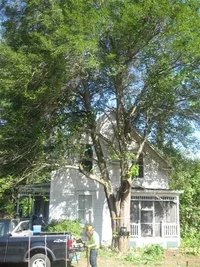
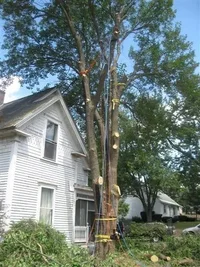
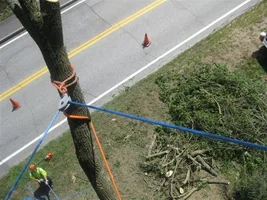
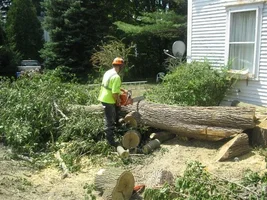
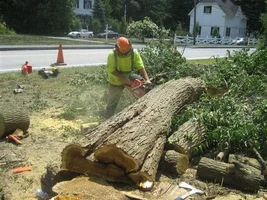
Here’s a nasty Mulberry tree that Porter and I removed the other day. The majority of the codoms were compromised with vertical splits running through them. Each one of them displayed some form of primary failure. The main trunk also had a major split running through it straight down into the ground. The tree was adjacent to an historic house and a NH State Highway. There was also a telephone wire running beneath the lowest branches on the right side.
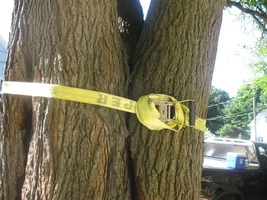
I sounded around the trunk first and found solid wood, so I was confident that after I reinforced the trunk and leaders with load binders straps and extra slings, it would be safe to rig small to medium sized pieces off of.
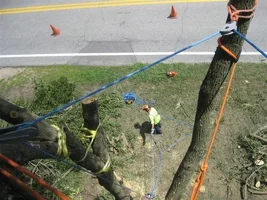
All wood was rigged down with the GRCS except for the last 25' of trunk wood, which we were able to fell into the brush pile on the left side. Since it was just Porter and I doing the work, there were times when I needed to control the butt end of a piece being lowered. I used a medium sized porty and 1/2" lowering line to control the movement.
We kept the loads small and manageable, as the splits throughout those leads were really scary looking, even after being strapped together. I also used 3 Hobbs blocks redirecting the loads back to a main leader when we removed the branches, so that we could minimize the forces at each rigging point. Trickiest part was removing the branches away from the roof, because I really didn't have as high a leader to use as a Gin pole as I would have liked.
Our landing zone moved around a bit as we worked our way around the tree. Porter did an outstanding job of “Minding the Lines” as Gerry Beranek says and keeping the LZ clear to work around. He is only 20 years old and shows a lot of potential in the tree care industry.
I sounded around the trunk first and found solid wood, so I was confident that after I reinforced the trunk and leaders with load binders straps and extra slings, it would be safe to rig small to medium sized pieces off of.
All wood was rigged down with the GRCS except for the last 25' of trunk wood, which we were able to fell into the brush pile on the left side. Since it was just Porter and I doing the work, there were times when I needed to control the butt end of a piece being lowered. I used a medium sized porty and 1/2" lowering line to control the movement.
We kept the loads small and manageable, as the splits throughout those leads were really scary looking, even after being strapped together. I also used 3 Hobbs blocks redirecting the loads back to a main leader when we removed the branches, so that we could minimize the forces at each rigging point. Trickiest part was removing the branches away from the roof, because I really didn't have as high a leader to use as a Gin pole as I would have liked.
Our landing zone moved around a bit as we worked our way around the tree. Porter did an outstanding job of “Minding the Lines” as Gerry Beranek says and keeping the LZ clear to work around. He is only 20 years old and shows a lot of potential in the tree care industry.