
Name this Leaf Scorch!

rfwoodvt

New member
Hey All!

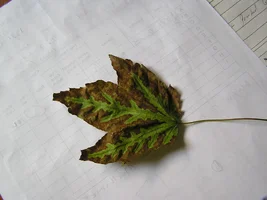
Saw this leaf scorch today on an Acer rubrum. What struck me was the symmetry and consistency of the Scorch.

I also noticed that there is no yellow buffer margin between the brown and green areas of the leaf.

I'm leaning towards bacterial leaf scorch but I'm not 100% on that.

What do you folks think? Would you tell the customer it is BLS?

I know what the "books" say about treating BLS, but does anyone have "field suggestions?"

ThanX!
 

Attachments

  • 132595-P1010095.webp
    132595-P1010095.webp
    199 KB · Views: 262
I am not a pathologist by any means but this certainly seems to look like bacterial leaf scorch. Have you taken a sample to your local extension service to confirm Xylella fastidiosa?

From what Sinclair states (pg 384 of their 1st ed) in Diseases of Trees and Shrubs this is a disease that hits primarily landscape and orchard trees. To me that is a red flag that says something is out of balance and I would work to create as favorable a growing condition for the trees in this client's yard as possible. (Mulch rings to allow nutrient cycling, etc.)

Detective Dendro addressed this issue in the August 2007 issue of Arborist News (Volume 16, No. 4, pg 73). He states that there is no known cure but that root invigoration, mulching and irrigation can minimize the summer water stress and help delay scorch sysmptoms. He also recommends removal of branches that are dead or severely infected may help by limiting the source of inoculum. For high-value trees he states that there is an antibiotic microinjection that may also delay symptom expression (I would consult with your local extension service on any treatment requiring injections).

The Arborist News article was written by Jim Zwack of Rainbow Treecare Scientific Advancements in Minneapolis, MN. Perhaps he would be a resource?

Unfortunately I don't have anything else to offer.

Sylvia
 
Bacterial leaf scorch is Pierce's disease.

What works here is tearing-out the grass cover and replacing with alfalfa, a nitrogen fixer. Certain running grasses are vectors, here it's St. Augustine or Burmuda. Sylvia mentioned mulching and irrigation, a good start for control but uninfected hosts are where you need to concentrate time on. It spreads like fire. Also had some positive reaction by acidifying the root zone and increasing and maintaining tilthy soil near the root collars.

Mogan David wines have vast experience with Pierce's, trying to alter the traditional recommendations of grass cover between vines and have kept their vineyards pretty productive.

Another trick might be to flood the root zone after spraying a heavily mixed dissicant (bicarbonate of soda) with a little liquid soap that will completely coat the leaf surfaces for a few hours - stimulating a rapid uptake of moisture to replace what your bleeding out of the plant - like squeezing a sponge. It all depends on how much time and effort you want to devote to this.
 
In further reading on BLS (I just finished a pathology class with Prof Bob Underwood) I remembered this thread.

In Sinclair's book (again page 384 so you might have already read this yourself)
"Scorch caused by buildup of salt in irrigated soil can mimic the symptoms of bacterial leaf scorch, but salt-injured leaves usually lack a yellow band between green and brown areas. Also, all leaves on a salt-injured shoot usually show scorch, whereas some leaves on a shoot with bacterial leaf scorch usually remain green. Scorched leaves remain on the tree until the normal time of defoliation in autumn."

So I was wondering if you noticed any of these other distinquishing characteristics in your client's case, also what the water quality was and irrigation regimen, soil sampling (if done), etc. If excess salts were the issue, leaching would also be recommended, I would think.

BTW, Oakwilt, I thought that was some really interesting and viable advice! I wouldn't think replanting in alfalfa would be applicable in a landscape situation so we would be back to getting out the grass, replacing with mulch. (Also Sinclair mentions that Alfalfa is also a reservoir?)

On your instructions for flooding the root zone after spraying a heavily mixed dessicant (Bicarb of soda) with a little liquid soap that will completely coat the leave surfaces for a few hours...I took that to mean I would spray the tree and then flood the root zone (not just spray the grass around the tree and then flood?

Thanks! Sylvia
 
By applying this 'dissicating' paste to the leaves and then flooding the root zone, we're creating a syphon from the ca opy to rapidly uptake hugh volumes of moisture (replacing the lost water in the leaves). This hydraulic effect is sometimes used to dilate the vascular tissues while impeding fungal or bacterial obstructions from completely restricting water uptake.

Not a proven method but down here we had to fly without pants often.

I believe Sinclair referred to alfalfa as
 
[ QUOTE ]
I believe Sinclair referred to alfalfa as

[/ QUOTE ]

Ok, Oakwilt...I am waiting with baited breath for the rest of the sentence!

Seriously, I appreciate your taking the time to discuss this intriguing treatment option.

What specific instances have you tried this with? should this be used with known fungal/bacterial problems only?

I am picturing a struggling tree that is fighting off one problem, but leaves it vulnerable to secondary issues. A "shot in the arm" may mean the difference between succumbing due to the additional stressor and/or being strong enough to continue fighting. (Would that be correct, or am I getting carried away here?)


Sylvia
 
In Texas we have successfully restored vigor in wilting hardwoods that were confirmed hosts for vascular fungal parasites that triggered blockages - but these treatments were an alternative to pressure injection at the root collars and designed to pump extreme element levels of zinc znd copper into the trees instead of the prescibed fungistats. Although this was also used early on to increase the uptake of management chemicals while injecting, we left those conventional therapies behind. Way behind.

Also particular to Texas was the confirmation of Burmuda grasses (as Sinclair puts it) being "reservior" species for Pierce's, instead of alfalfa or the native covers. Many vineyards have had great losses documented from scorch and the attempts for control led to the California recommendations - thus the nitrogen-fixing covers. Burmuda here is an economic grass, advocated by the ag schools and studied for nutrition instead of adaptive traits.

If man would restore what was here before, amazing things would happen.
 
[ QUOTE ]

In Sinclair's book (again page 384 so you might have already read this yourself)
"Scorch caused by buildup of salt in irrigated soil can mimic the symptoms of bacterial leaf scorch, but salt-injured leaves usually lack a yellow band between green and brown areas. Also, all leaves on a salt-injured shoot usually show scorch, whereas some leaves on a shoot with bacterial leaf scorch usually remain green. Scorched leaves remain on the tree until the normal time of defoliation in autumn."


[/ QUOTE ]

I don't know Sylvia on the salt issue. Road Salt is always a concern especially on this particular property.

I don't have data suggesting the scorched leaves persist till fall and, though eventually all the leaves on a shoot get affected, it is progressive and not all of them succumb.

OakWilt, I can see your method pulling a lot of fluid up to the crown, but I am concerned <ul type="square"> [*] a) that it will produce short term results only and [*] b) that the dessicant will damage the otherwise tenuous leaves [/list]
I may be worried about nothing, but I'd need to see more on the treatment.

BTW Sylvia, how did your pathology class go with Bob? Was it online or was it on-campus?
 
[ QUOTE ]
BTW Sylvia, how did your pathology class go with Bob? Was it online or was it on-campus?

[/ QUOTE ]

On-line. I really wish I could attend on-campus; however, I am in Montana and he is in No. Dakota. One of the things I really like about Prof Bob is not only is he extremely knowledgable about the subjects, but he was/is in the profession so has a frame of reference that is relevant. (And is amazingly patient to someone who asks probably an irritating amount of questions!
grin.gif
)

I got a LOT out of it. Not surprisingly, I would term this an introduction to many disorders and pathogens so I will be following up with a lot more study to get things more solid in my mind.

The class covered abiotic disorders, including but not limited to mechanical, nutrient deficiencies and touched on mycchorizae (which I could spend an entire semester studying...incredibly fascinating). Biotic disorders fungal, bacterial, viral and phytoplasmal in nature.

I loved the labs! So fun, and really taught me not only about the disorder but HOW to research for more information (an important aspect in and of itself).

The biggest issue was that I tried to take this class this summer which is a shortened 8 week course as opposed to the regular semesters of 16 week. AND I took a second class on top of that (Urban Forestry Management) AND we were working full time. We got home from work, the computers and books came out and that was it until 10 to 11 p at night.

The U of No. Dak - Bottineau offers an on-line diploma program for Urban Forestry Technology, geared towards the working tree care professional. So that is my goal as I study for the BCMA.

Sylvia
 
[ QUOTE ]
If man would restore what was here before, amazing things would happen.

[/ QUOTE ]

And that pretty much sums it up, doesn't it? So many of our problems are because we are trying to change where we are to suit other ideals.

I am really intrigued by this treatment option. It would seem that a "flushing" of the system would be warranted if the issue were salt-based as well, wouldn't it? as leaching out of high salts, overdose/accidental pesticide application, etc. can minimize negative effects.

Sylvia
 
This tree is also showing nutrient deficiency, manganese and iron, so the first treatment option should be to closely examine the trunk flare for stem girdling roots and then assess the viability of the critical root zone. Sometimes signs like the heat/drought scorching on the leaves are really "caused" by another situation. Luck, R
 
Hi Roxy,

ThanX for the input.

I should mention that this scorch was limited to individual limbs, in no particular pattern within the tree and only to about a quarter of the limbs.

When symptoms were displayed they affected the whole limb so there was no "progression" displayed per se.

The unaffected limbs were doing just fine, with no chlorosis or other symptoms.

SGR's were considered and checked with none present.

BLS still seems to be the culprit...
 
I'm not sold on the BLS diagnosis here. Got any more case history, particularly site description? It is pretty uniform to be BLS don't you think? And sounds like it is random throughout the canopy right? What time of year was that pic taken? What pests are active than in your area?
 
After consulting Sinclair and Lyons, I'm mostly sold (online) for BLS on the Acer. It's only Pierce's in Grapes primarily. Would still expect to see some yellow margins at the necrotic tissue interface in BLS. Salt would burn it this fast wothout the yellow margins there. Was there any cupping? How random was it dispersed and how high in the canopy? Did you do a TFX (trunk Flare Excavation)? If it is BLS, death sentence, but you could extend life/prolong death if the client wanted through therapy. Make a replacement plan if that is the route!
 
Send some pics/samples into your nearest university extension agent for confirmation. Some extension departments offer online access to post information and receive a response.

jp
grin.gif
 
There's more here. Don't jump to a conclusion yet. If only one side or area of the tree is affected, could it have been exposed to radiant heat, as from asphalt or exhaust from a delivery truck? Could that portion of the tree have been exposed to herbicide drift, followed by drought conditions? I'm not convinced you're dealing with simply a bacterial infection. It deserves another look, methinks...
 

New threads New posts

Back
Top Bottom