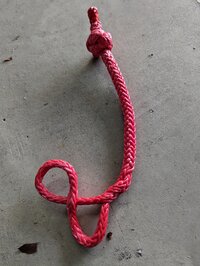
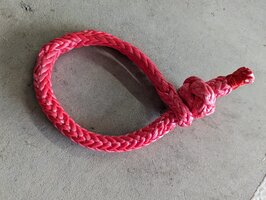
My version of a soft shackles.

dmonn

Branched out member
I have watched a zillion soft shackle videos over the past year or so, and have taken bits and pieces from several of them to come up with the version in the photos. The knot is a diamond knot. The noose is easily opened since the "tucked leg is not buried. The two-strand section ends in a double Brummel. The buried section ends almost inside the diamond knot. I did a short, stitched whipping of the loose ends to hold them together, and cut them with a hot knife and cleaned up the fused end.

Any comments or criticisms are welcome.
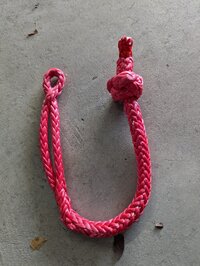
 

Attachments

  • PXL_20221201_161206477.jpg
    PXL_20221201_161206477.jpg
    876.1 KB · Views: 32
  • PXL_20221201_161222167.jpg
    PXL_20221201_161222167.jpg
    885.6 KB · Views: 33
  • PXL_20221201_161315504.jpg
    PXL_20221201_161315504.jpg
    745.1 KB · Views: 33
@dmonn i have never really looked at soft shackles, how would this be used? Is there an eye at the end past the knot? Or is this meant to represent a splice you would put at the end of a rope? Just not seeing how it could be used.
 
You can use it just like a carabiner. Connect stuff to your saddle or a block to a sling or anything like that. I wouldn't use it for life support unless it was an emergency and there wasn't a better choice, but they're plenty strong enough.
 
I’m just not seeing how it attaches to the load line. I get it you just choke it on the load but then to my eyes I just see a short tail with a knot on the end. Feel like I’m missing something obvious here.
 
You can expand the hole on the one end to push the diamond knot end through it. Once loaded, the hole becomes very small and doesn't allow the knot to pull through. His last picture is the "closed" configuration. I bet @Brocky can serve up a darn good picture of this. Otherwise I'll do it once I get home from work.
 
They're becoming very common for use on sailboats. It cuts down on the weight, they're easier and quicker to open and close than a metal shackle and just as secure, easy to make yourself, and less expensive than metal shackles. They're really nice to use to connect jib sheets to the jib or spinnaker sheets to the spinnaker. Those are places where the sail can flap wildly, and people need to be close to them while they are flapping. You run the risk of getting hit in the face with the connector, so a fabric connector hurts less than a stainless steel one!

For tree work they have more limited applications. As stated, they're not great for dynamic loading unless they are way oversized. Some might not be comfortable using them for life support, though after using them on sailboats in lots of different applications I personally would feel pretty confident using them for life support. They typically have a static breaking strength greater than the strength of a single strand of the dyneema/spectra that is used. When I play around with them, I can't see how they would open accidentally and I've not read any reports of that happening.

There are lots of variations on how to make them. If you compare mine to the two Brocky posted, you can see three different styles. It looks like the ones shown by Brocky use a button knot. I usually use a diamond knot. I've also seen (and used) a type of overhand knot with the ends tucked back into the strands going into the knot. Mostly personal preference, but sometimes the application suggests one over the other.
 
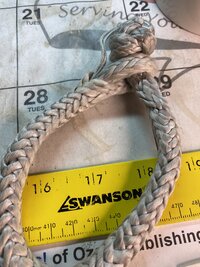
This was made by Colligo, the originators of the soft shackle. Diamond knot, then a single Brummell, and just a bury, no opening eye to deal with. They load them up closed to set, I could tell by the smashed braids. Notice how large the eye is, too small and it tightens up before both sections of cord equalize, and only one section holds the load. You may have the same problem with your shackle, both the eye and the section between the knot and the locked brummel.
F3D4101A-6807-48A8-B2B5-C2C755DE5861.jpeg
 
The most preferred connectors for Hammockers and High Liners are the soft shackle with the button knot. Mainly because the tails are buried back through the knot, resulting in the eye holding four strands. As Tree Climbers use static ropes I can't see any reason not to use soft shackles in some ways. I will splice a couple of 6 or 8 mm Marlow D12 sk99 soft shackles and try them instead of securing with carabiner when tying alpine butterfly knots. Any other suggestions where soft shackles might have their places when tree climbing?
 
This was made by Colligo, the originators of the soft shackle. Diamond knot, then a single Brummell, and just a bury, no opening eye to deal with. They load them up closed to set, I could tell by the smashed braids. Notice how large the eye is, too small and it tightens up before both sections of cord equalize, and only one section holds the load. You may have the same problem with your shackle, both the eye and the section between the knot and the locked brummel.
View attachment 85017
Thanks Brocky. I always appreciate your input.

So far I haven't had any problems with my loops being too small for the strands to equalize when loaded. For me, the trick has been keeping them small enough to be secure when using a diamond knot instead of a button knot. I like the diamond knot because the tails stick out of the knot. They make it easier to pull the knot through the loop when your fingers are cold and the line is wet. I know the button knot increases the overall breaking strength of the shackle, but so does increasing the diameter of the line you're using. I also find the diamond knot easier to tie than the button knot. Just personal preference on my part.
 

New threads New posts

Back
Top Bottom