Mushroom on my Oak tree

Location
NY
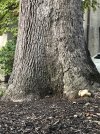
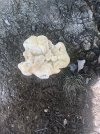
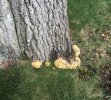
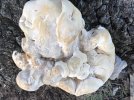
Hi all, I just discovered this board and unfortunately, yesterday, I discovered a mushroom growing at the base of my oak tree. A few years back we lost the beautiful oak in front of my house to root rot. I discovered a mushroom at the base of that tree and unfortunately several arborists told me it would eventually fall, so we took it down for safety. So, naturally the mushroom on the tree is the back now has me very concerned. An arborist is coming next week to give their opinion, but I'm wondering if any experts here have seen this type of mushroom before. It is the same color as the mushroom that was on our oak in the front of the house , but this one is bulkier. The one on the front tree was flat if I remember correctly. Thanks for any advice.

image_67564289.JPG
image_67516161.JPG
 
@KTSmith is the real fungus expert here, so he can probably give you the best answer. In my experience, I would say that mushroom is bad news, but another opinion from the real expert is always best.
 
@KTSmith is the real fungus expert here, so he can probably give you the best answer. In my experience, I would say that mushroom is bad news, but another opinion from the real expert is always best.
Thank you for responding. That is what I am afraid of! The tree is about 150 years old!
 
Welcome to the TreeBuzz forum, @JoanneS! I think @Reach was probably right about @KTSmith. There are probably at least a few others that can give some insight, but I think you're already on the right track having someone out to look at it.

My question as an ignorant individual would be whether or not it is possible to save a tree once a fungus like that shows up? Can drastic measures be taken that have a reasonable chance of success, or is it already too late to save the tree? My gut instinct tells me that if it is possible, the treatments are probably very expensive. I hope it works out for you, and that maybe it can be saved. Take care. Tim
 
My question as an ignorant individual would be whether or not it is possible to save a tree once a fungus like that shows up? Can drastic measures be taken that have a reasonable chance of success, or is it already too late to save the tree? My gut instinct tells me that if it is possible, the treatments are probably very expensive. I hope it works out for you, and that maybe it can be saved. Take care. Tim
Fungus is nearly impossible to treat with any effect. I believe (but may not be quite correct) that it is because it is very difficult to penetrate the tree entirely due to the level that a fungus permeates a tree before the fruiting bodies appear, and because the tree will do it’s best to wall off the infected wood through CODIT, making it even more difficult to treat the fungus itself.

I have heard of treatments that may sometimes slow the progression of the decay, but in the case of a large tree that would become hazardous, I would not take the chance because it’s also very difficult if not impossible to determine the exact strength loss the fungus has caused.

Take all this with a bit of caution, until/unless confirmed by JD or Mr. Smith. Fungus is not my area of expertise.
 
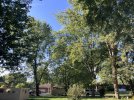
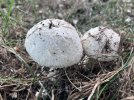
Not to hijack the thread and turn it into an I've got a mushroom question......but doesn't anyone know anything about this mushroom growing on the ground in the prettiest groves of silver maples??

I find myself more and more interested in mushrooms.
 

Attachments

  • IMG_0499.jpeg
    IMG_0499.jpeg
    1.2 MB · Views: 15
  • IMG_0501.jpeg
    IMG_0501.jpeg
    532.7 KB · Views: 15
  • IMG_0500.jpeg
    IMG_0500.jpeg
    559.2 KB · Views: 15
There are literally hundreds of mushrooms (macrofungi) that grow on trees. Almost all of them are insignificant. For a point of reference...there is a 450+ page book called Macrofungi Associated with Oaks of Eastern North America. A 500 page guide called Mushrooms of West Virginia and the Central Appalachians (obviously, there is a lot of overlap between those 2 books!). Point being, LOTS of different mushrooms.

However, there are s few that are significant. I'll defer to Kevin or JD if they chime in, but the OP's picture looks like maybe weeping polypore (AKA Inonotus dryadeus AKA Pseudoinonotus dryadeus). This is one that Chris Luley calls his "big 5". (see Wood Decay Fungi of Living Urban Trees)


Ify ID is correct, this takes more that a quick look. Doesn't mean tree has to go (though it might)... That is a small spot, so hopefully an isolated area associated with it.

Reliant MAY help a little, but I would have low expectations.
 
Not to hijack the thread and turn it into an I've got a mushroom question......but doesn't anyone know anything about this mushroom growing on the ground in the prettiest groves of silver maples??

I find myself more and more interested in mushrooms.
Looks like a species of Amanita to me. Not harmful to the tree.
 
  • Like
Reactions: ATH
Reliant MAY help a little, but I would have low expectations.
And only if applied correctly. My gripe with soil applied chemicals is most people don’t apply enough!

I’d be interested to hear what species. Looks like an old Laetiporus (chicken of the woods) which I think it’s a minor wood decaying mushroom.

I’d say the tree is a good candidate for an advanced risk assessment with a resistograph, sonic tomograph or both.

I’d vet carefully who you have look at this tree. A lot of “arborists” will use the sole presence of a mushroom as simple reason to remove the tree without any knowledge of what the mushroom is and it’s relationship with the tree.
 
Thank you all for your replies. That mushroom was definitely never there before or in previous years. Ever since I lost my oak in the front of the house in 2016, I typically take a walk around this tree once a month or more to check for any issues. It is a very healthy looking tree, at least to my eyes, and never gave us any issues. The one in the front was a different experience and we had to remove dead branches, cable it and it even lost a branch that crushed my car (I hated that car anyway so it worked out!). I've attached a picture of the front tree from 2016 which was taken down. The mushroom, unfortunately, looks similar to the one on my back tree at least in color. I feel like this mushroom on the back yard tree showed up quickly as I did not notice it in August and I'm in my yard all the time.

It just occurred to me that my neighbors have had construction going on at their home since this past June. Our homes are very close together, and they began jackhammering and digging a foundation in their yard, I would say 12 to 15 feet away from this oak tree. The tree is near the border of the properties. The oak tree root with the mushroom directly faces their new addition. Could a tree show damage that quickly, within 3 months? When the tree in the front got root rot, the arborist suggested that the root could have been damaged during construction and the neighbor on the other side did have pipes dug up in the front and that area faced the root with the mushroom. Just wondering if this could be what is happening (not accusing the neighbors - we will take care of the tree). Thanks.

Below photo is from 2016 and the tree in the front that was taken down.

image_6487327 (6).JPG
 
Depending upon site, soil and tree health specific conditions, trees can co exist with fungal associates for a long time. Maintaining tree health and facilitating as full a canopy as possible to keep sapwood functioning at peak performance can be important. At the ISA International Conference I just attended, the work of Lynne Boddy and A.D.M Rayner was a frequent topic of discussion. I'm attaching a summary of their research paper here, along with a link to the article itself.

"It is argued that the development of decay in living hardwoods can best be explained in terms of the unsuitability of functional sapwood for mycelial establishment owing to its high moisture content and lack of easily assimilable nutrients other than within living cells. Decay occurs when these limitations are removed by any mechanisms which prevent or interfere with the normal functioning of sapwood. Recent concepts of decay in living trees have implied an active host defence against infection. This view is discussed against the alternative that non-specific mechanisms which maintain sapwood function will, by their very nature, prevent establishment of -ycelium of decay and stain fungi. The significance of mixed microbial communities in the development of decay is discussed, particularly in relation to the supposed requirement for specific sequences to overcome host defences."

In other words, the more of the canopy leaves are removed, the less water is transpired by the sapwood. As sapwood looses its function and dries/dies, it becomes susceptible to colonization by wood consuming fungi.

A holistic approach is infinitely preferable to having someone with equipment/payroll needs to fund, come out to tell you that your tree is best removed, and the quicker the better. If you want to consider all the options, pay for a consulting arborist to visit your site and perform a thorough assessment of the tree, what type of fungi is on it, what parts, if any, of the structural parts of the tree are compromised, and what is the tree doing to mitigate the problem with reaction growth.


 
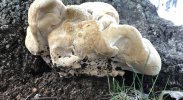
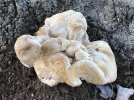
I took a few more photos of the mushroom today and examined it closely and I do not see any weeping on the surface. I tried to photograph the underside as well.
image_16888321.JPGimage_50411009.JPGimage_16876801.JPG
 
Last edited:
I will reserve judgement until our resident mycologist KTSmith checks in but from your photos, an educated guess would Inotus dryadeus whith is a root crown/but root fungi. Judging by the size of trunk and the limited area of fruiting bodies I would not be afraid to let the tree stand at least a few more years with yearly inspections. Dr.Smith...
 
Not to hijack the thread and turn it into an I've got a mushroom question......but doesn't anyone know anything about this mushroom growing on the ground in the prettiest groves of silver maples??

I find myself more and more interested in mushrooms.
I'd start with Amanita thiersii or Chlorophyllum molybdites. These are quite different gilled mushrooms. The shaggy Amanita will have a swollen, saccate base and white gills and Chlorophyllum will have a tapered base ands gills will be greenish/yellowish...definitely not white. More to the point of the highjacker, these pose no threat to lawn, garden, or trees. Both are toxic to humans with ingestion.
I'll get back to the earlier post shortly.
 
I'd start with Amanita thiersii or Chlorophyllum molybdites. These are quite different gilled mushrooms. The shaggy Amanita will have a swollen, saccate base and white gills and Chlorophyllum will have a tapered base ands gills will be greenish/yellowish...definitely not white. More to the point of the highjacker, these pose no threat to lawn, garden, or trees. Both are toxic to humans with ingestion.
I'll get back to the earlier post shortly.
Thank you, @KTSmith. Eagerly awaiting your response.

 
I took a few more photos of the mushroom today and examined it closely and I do not see any weeping on the surface. I tried to photograph the underside as well.
View attachment 83665View attachment 83666View attachment 83670
Sorry to be late to the party here. With the usual disclaimer that most folks who are paid to identify fungi do not do so from photographs, I'd go with Inonotus dryadeus, the weeping (or warted) polypore.Why? Several prominent and unrelated wood decay fungi start out from a nubbin (my term) or primordium with no obvious geotropic orientation (Ganoderma, Fomitopsis etc). The layer which becomes the fertile layer may well be continuous all around the baby bracket. But here, we have a critter that has some mass yet still hard to discern upper/lower surfaces, and then leads to I. dryadeus. For those who follow the inside baseball stuff: Yes, I know that this species has been placed in the genus Pseudoinonotus which may well be a wonderful thing, but I haven't done the legwork to see why this was split off from Inonotus. Of course when I was in school, I was taught it as being a Polyporus...or even a Poria!
 

New threads New posts

Kask Stihl NORTHEASTERN Arborists Wesspur TreeStuff.com Teufelberger Westminster X-Rigging Teufelberger
Back
Top Bottom