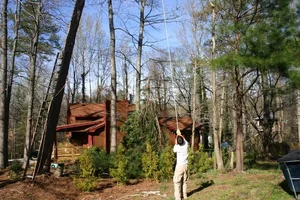
Multiple limbs lowered together

In conifer removals, I often use this rigging. Just wondered if anybody else has, and if there are reasons not to. (Of course, you must cut the bottom limb off first.) see attachment
 

Attachments

That is what I've called 'Bouquet rigging' because the limbs come down like a big brushy bouquet.

I've been doing that for a long time.

I would never rig them like you illustrated on the left side using only a round turn. The right side works better but is a real hassle to rig and untie.

An easier way to rig that is to use slings. Depending on the weight of the limbs I would use different slings. For 'beater' slings that aren't heavy I made up many slings with bowlines on each end out of chunks of climbing line that was still in good shape. As the pieces got heavier my rigging followed suit.

It is really easy to clip a biner in the sling, whip the sling around and choke it off. Then you can clip the biner to the lowering line.

There are many ways to rig the slings. My foundation for a bouguet is to set a rigging line and attache a heavy rigging ring. Several slings can be clipped into the ring. An alternative is to make the rigging rope a speed line. With some planning you can deconstruct a large lateral limb or several limbs into a nice bundle. Setting the slings with a plan and then cutting them consecutively will fold things nicely.
 
aren't the left and right sides of the illustration a before and after? the round turn becomes a half hitch?

about the only time i rig more than one conifer limb at a time is if i'm using a speedline. it usually seems more of a hassle than it's worth otherwise. i can take apart a limby fir fairly quick one limb at a time, rope zipping up and down, a rhythm gets going.
 
[ QUOTE ]
I would never rig them like you illustrated on the left side using only a round turn. The right side works better but is a real hassle to rig and untie.


[/ QUOTE ] Ithink both sides are the same set up. The right side is just loaded making the round turn become a 1/2 hitch. The key would be to make the round turn in the correct direction.
 
I used to do that alot. But I started using clove hitch on the top branches (or just use loop runners). I personally carry 6 at all times on my saddle (3 for setting lowing lines and multiple branches; 3 with double auto locks for climbin lines, or direct clip into saddle).

The reason I switched, is due to upper limbs can fall out if something catches the bottom limb and puts slack in the line. Sure it takes a bit longer to tie and untie...but it is alot safer.
 
You make good points, guys.

I might mention a couple things:
-I only use this rigging if the limbs are slightly bigger than I can hold on to with one hand, while cutting with the other.
-If the limbs are much bigger, I lower one at a time.
-I guess I'm old school, and just plain old. The idea of carrying slings and carabiners up with me just means more weight. And, although I haven't tried it, it seems more time-consuming than a series of half hitches with a running bowline on the lowest limb.
-Good point about the limbs hanging up, Bryan. Make sure the downward path is wide open. (I always cut limbs flush with the trunk as I go up, to avoid those hangups.) And I do sometimes use the clove hitch.

"Bouquet rigging" sounds good.
 
The LZ was about a 20x20x20 triangle so this was a good way to contain several limbs at once.
 

Attachments

  • 65397-IMG_4570(2).webp
    65397-IMG_4570(2).webp
    145.8 KB · Views: 234
[ QUOTE ]
In conifer removals, I often use this rigging. Just wondered if anybody else has, and if there are reasons not to.

[/ QUOTE ]

I use it quite a bit even in hardwoods but never over high value targets.
 
The round turns roll into marls-I do that with small stuff that isn't highrisk-Things I want to keep control of so the don't swing, spring and jump out toward a target. A half hitch provides a little more security. Slings are really th eticket if you have many bouquets to rig.
 
I do the multiple rigging thing, but I've always been too scared to use just a half-hitch on the inside limbs.
 
I don't see a problem with it if you can capture a branch or two outside of the hitch.
I use a rigging plate with multiple slings for multiple branches that require controlled lowering .
 
I know, it should work perfect but a part of me just refuses to trust it. Ha. Imma KRAZY...
 
[ QUOTE ]
.

I've been doing that for a long time.

I would never rig them like you illustrated on the left side using only a round turn. The right side works better but is a real hassle to rig and untie.


[/ QUOTE ]

Tom the right side and the left side are identical. The right side of the diagram is after the limbs have been cut. It's neither difficult to rig or untie.
65426-Limbcluster.jpg
 

Attachments

  • 65426-Limbcluster.webp
    65426-Limbcluster.webp
    65.7 KB · Views: 111
That technique (in TreeCo's pic) is in Jer's treework book, and I've been using it ever since I saw it there, instead of tying clove hitches (too slow)...it works great.
 
i use sling/krab sets; occasionally half hitches instead. But; i always dog the half hitch into the keeper of a branch crotch or imperfection.

Usually i cut the bottom limb first. Sometimes i'll place sling around bottom limb and on harder limb over it. Then jsut tie rig line further out on harder limb; tension rig line well. Cut lower limb to give more weight at whatever distance from/behind rigging line hitch on harder/2nd limb. This, gives more leveraged ballast on stob end to keep green end up higher/ give more float; especially when swing it around, and trying to keep it high enough to sweep out from over obstachle below.

Another technique, is to run rig line more horizontal, to try to get limb over roof to sweep off sideways. If that seems chancey/ might not come sideways enough before tipping down you can try ballast technique above; but what if no limb under to cut first for more ballast? Then, i really tighten line well; and find another limb along the way between rigging point and tricky load to move sideways off roof etc. i place sling on the 2nd/helper limb and clip to rig line near center of trickier load (ast end of rig) and rig point or so. Then give face to trickier limb; and back cut almost to failure. Quickly remove saw and go to 2nd/helper limb (that can be partially pre-cut too); and quickly cut it off; slamming it into tighened horizontal line to leverage line hard. This multiplies the sidewards pull of the rig line on the trickier limb, to hopefully flex it's hinge and pull it around sideways (if precut right).

If i can't get a near horizontal run from rig point to end of line/trickier limb; A) the leveraged force willnot be as much B) the helper limb may run down to the trickier limb and possibly make things worse. So then i place butterfly at about halfway point between rig point and trickier limb. Also pretighten rig line even harder, possibly heavier helper limb. For the leverge multiplier is going to Horizontal angle X line tension X helper weight. As i give up some horizontal angle; i logically have to increase line tension or load wieght multipliers for same effect.

This works on perpendicular force applied to a tight line to leverage line to higher tension. So, jsut as i may use a zrig as a tie down; i will only use that to stiffen line/ to make it resist bending(resistance to bending gives leverage when perpendicualr/ non-inline is applied). Then bend lines of z, to get my real/ high leveraged tightening. i use this to pretighten the line (tighten with inline force, then Brion Toss's line sweating descriptions to tighten more) in pretensioning; then hit that tighter line with horizontal force from helper limb.
 
[ QUOTE ]
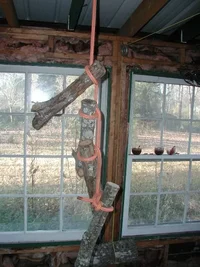
This technique doesn't leave the limbs looking like a "bouquet" because the limbs are not in a group


[/ QUOTE ]

TreeCo, those pieces of timber would look like a 'bouquet' if there were leaves and twigs on them.

Try to imagine it.

And finish that wall off! I can still see the insulating foam!
Nice windows though
 
Whew...there is no way that I would use the setup that Treeco shows in his picture. Unless I'm missing something it looks like the rope could spill with only a little jiggle and the branch would go airborne.

slings are so easy to use and rack on your harness. Or...sling them like the rock jocks bandolier style.
 
Tom I didn't think you were talking about the same technique as olman60. I'm pretty sure my photo is what he has drawn in his diagram. I've used pieces of firewood for demostration but the technique is for talking limbs 10 or 15ft. long or longer.

Slings are great and I use them more often than I use this technique. This is still a great technique and can be faster and easier than slings. Plus it is great fun!

It's surprising how well the limbs are captured. I wouldn't use it over high value targets but over landscape plants, lawn you don't want to damage, etc. it works quite well. I have never taken limbs over 3" in diameter this way.

Let's say you are taking three limbs in one lowering. Start at your highest limb and make your wrap making sure the working end of the rope is always towards the trunk. Ditto for the second limb. On the third limb place your regular rigging knot. Cut the lowest limb first, then the second limb, and last the top limb. The bull rope must be kept tight for all three cuts. Loads can never be dropped into this rigging and the lowering point must always be equal in height or higher than the rigged limbs.

It must be a clear run to the ground because any hang up will likely result in a loose limb.
 

New threads New posts

Back
Top Bottom