Monday's Job

Location
Seattle
Monday\'s Job

Here's another one of those day-in-the-life stories of an arborist. If this is too boring for some, what did you do yesterday?

urbantreecare1a.jpg

Here's a job that involves removal of 5 Douglas fir trees, 75-80' tall, in a narrow back
yard. The only limb lowering necessary was over a high wall to the rear of the property.

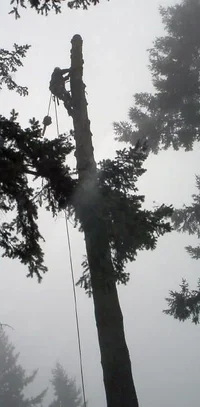
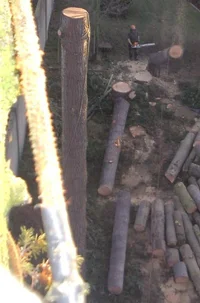
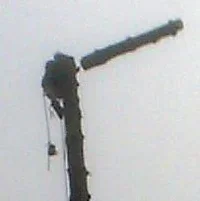
Here's Jeff up on the stick he is chunking down. After this tree, he became a ground
man for the rest of the job. Jeff has a small but clear lawn strip to drop the pieces on,
and it ended up looking like the cratered surface of Mars. So much for collateral
damage. The yard is to be re-landscaped. The tough part of this job was bringing the
wood out to the front and loading it up in the trucks.

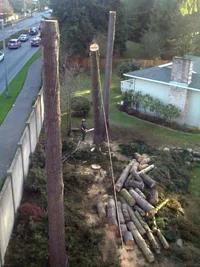
I did the other 4 trees, and have already stripped the brush off, and come down out of
the tree by the chimney. There is room to drop all the trees when they are this height,
and we left pull ropes hanging in them to control their fall. My first tree was located
more in the center of the lawn strip, and did not involve lowering any brush. Later, this
tree became an obstacle to the sections of wood that were dropped from the two trees
on the right. In a later picture, you'll see how it became a stump so that the wood did
not hit it and bounce over the
back wall out into the street.

The lot slopes upwards from front to rear. Notice how low the street grade is. The
house sits up higher, and the rear lawn is on a third terrace up. It was good for
dragging armloads of brush out downhill along the left side of the house. It was bad for
dropping logs, because there was the distinct possibility of hitting the terrace bank and
catapulting wood down into the back wall of the house. The soft lawn allowed the
pieces to embed themselves in the dirt and generally stay put. The only work that
bounced off this stump was the last piece off the large tree to the right. It gave us a
thrill when it flipped, but by then, much wood was piled up as a barrier, just above the
bank, where it came to rest.

The next pic in the series will have to be downloaded, as it is not online.
 

Attachments

  • 2900-UrbanTreeCare7.webp
    2900-UrbanTreeCare7.webp
    3.9 KB · Views: 106
Re: Monday\'s Job

Hope you clicked on 'Attachment' at the top of that last page, as that was a two-for-one post. Pic 3 is at the top of this page.

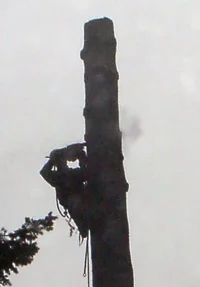
Jeff is making his wood go right where he wants it. I didn't realize it at the time, but he is using an undercut only, instead of a wedge-shaped face cut. It's actually a snap cut, facing the intended direction of fall. He calls it a jump cut, which to me would mean the backcut is below the undercut. In a minute, you'll see him get into trouble with a piece that doesn't want to tip.
 

Attachments

  • 2901-UrbanTreeCare5.webp
    2901-UrbanTreeCare5.webp
    29.1 KB · Views: 117
Re: Monday\'s Job

The piece is stuck. Jeff has been pushing from slightly off to one side, to make sure it doesn't go over the wall to his left. Jeffrey, the boss who is on the ground with me watching Jeff struggle up in the tree, thinks his flipline needs to be shortened up, as it has been moved to the hip dees. Jeff ends up undercutting a thin, partial-depth slice from the leading lip of the face. This involves taking his hands off the work while it is cut up, a dicey 3 minute time-lag. When he puts his weight behind it, it finally goes, to everyone's relief. We offer a tag line to help pull them over, but are politely waved off. Seeing as it is my first & only day on this crew, it's not my place to press the issue.
 

Attachments

  • 2902-UrbanTreeCare6.webp
    2902-UrbanTreeCare6.webp
    12.2 KB · Views: 117
Re: Monday\'s Job

Thanks for the memories, Ox. I have a thumb that cracks and bleeds on dry, cold days from the scar tissue. I was doing about the same thing 8 years ago and couldn't push the piece over. I accidentally pushed the bottom out and the top of the log came back at me. The log smashed my thumb against the top of the spar and bounced off my shoulder. I no longer chunk down pine logs taller than I am. I take smaller pieces or put a notch and tagline in them.
 
Re: Monday\'s Job

Now Jeff has a rhythm going, and the rest of the lower pieces come off without a hitch.

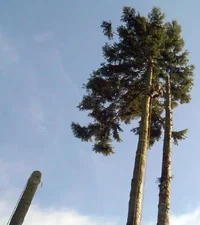
The morning fog has burned away, and it's turned into a great day to be alive. Ox is in the top of the clump of two firs at the right side of the yard, and the pieces are going where they need to. The lower limbs on the left side of this pic need to be lowered, due to a nice dogwood tree at the base of the wall. Hardly any ropework was done on the smaller stem, as the size of the limbs allowed them to be handled.

This is probably a good time (the boring part) to discuss the properties of breaking Doug fir limbs that are tip-heavy. The tendency is for them to snap off suddenly when the saw is applied to the top of the limb. This is due to the close spacing of the annual growth rings just underneath the bark covering the upper portion of the limb. This is called tensionwood, and it actually suspends the limb horizontally. Klaus Mattheck addresses this phenomenon in his elegant book about Visual Tree Assessment called
stupsi%20book%20cover.jpg
Stupsi Explains the Tree

The point is, and this has not been published anywhere that I know of, that the limb can be released gradually by pushing upward while making the top cut. This even works for very heavy, long limbs, which can be controlled to fall into a drop zone well away from underneath the position of the limb. The flipline must be almost an arms length below the whorl of the limb being cut, allowing the climber to straight-arm the limb directly over his head. Pushing up hard while cutting from the top down lets the weight off gradually. A lot less lowering is needed after using this limbing technique.
 

Attachments

  • 2906-UrbanTreeCare1.webp
    2906-UrbanTreeCare1.webp
    32.6 KB · Views: 108
Re: Monday\'s Job

About halfway thru the day, my buddy Jeffrey is dropping the large tree on the right side of the yard. This tree was the biggest of all, and the nice little obstacle Dogwood underneath can be clearly seen as something desirable.

The reason I took this pic from the treetop? Jeffrey is falling it to retrieve the pull rope, so we can use it to lower limbs, for we used up all his spare ropes to hang for the subsequent falling process. The brush had to go out first, then the sticks can come down. It would have been nice to have an additional bull line, so this stick could have been left until the pitchforking was done. Notice the stump that the tree is about to land on. No problemo. The stick didn't bounce off it.

Jeffrey has an unconventional felling procedure himself. He makes a healthy backcut mark first, then proceeds to put in the face. The face is lined up with this backcut, then the tree is fell. I'm still learning, cause it was a new one on me. Seeing this out of sequence operation surprised me, as Jeffrey is an Arbormaster graduate. Been doin' it this way for years.

Notice that cute little 15' high concrete sound wall that separates the roadway corridor from the residential neighborhood. We wouldn't want any 25' long fir limbs out in that street, now, would we?

The pics of this 4-person job deserve to have their story told in detail. They seem to encapsulate the scope of the project: See it and weep. My calves are a bit crampy, but then the residuals from standing in the spurs all day are fairly minor. It was only yesterday, but seems like a hundred years ago.
 

Attachments

  • 2907-UrbanTreeCare2.webp
    2907-UrbanTreeCare2.webp
    55.5 KB · Views: 120
Re: Monday\'s Job

Another one bites the dust.

Actually, this smaller tree had the long lowering line we needed. The tree being fell in the previous pic had a short tag line, and was in the way of getting the only long bull rope available.

All this falling was while I was waiting up in the last tree. We had been swapping ends of a short bull line, with me handling the rope, but soon that became too short, as well.

For lots of folks, this is just a refresher, having done it hundreds of times yourselves. Hopefully, the photo-essay can bring out the ingenuity in us all. Each of these moves seemed logical at the time, but I'm not sure they could have been plotted out ahead of time. This is the design of dynamic rigging systems, on the fly. Some would call it engineering.
 

Attachments

  • 2908-UrbanTreeCare3.webp
    2908-UrbanTreeCare3.webp
    43.4 KB · Views: 103
Re: Monday\'s Job

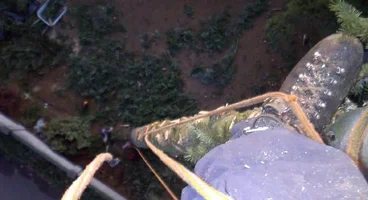
Looking straight down that last stem. Jeffrey is letting me know that it is to be left standing until the following day. "Come on down!" I heard that!

This will let them haul out all the duff without having a bunch of blocks in the way. This tree was closest to the back gate. Of course, my blocks are 8-10' long, and not that easy to roll out of the way for the next piece.

On to the next job!
 

Attachments

  • 2909-UrbanTreeCare4.webp
    2909-UrbanTreeCare4.webp
    30.5 KB · Views: 98
Re: Monday\'s Job

I don't know, probably fiberglass, for weight. They're the biggest ones I could find. Scarpa SL backpacking boots in size 15 extra wide are hard to come by. Especially if you show up to work the jamboree in wingtips.
 

New threads New posts

Back
Top Bottom