
Oh yeah YoYo, the op replacement prussic for the CE lanyard is 30", which is standard. Treestuff sells a 24" HRC and a 24" samson ultratech which would make a great lanyard prussic. Just got the HRC one and it is really nice, am going to be using them to climb on the wrench too. Well I will try it and see how it performs.

Navigation
Install the app
How to install the app on iOS
Follow along with the video below to see how to install our site as a web app on your home screen.
Note: This feature may not be available in some browsers.
More options
You are using an out of date browser. It may not display this or other websites correctly.
You should upgrade or use an alternative browser.
You should upgrade or use an alternative browser.
Micro pulley for lanyard adjuster.
- Thread starter 02SVT
- Start date

Treespotter
New member
- Location
- Houten, The Netherlands


- Location
- Retired in Minneapolis
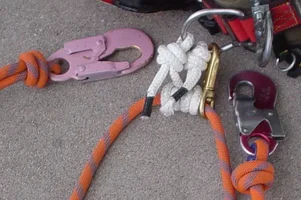
For a long time I used a brass swivel snap for a lanyard and climbing hitch slack tender. The piece isn't very glamorous or sexy though but it is cheap and functional.
This is an example of how I used it on a lanyard. it would work the same for my climbing hitch. The eye would go between the terminations of my hitch cord on an HMS biner and the snap would go below my hitch.
This is an example of how I used it on a lanyard. it would work the same for my climbing hitch. The eye would go between the terminations of my hitch cord on an HMS biner and the snap would go below my hitch.
Attachments
[ QUOTE ]
[ QUOTE ]
Yoyo~ I've never seen a HC pulley in that orientation. Quite interesting. Have you tried it with the prusik/biner in the lowest hole?
[/ QUOTE ]
Thanks Oceans...
Without the dog leash snap? Yes, but as with the fixed plate pulley, I don't get to keep everything I pull thru the pulley. (video in prior post) I suppose a much shorter e2e like the one they have on the CE lanyard would also be a solution.
If you mean using the lowest hole or the hole to the right (in my photo) of the HC pulley.......I just tried that and it is an improvement. It gets the pulley that much closer to the hitch and seems to stay in place between pulls.
ANOTHER GREAT SUGGESTION, THANKS.

[/ QUOTE ]
Whats the advantage? Why not use a single eye pulley? That seems to waste the function of a hitch climber. You've essentially rendered the other termination eyes of the HC ineffective because it can no longer be considered life support due to the dogsnap.
Id take that back to the drawing board!
[ QUOTE ]
Yoyo~ I've never seen a HC pulley in that orientation. Quite interesting. Have you tried it with the prusik/biner in the lowest hole?
[/ QUOTE ]
Thanks Oceans...
Without the dog leash snap? Yes, but as with the fixed plate pulley, I don't get to keep everything I pull thru the pulley. (video in prior post) I suppose a much shorter e2e like the one they have on the CE lanyard would also be a solution.
If you mean using the lowest hole or the hole to the right (in my photo) of the HC pulley.......I just tried that and it is an improvement. It gets the pulley that much closer to the hitch and seems to stay in place between pulls.
ANOTHER GREAT SUGGESTION, THANKS.
[/ QUOTE ]
Whats the advantage? Why not use a single eye pulley? That seems to waste the function of a hitch climber. You've essentially rendered the other termination eyes of the HC ineffective because it can no longer be considered life support due to the dogsnap.
Id take that back to the drawing board!

Richard Mumford-yoyoman
Been here a while
- Location
- Atlanta GA
[ QUOTE ]
Whats the advantage? Why not use a single eye pulley? That seems to waste the function of a hitch climber. You've essentially rendered the other termination eyes of the HC ineffective because it can no longer be considered life support due to the dogsnap.
Id take that back to the drawing board!
[/ QUOTE ]
Let me try to explain how the "drawing board" got me to this point in the lanyard. I'm really liking it by the way.
Once I ascend into the tree I use two lanyards for working my way up thru the limbs. The HC pulley simply tends the slack on my lanyard and in this configuration I find that it does so with great efficiency. Because the snap puts the pulley in just the right place to capture almost 100% of my rope pull.
When I used a pinto type pulley on the carabiner, I would pull up say 8" and settle back down on just 4" of it. Meanwhile the HC pulley was just being carried or left on the tail of my climbing line.
So now with this setup, when I am ready to leave the lanyard and continue with the climbing line, I just take the HC pulley off the snap, leaving the hitch and carabiner in place, then I put the HC pulley on my climbing line where I have the hitch and carabiner, and use the HC pulley in whatever configuration is needed such as the "V rig" or "M rig" or all those other multifunction uses that I am learning about.
Also, for me, on the lanyard, I have found that the Michoacàn hitch is the smoothest and surest and most compact.
Another note, in this configuration, I don't think the snap is really part of the life support function, only tends slack on the lanyard so the integrity and life support of the lanyard, the e2e and carabiner are intact.
I hope that makes sense and I really appreciate the input. It is a learning process and a progression that I am sure is ever changing and what works for one may not work for another but only by seeing and learning from others am I able to move forward.
Thanks
Whats the advantage? Why not use a single eye pulley? That seems to waste the function of a hitch climber. You've essentially rendered the other termination eyes of the HC ineffective because it can no longer be considered life support due to the dogsnap.
Id take that back to the drawing board!
[/ QUOTE ]
Let me try to explain how the "drawing board" got me to this point in the lanyard. I'm really liking it by the way.
Once I ascend into the tree I use two lanyards for working my way up thru the limbs. The HC pulley simply tends the slack on my lanyard and in this configuration I find that it does so with great efficiency. Because the snap puts the pulley in just the right place to capture almost 100% of my rope pull.
When I used a pinto type pulley on the carabiner, I would pull up say 8" and settle back down on just 4" of it. Meanwhile the HC pulley was just being carried or left on the tail of my climbing line.
So now with this setup, when I am ready to leave the lanyard and continue with the climbing line, I just take the HC pulley off the snap, leaving the hitch and carabiner in place, then I put the HC pulley on my climbing line where I have the hitch and carabiner, and use the HC pulley in whatever configuration is needed such as the "V rig" or "M rig" or all those other multifunction uses that I am learning about.
Also, for me, on the lanyard, I have found that the Michoacàn hitch is the smoothest and surest and most compact.
Another note, in this configuration, I don't think the snap is really part of the life support function, only tends slack on the lanyard so the integrity and life support of the lanyard, the e2e and carabiner are intact.
I hope that makes sense and I really appreciate the input. It is a learning process and a progression that I am sure is ever changing and what works for one may not work for another but only by seeing and learning from others am I able to move forward.
Thanks

SRTsteve860
New member
- Location
- North West Connecticut
[ QUOTE ]
Another note, in this configuration, I don't think the snap is really part of the life support function, only tends slack on the lanyard so the integrity and life support of the lanyard, the e2e and carabiner are intact.
[/ QUOTE ]
This is the exact point that tophopper was making. If you had your HC threaded onto your 'biner then you have access to the other 2 holes on it for life support functions (whatever they may be depending on situation) In the arrangement you have, you are unable to make use of those two oh-so-useful attachment points on the pulley just because the snap is preventing it from being safe for life support.
But with reference to this set up being temporary and used with the double lanyard technique it has its benefits of being able to remove the pulley without opening the biner (which seems to be your primary life support at the time), having to remove an eye of your prussik, so you can un-thread the pulley.
As you accumulate more equipment you will eventually have a micro pulley for your climb line, and one for your lanyard, so the need for switching over equipment is not necessary.
Another note, in this configuration, I don't think the snap is really part of the life support function, only tends slack on the lanyard so the integrity and life support of the lanyard, the e2e and carabiner are intact.
[/ QUOTE ]
This is the exact point that tophopper was making. If you had your HC threaded onto your 'biner then you have access to the other 2 holes on it for life support functions (whatever they may be depending on situation) In the arrangement you have, you are unable to make use of those two oh-so-useful attachment points on the pulley just because the snap is preventing it from being safe for life support.
But with reference to this set up being temporary and used with the double lanyard technique it has its benefits of being able to remove the pulley without opening the biner (which seems to be your primary life support at the time), having to remove an eye of your prussik, so you can un-thread the pulley.
As you accumulate more equipment you will eventually have a micro pulley for your climb line, and one for your lanyard, so the need for switching over equipment is not necessary.

Treespotter
New member
- Location
- Houten, The Netherlands
[ QUOTE ]
Its the shiz!.lol..no, have not tryed it but looking at the specs its,
not load bearing
not rated
not PPE
I wonder why there's no spec on this, WLL?
[/ QUOTE ]
????
Just take a good look at the place where you use it!
Why do you want to know the load bearing, why would you need it rated, why do you want that to be PPE.
There is NO work load on it when in use.
The Rope Slider is in no way interfering with the grabbing capacity of your hitch. The only thing it does is super smoothly directing your flip line in a straight line to and from the hitch and releasing the hitch when pulling the tail.
The item is not developed nor intended for load bearing. It's developed for hitch assistance.
Its the shiz!.lol..no, have not tryed it but looking at the specs its,
not load bearing
not rated
not PPE
I wonder why there's no spec on this, WLL?
[/ QUOTE ]
????
Just take a good look at the place where you use it!
Why do you want to know the load bearing, why would you need it rated, why do you want that to be PPE.
There is NO work load on it when in use.
The Rope Slider is in no way interfering with the grabbing capacity of your hitch. The only thing it does is super smoothly directing your flip line in a straight line to and from the hitch and releasing the hitch when pulling the tail.
The item is not developed nor intended for load bearing. It's developed for hitch assistance.

macswan
Been here a while
- Location
- Champlain Valley, VT
they look slick, next order i'm definately throwin one on.

New threads New posts
-
test
-
-

-
 Alternatives to standard asphalt around roots
- Started by southsoundtree
- Replies: 14
-
-

-

