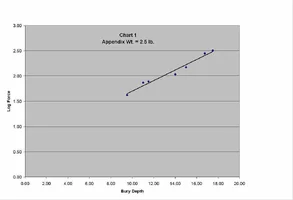
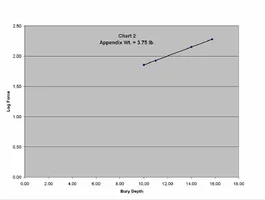
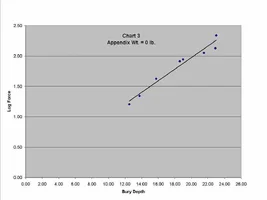
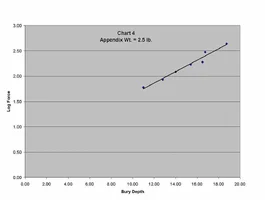
The purpose of this set of experiments was to uncover the relationship between bury length and splice holding force in hollow-braid rope. This is an interesting problem in itself, but could be of real use to people who make their own splices or use loopie slings.
The rope used in these experiments was 5/16-inch Tenex Tec from Samson. I chose this polyester hollow braid because it is hands down the easiest rope to splice I have yet discovered.
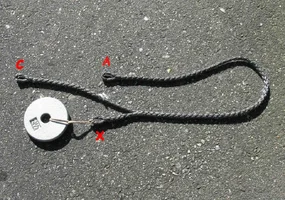
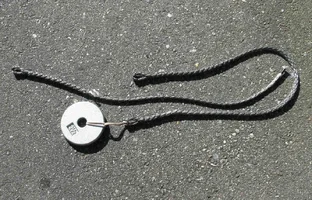
The attached photo illustrates the experimental design. The eye-and-eye sling from X to A is the "cover" of the "splice", and an entirely separate rope with the eye marked "C" is the "core."
Each experiment consisted of inserting the core to a measured depth, milking all the slack out of the splice, then mounting everything vertically. Eye A is at the top, attached to a load cell. Eye C is anchored at the bottom, while the appendix, X, hangs freely. Above the load cell is a pulley that allows the pull to be applied from the top. An experiment consists of increasing tension until the splice slips, then reading the maximum force registered by the load cell.
The rope used in these experiments was 5/16-inch Tenex Tec from Samson. I chose this polyester hollow braid because it is hands down the easiest rope to splice I have yet discovered.
The attached photo illustrates the experimental design. The eye-and-eye sling from X to A is the "cover" of the "splice", and an entirely separate rope with the eye marked "C" is the "core."
Each experiment consisted of inserting the core to a measured depth, milking all the slack out of the splice, then mounting everything vertically. Eye A is at the top, attached to a load cell. Eye C is anchored at the bottom, while the appendix, X, hangs freely. Above the load cell is a pulley that allows the pull to be applied from the top. An experiment consists of increasing tension until the splice slips, then reading the maximum force registered by the load cell.