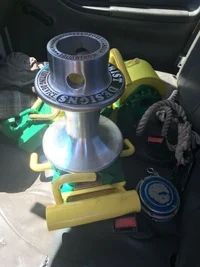
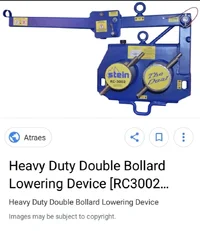
Lowering Device - VTT LD2

MikePowers321

Carpal tunnel level member
Location
Leeds, Ny
I had never seen this device before. Just figured I'd share this as I ran into it by accident. Pretty decent price point being shipped free from Russia.

MBS 70 KN
WLL 14 KN

https://www.ebay.com/itm/VTT-LD2-ar...780459?hash=item1cb260eb6b:g:GlYAAOSwKJhbS0HB

s-l1600.jpg
 
20180917_204736.webp

Looks like they borrowed Reg's old design. I believe he has now switched to the winch on his double bollard design. It doesn't look as beefy as the Stein, but doesn't come with the price point either.
 
I was hoping we could maintain polite conversation,
by not just tossing around the T word and such.
.
I believe all these lengthwise pulls up a usual receding taper (here the swell above device is favorable) should have DOUBLE BEARING support mount on the trunk.
.
I think of a Timber, choke thru single eye sling or single web drawn tight as SINGLE BEARING.
>>Pulled straight out perpendicular to tree so inline with best Nip as stop is mechanically proper inline like properly shown for Timber.
>>But, pulled crosswise to this line, lengthwise to trunk is not inline, if dragging would convert to Killick for this reason.
>>I think of SINGLE BEARING as like a hinging potential to then start a slide upward into receding taper encouraging slide to continue upward.
.
vs.
.
DOUBLE BEARING of Cow based , or standard roundsling choke or dual spaced straps
>> Whereby can imagine turn on load side of same lengthwise pull being hinge
>> Next turn below 'pinning' against the hinge mechanic, against making the rotation upward arc of longer distance than first turn towards loading especially if gripper teeth being made to dig on top side by top hinging 'bearing' on the support.
.
I try to always find a cross comparisons in rigid devices to contrast/define better the flexible support mechanic trying to define and validate
My rigid model here is first nail or bolt fastens to wall etc. but still allows spin rotation, but second bolt or nail stops all adjustment, and is pin to lock against hinge rotation effect.
So name similarly in rope.
>>only 'linear hinging' of rope length inline side to side vs. rigid device rotation non length change type similar hinge mechanic.
.
Ashley warned that lengthwise pulls are riskiest and the impossible not be expected. Dedicates a lone chapter to this.
Few tons of sudden impact on tapered trunk and hinging effect model playing out might be what he warned of, at least closer than I'd like to go when just another well placed turn could totally change L.U.C.K. (Labor Under Controlled Knowledge ) immediately!
 
I was hoping we could maintain polite conversation,
by not just tossing around the T word and such.
.
I believe all these lengthwise pulls up a usual receding taper (here the swell above device is favorable) should have DOUBLE BEARING support mount on the trunk.
.
I think of a Timber, choke thru single eye sling or single web drawn tight as SINGLE BEARING.
>>Pulled straight out perpendicular to tree so inline with best Nip as stop is mechanically proper inline like properly shown for Timber.
>>But, pulled crosswise to this line, lengthwise to trunk is not inline, if dragging would convert to Killick for this reason.
>>I think of SINGLE BEARING as like a hinging potential to then start a slide upward into receding taper encouraging slide to continue upward.
.
vs.
.
DOUBLE BEARING of Cow based , or standard roundsling choke or dual spaced straps
>> Whereby can imagine turn on load side of same lengthwise pull being hinge
>> Next turn below 'pinning' against the hinge mechanic, against making the rotation upward arc of longer distance than first turn towards loading especially if gripper teeth being made to dig on top side by top hinging 'bearing' on the support.
.
I try to always find a cross comparisons in rigid devices to contrast/define better the flexible support mechanic trying to define and validate
My rigid model here is first nail or bolt fastens to wall etc. but still allows spin rotation, but second bolt or nail stops all adjustment, and is pin to lock against hinge rotation effect.
So name similarly in rope.
>>only 'linear hinging' of rope length inline side to side vs. rigid device rotation non length change type similar hinge mechanic.
.
Ashley warned that lengthwise pulls are riskiest and the impossible not be expected. Dedicates a lone chapter to this.
Few tons of sudden impact on tapered trunk and hinging effect model playing out might be what he warned of, at least closer than I'd like to go when just another well placed turn could totally change L.U.C.K. (Labor Under Controlled Knowledge ) immediately!

Oh come now.. they have to do sumthin with all dat recycled steel coming out of Chernobyl.
 
I was hoping we could maintain polite conversation,
by not just tossing around the T word and such.
.
I believe all these lengthwise pulls up a usual receding taper (here the swell above device is favorable) should have DOUBLE BEARING support mount on the trunk.
.
I think of a Timber, choke thru single eye sling or single web drawn tight as SINGLE BEARING.
>>Pulled straight out perpendicular to tree so inline with best Nip as stop is mechanically proper inline like properly shown for Timber.
>>But, pulled crosswise to this line, lengthwise to trunk is not inline, if dragging would convert to Killick for this reason.
>>I think of SINGLE BEARING as like a hinging potential to then start a slide upward into receding taper encouraging slide to continue upward.
.
vs.
.
DOUBLE BEARING of Cow based , or standard roundsling choke or dual spaced straps
>> Whereby can imagine turn on load side of same lengthwise pull being hinge
>> Next turn below 'pinning' against the hinge mechanic, against making the rotation upward arc of longer distance than first turn towards loading especially if gripper teeth being made to dig on top side by top hinging 'bearing' on the support.
.
I try to always find a cross comparisons in rigid devices to contrast/define better the flexible support mechanic trying to define and validate
My rigid model here is first nail or bolt fastens to wall etc. but still allows spin rotation, but second bolt or nail stops all adjustment, and is pin to lock against hinge rotation effect.
So name similarly in rope.
>>only 'linear hinging' of rope length inline side to side vs. rigid device rotation non length change type similar hinge mechanic.
.
Ashley warned that lengthwise pulls are riskiest and the impossible not be expected. Dedicates a lone chapter to this.
Few tons of sudden impact on tapered trunk and hinging effect model playing out might be what he warned of, at least closer than I'd like to go when just another well placed turn could totally change L.U.C.K. (Labor Under Controlled Knowledge ) immediately!

What the what?
 
Interesting point about the advantage of using two straps. I've wondered if the rotational forces that can happen, would weaken the strap quicker. This rotating and the upward pull would seem to work together to dislodge the device and shoot it up the trunk.
 
What in the absolute wall of brain-crushing text did I attempt to decipher
.
Sorry, just trying to show again this is all geometry, and the simple violations there of.
.
Whenever trying to get support against a pull (or push) seek to have a STRAIGHT support column between endpoints of input force and controlling stop as a basic precept.
(remaining column percentage at angle is simply cosine, i think of as columnSine;
while see side forces as the sin(e) percentage of total force/distance against this this target columnSine)
.
Massive pulls by Porty etc. perpendicular to support column /parallel to trunk thus are already SEVERELY compromised and "Double Bearing" (thought i got that term from TreeBuzz) is at least called for.
.
inline-for-support-architecture-angled-for-shearing-forces.png

.
As an aggravating condition most trunks are not neutral, but taper in to invite more slip to Porty mount; vid does show widening taper upward that could help reduce , not urge slip effect.
.
Knot break strength, support pull, nip etc. are virtually ALL studies in assuming each leg of support as pristine strength, compromised by geometries as have tried to show.
.
Plural supports ALWAYS give properties over and above solo supports.
>>Climber's friction hitch seizes on solo SRT rope column of support
>>Climber's friction hitch can operate slide in plural DdRT rope support columns.
DdRT allows climber weight as load to switch over instantly to solid leg if expanding dynamic side/leg of DdRT, just like if separate rope was tearing apart, the buddy line(s) instantly try to take load. SRT has no buddy lines to take load, so hitch clamps tighter and doesn't want to slide.
>>Similar buddy systems in ALL plural supports.
.
work time.....

 

New threads New posts

Kask Stihl NORTHEASTERN Arborists Wesspur TreeStuff.com Teufelberger Westminster X-Rigging Teufelberger
Back
Top Bottom