Long Locked Brummel

SingleJack

Participating member
Location
W MD
I'm needing some splice advice ... that is, a critical review of an idea:

I'm working on combining two tethers into one using a variation of the locked brummel. Simply put, I've extended the 'pass-throughs' so as to create a two interlocking buries. The goal is that either 'tail' of the long locked brummel can be loaded individually or together.

Here's a gif of the concept:

294148-LONGLOCKBRUMMEL2.gif


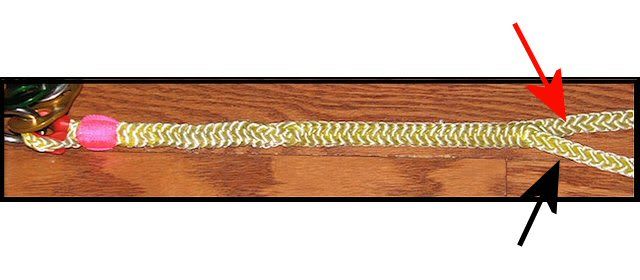
Here's a photo of the prototype:

6164110861_0dc2078161_z.jpg


It does seem to work quite well. And, it neatly eliminates the clutter of two tethers. I'm hoping to get some evaluations of the concept - crazy versus not-so-crazy.

 

Attachments

  • 294148-LONGLOCKBRUMMEL2.gif
    294148-LONGLOCKBRUMMEL2.gif
    72.3 KB · Views: 58
[ QUOTE ]
Very interesting. Would like to see what it breaks out at.

[/ QUOTE ]
I think I know the answer, and the answer depends on which leg is loaded. In the photo the black arrow points at the core leg and the red arrow at the cover leg. No matter which leg is loaded, in the eye at the left the two legs are equally loaded. There is a progressive transfer of load from one leg to the other from the right side to the left side of the diagram for this to happen, the normal behavior of a splice.

jack.jpg


Of the two legs, the core leg can take more load, right up to the full rated strength of the rope, because it is not distorted or disturbed at all at the right side of the diagram where it is under full load. The cover leg, (red arrow), on the other hand, has a big hole in it where the core emerges. This absolutely and unavoidably weakens the rope at that point. I have measured this a couple of times for Tenex Tec. Both times the reduction in strength was about 10%.

This hole-in-the-rope weakening of the rope also applies to the weaves of a Brummel, locked or not, but it doesn't matter. Both legs of the rope in the Brummel area are carrying load, and weakening either one (or even both!) by 10% still leaves you with far more than the strength of a single leg.

Jack, why are you fooling aroung with the long Brummel? Why not a normal short one? Or none at all? If you have a normal length bury with good stitching you can load either leg with no fear the eye will slip apart.
 
[ QUOTE ]
...
Jack, why are you fooling aroung with the long Brummel? Why not a normal short one? Or none at all? If you have a normal length bury with good stitching you can load either leg with no fear the eye will slip apart.

[/ QUOTE ]

Well, great! That's the kind of informed advice I was after. That'll be a lot easier and cleaner.
 
Nick makes a good point about the possibility of a collapsing eye, and his proposed solution would solve it. This possibility arises if you load the core strand--there is nothing putting tension into the cover so it does not grab the core. In a normal splice, stitching at the throat guarantees the cover will be loaded and therefore the cover and core will lock together. But that is not the case here.

Your oddball structure is in some ways the reverse of a normal eye splice. To make sure the cover is always in tension, regardless of whether you incorporate Brummels or not, the stitching should be at the opposite end of the splice from the eye! If you load the cover leg--no problem--the splice operates in the normal fashion. In this case the stitching is superfluous.

But imagine you are slowly adding load to the core leg. Both legs of the eye become loaded, and the stitching guarantees nothing comes apart. Since there is tension in the cover for its full length, it is clamping down on the core for its full length, creating friction between the core and cover. The splice is working. The stitching becomes a minor part of the force holding everything together as the load increases, but it is essential to get the thing to work.

If you imagine a normal eye splice where somehow the entire load ends up on just the core leg of the eye, that situation is very similar to the structure you propose (though I didn't recognize it at first). I have tested that structure a number of times because I used to worry about it, and with good stitching and a normal length bury the splice holds right up to the breaking strength of the rope.
 

New threads New posts

Back
Top Bottom