*useless info*
Participating member
- Location
- usa
From gymnastics i had this whole internalized concept of ushering force thru different pathways of body and other devices to capitalize on different effected returns...
Since a teen, i had a number of separate power tricks to keep up with bigger guys(everyone else!).
Sitting in DdRT years later; helped me define them as all the same concept over and over tho!
Once distilled this pivotal concept out from the different applications, could then drop it into spice up recipe of other things. GAME ON!
Also a few pivotal concepts are easier to remember,but then control so much more!
>>so i don't ache to remember a pile of usages, just the bare principle if i can connive the shituation into a usable pattern for these concepts.
.
Pulling self up in DdRT applies effort + equal/opposite reaction of effort against bodyweight
>>for 2xEffort against bodyweight. In old B&W movies might see as a 'dumb waiter' or similar in Tarzan jungles etc.!
.
But setting bodyweight against load, then enforcing the same 2xEffort against load takes this a step further; and is what i was doing all along!
It can also make a 5x effort rig an8xEffort + 5xBodyweight just by placing self in scenario differently!!!
Can hold 'purchase' of tension in rig with the 2xEffort part of input, then then IMPACT with bodyweight!
In climbing/rigging can get 1xEffort inserted between load and support frictions!
>>then back that up with 1xEffort + bodyweight after frictions
>>can make a big difference especially when using leg instead of arm for effort input into system
.

.
All you need is a 1st class lever position of pivot between input and output.
1st class lever simply means input/output move in different directions.
>>Because pivot is between input/output like see saw, or pulley hanging from branch.
So if bodyweight force wrong direction to set against load
>>reverse direction of bodyweight to then pull on load by 1st class lever
set effort to pull on both sides of pivot for 2xEffort
>>your effort + it's promised equal and opposite.
Essentially can picture instead using a see-saw as a lever to lift
>>sit on 1side and lift loaded side>>directly gives 1x against load
and see saw feeds bodyweight and equal/opposite of effort from your side to pull against load also.
.
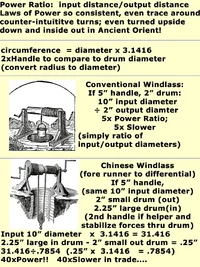
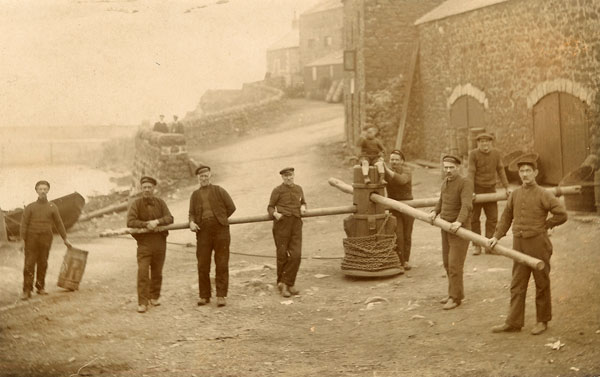
In the above picture, the 3 bottom examples:
note how the red/blue gloves move opposite directions
AND CENTER OF CIRCLE OF 4WAY, SPAR, LOG IS THE NEEDED PIVOT!
Can find CoG as pivot and load in similar scenarios
Can see martial arts moves similarily in this...
.
No real magic tho, just conservation of all forces to fold back against target
especially by using bodyweight and equal and opposite of effort that always exist, but seldom employed so!
.
Can also 'inset' a pulley system inside of another so that the inner system doesn't pull on an anchor on 1 end first,but rather make that usual 'waste' of force pull into the system also.
'CONSERVING' the usual 'wasted' equal and opposite reaction and putting it to work on target!
.
i think that is exactly what unspokenly was said here in this old drawing:

.
Note how the upside down 2:1 rig on the 5:1 would compound to 10:1 ;
BUT placing that high friction hitch to pull in the system instantly makes this a 13:1 !
W/O ADDING FRICTIONS ! Tapping free force that was always there!
Making forces that usually pull outside system to anchor
>>instead fold back into conserve those forces into system against load.
.
BUT: hang on blue arrow
pull up on blue circle
Gives 4xEffort at each end of smaller now 'inset' rig
+3xBodyweight to top of smaller rig
+2xBodyweight to bottom of smaller rig
.
So we feed 4xEffort + 2xBodyweight to bottom of smaller rig into the 5:1 !!
it is then joined at the top by 4xEffort +3xBodyweight to top of smaller rig
Gives: 20xEffort + 4xEffort = 24xEffort
then 10xBodyweight +3xBodyweight = 13xBodyweight
TOTAL: 24xEffort + 13xBodyweight
>>Careful, we can easily 'break shit' now!!!!
.
Instead of 2x5xEffort If pull blue and friction hitch tied off at some anchor point like usual !
Far cry from 10xEffort, or even the 13x effort
By different 'gymnastics' of positioning !
.
With this basic concept, and the swig/sweat concept, very powerful things are possible were others see none; in minimalist of tools added to scenario that we are surrounded by daily
ABoK Glosarry:SWIG, SWIGGING OFF: To pull on the center of a taut rope at right angles to the fall, and to give the slack so gained to the man at the pin.
.
ABoKLesson#3172. Swig blocks have no shivs and are used to set up on the lashings of a whaleboat on the cranes. They resemble snatch blocks without shivs.
.
Climber using own body to conduct equal and opposite of rope pretension effort to pull on load before support frictions, is it's own sweet prize too!
>>especially when that is a climber's leg force!
Using force in 2 parts of bodyweight and efforts
>>and using 1 part to hold target at tension, and impact with other force (bodyweight or effort) very helpful also!
Since a teen, i had a number of separate power tricks to keep up with bigger guys(everyone else!).
Sitting in DdRT years later; helped me define them as all the same concept over and over tho!
Once distilled this pivotal concept out from the different applications, could then drop it into spice up recipe of other things. GAME ON!
Also a few pivotal concepts are easier to remember,but then control so much more!
>>so i don't ache to remember a pile of usages, just the bare principle if i can connive the shituation into a usable pattern for these concepts.
.
Pulling self up in DdRT applies effort + equal/opposite reaction of effort against bodyweight
>>for 2xEffort against bodyweight. In old B&W movies might see as a 'dumb waiter' or similar in Tarzan jungles etc.!
.
But setting bodyweight against load, then enforcing the same 2xEffort against load takes this a step further; and is what i was doing all along!
It can also make a 5x effort rig an8xEffort + 5xBodyweight just by placing self in scenario differently!!!
Can hold 'purchase' of tension in rig with the 2xEffort part of input, then then IMPACT with bodyweight!
In climbing/rigging can get 1xEffort inserted between load and support frictions!
>>then back that up with 1xEffort + bodyweight after frictions
>>can make a big difference especially when using leg instead of arm for effort input into system
.
.
All you need is a 1st class lever position of pivot between input and output.
1st class lever simply means input/output move in different directions.
>>Because pivot is between input/output like see saw, or pulley hanging from branch.
So if bodyweight force wrong direction to set against load
>>reverse direction of bodyweight to then pull on load by 1st class lever
set effort to pull on both sides of pivot for 2xEffort
>>your effort + it's promised equal and opposite.
Essentially can picture instead using a see-saw as a lever to lift
>>sit on 1side and lift loaded side>>directly gives 1x against load
and see saw feeds bodyweight and equal/opposite of effort from your side to pull against load also.
.
In the above picture, the 3 bottom examples:
note how the red/blue gloves move opposite directions
AND CENTER OF CIRCLE OF 4WAY, SPAR, LOG IS THE NEEDED PIVOT!
Can find CoG as pivot and load in similar scenarios
Can see martial arts moves similarily in this...
.
No real magic tho, just conservation of all forces to fold back against target
especially by using bodyweight and equal and opposite of effort that always exist, but seldom employed so!
.
Can also 'inset' a pulley system inside of another so that the inner system doesn't pull on an anchor on 1 end first,but rather make that usual 'waste' of force pull into the system also.
'CONSERVING' the usual 'wasted' equal and opposite reaction and putting it to work on target!
.
i think that is exactly what unspokenly was said here in this old drawing:
.
Note how the upside down 2:1 rig on the 5:1 would compound to 10:1 ;
BUT placing that high friction hitch to pull in the system instantly makes this a 13:1 !
W/O ADDING FRICTIONS ! Tapping free force that was always there!
Making forces that usually pull outside system to anchor
>>instead fold back into conserve those forces into system against load.
.
BUT: hang on blue arrow
pull up on blue circle
Gives 4xEffort at each end of smaller now 'inset' rig
+3xBodyweight to top of smaller rig
+2xBodyweight to bottom of smaller rig
.
So we feed 4xEffort + 2xBodyweight to bottom of smaller rig into the 5:1 !!
it is then joined at the top by 4xEffort +3xBodyweight to top of smaller rig
Gives: 20xEffort + 4xEffort = 24xEffort
then 10xBodyweight +3xBodyweight = 13xBodyweight
TOTAL: 24xEffort + 13xBodyweight
>>Careful, we can easily 'break shit' now!!!!
.
Instead of 2x5xEffort If pull blue and friction hitch tied off at some anchor point like usual !
Far cry from 10xEffort, or even the 13x effort
By different 'gymnastics' of positioning !
.
With this basic concept, and the swig/sweat concept, very powerful things are possible were others see none; in minimalist of tools added to scenario that we are surrounded by daily
ABoK Glosarry:SWIG, SWIGGING OFF: To pull on the center of a taut rope at right angles to the fall, and to give the slack so gained to the man at the pin.
.
ABoKLesson#3172. Swig blocks have no shivs and are used to set up on the lashings of a whaleboat on the cranes. They resemble snatch blocks without shivs.
.
Climber using own body to conduct equal and opposite of rope pretension effort to pull on load before support frictions, is it's own sweet prize too!
>>especially when that is a climber's leg force!
Using force in 2 parts of bodyweight and efforts
>>and using 1 part to hold target at tension, and impact with other force (bodyweight or effort) very helpful also!
Last edited: