Lichen on Trees

Which saddle should I choose?

  • Master 2 Deluxe

    Votes: 0 0.0%
  • Glide

    Votes: 0 0.0%
  • Don Blair Ultra Light

    Votes: 0 0.0%
  • New Tribe, unspecifed

    Votes: 0 0.0%

  • Total voters
    0
[ QUOTE ]
[ QUOTE ]
BCMA,

I notice that you don't have the climber specialist listed in your certifications. Is this an oversight, or was this one of the certifications that you figured wouldn't be worth your time?


I'm personally working on my ASCA needlepoint badge, might even get it before Christmas!

SZ

[/ QUOTE ]

I blew my back out after about 18 years of climbing and tree work. I now unfortunatly have to keep my two feet on the ground. But...I have thought about getting that one also.
wink.gif


[/ QUOTE ]

I could believe that.....but it's hard to take anything you say credibly when you are so anonymous.
wink.gif


I mean, I could say that I climbed for 18 years, but too many people know that it's not true. I also could say that I am a BCMA, CTSP, and an Oscar Award winning actor.

But I don't. Cause I'm not.


I feel that you probably are a BCMA, but you are too scared to let us know who the real BCMA is.
 
[ QUOTE ]
[ QUOTE ]
[ QUOTE ]
it's hard to take anything you say credibly when you are so anonymous.

[/ QUOTE ]Stephan the skeptic--just pm him to relieve the great burden of doubt. he is what he says he is.

Now, about those lichens...
 
You're right Guy.

A very lame attempt by me to create drama.

BCMA, I apologize. I respect your opinions, and take what you say at face value.


Now, about lichens:

I once had a tree guy ask me what kind of disease was affecting his Dogwoods at his house. I met him there, and he was talking about the lichens growing on the bark.

He is a good old boy, and country-wise. He said he had always heard it was a bad thing to have all of the "green stuff" growing on the trunk, that it was an indication of poor health.

That was a few years ago now, and I'm sure those Dogwoods are still doing well.

I like the way lichens liven up bark.


SZ
 
[ QUOTE ]
You're right Guy.

A very lame attempt by me to create drama.

BCMA, I apologize. I respect your opinions, and take what you say at face value.

SZ

[/ QUOTE ]

Hey- No problem. I wish I had more time to participate in these forums. I was introduced to them just a little while ago. Unfortunately, things are really busy and life has to be prioritized. I will be at the TCIA EXPO, and I think it would be a good idea for someone to schedule a “BUZZ” meeting. It would be great to meet many of you.

Concerning lichen- one of the problems of discussing a subject such as this is that there are so many environmental conditions, species considerations, etc. It’s easy to speak in general term and try to get everything to fit in a box, but nature just does not work that way. That is the way it is with this subject. The moss and lichen the we have in the Northwest is not the same as in Florida. We have different environmental conditions and species that are going to react differently to their environment. I have thought long and hard on this subject and believe that I’ve noticed situations where we had a tree/lichen/moss relationship that I thought was not healthy for the tree. Again, it was not the lichen or moss in and of themselves that were stressing the trees, but the environment they created- mainly moisture retention against the trunk.

This is the exciting thing about arboriculture. There are always things to learn. Arboriculture is not just about trees themselves, but our entire environment and all the natural sciences that are interrelated. Exciting stuff!

Now…What about the TCIA EXPO??
 
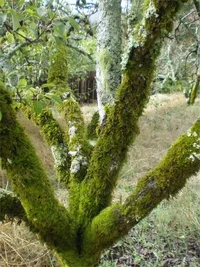
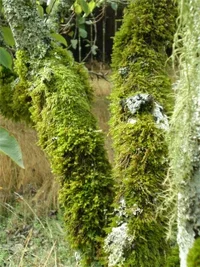
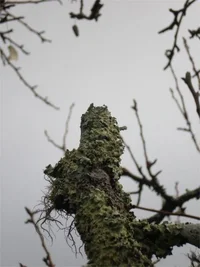
Banjo- they have all just awakened from a LONG dormant season of 7 months with little moisture except for occasional fog.

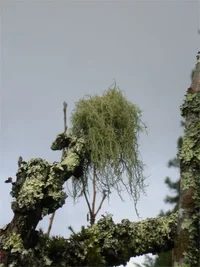
There are 8+ different lichens and 3 mosses on that one tree.
The last photo (that looks like a mop head) is Usnea. It is a fruticose lichen.

There are 3 groups of lichen:
1) fruticose(pendulous or shrubby)
2) crustose (crust-like formation)
3) foliose(leafy & lobed)
Microchemical tests and a microscope are sometimes necessary to ID some species. And as microbiological techniques improve nomenclature shifts for some lichen.

These are what I could ID: (tongue-twisting names)
3 crustose - Pertusaria amara, Lecanora sp., Ochrolechia laevigata
4 foliose - Flavopunctelia flaventior, Parmotrema chinense, Xanthoparmelia, Parmelia sulcata
1 fruticose - Usnea sp.
And the mosses:
Dicranum polysetum
Antitrichia
Dendroalsia abietina


-Diane-
 
Thanks, Guy, for looking. Certainly, carbs go from fungus to tree (or woody plant) when the fungus forms a bridge, say with a mycorrhizal fungus that links a tree (say, hemlock) with an achlorophyllus higher plant (e.g., Indian-pipe (Monotropa)). That sort of bridge also happens with some of the ergot fungi (as in the tangle-top disease with grasses infected with Myriogenospora). I just don't know of that with lichens! Of course, I've been wrong before...

Kevin.
 
Guy - Since lichens are a combination of a fungus and a microscopic alga and the alga is the photobiont I have only heard of the carbohydrate movement from the alga to the fungus in lichens.
(Basically, because the fungus is parasitizing the alga.)
But I'll keep my eye out for any study that may speak of carb movement from the lichen to the tree.

-Diane-
 
"Easy to see" depends on your tools.

I'd have to respectfully disagree. The folks interested in fungus translocation and physiology of symbiosis jump in pretty quickly if there is a whiff of a connection or pathway.
 
[ QUOTE ]
"Easy to see" depends on your tools.

[/ QUOTE ]Absolutely. I just wish i had better tools.[ QUOTE ]


I'd have to respectfully disagree. The folks interested in fungus translocation and physiology of symbiosis jump in pretty quickly if there is a whiff of a connection or pathway.

[/ QUOTE ]We do agree; they would be down that pathway if they saw it. I was just doubting that there is sufficient interest in this to *initiate* such an investigation.

But I'd love to be wrong on that.
laugh.gif
 

New threads New posts

Back
Top Bottom