Lanyard twist?

Woodwork

Participating member
Location
Tidewater
Hey, all, new guy here, and I searched for this topic but didn't find anything much.

I just got some spurs and tried climbing with them for the first time yesterday, using a lanyard and a climbing rope for safety. Had lanyard clipped with swivel clip to the left D ring on harness, and prusik loop to carabiner to d-ring on right.

The lanyard kept gettting twisted, with the prusik loop on right winding around the lanyard, etc., and I'm not sure why this is happening. I mean, I realize I'm somehow twisting the lanyard, but not sure whether I'm doing something wrong (or failng to do something else to address this) or whether twisting lanyards are "just the way it is."

What I ended up doing was disconnecting the lanyard and untwisting it from time to time. But I don't see anyone else needing to untwist their lanyards, so I'm thinking I'm doing something wrong.

Now that I think about it, I'm thinking the only way this can happen is if the lanyard slips down the tree before grabbing...so maybe I'm raising the lanyard too far between steps up, and I should take smaller "bites" with the lanyard so it doesn't slip down the tree and twist...?

Can anyone help me here? Thanks in advance for any clues.

Jeff
 
That's what it sounds like, the lanyard is rolling. You have the right idea, though... take your time and smaller steps until you get the hang of controlling the twist. Learning to go up isn't the hard part, doing it smoothly and naturally, however, takes some practice. Any twist you impart on the lanyard should come back out as you "flip" the line up, again... that just takes some time watching the lanyard and your movements. Is there a dead/dying tree nearby that is either smooth-barked or has no bark? Make sure it's sound enough to go up a few feet, and just practice going up and down it abut six feet or so while paying attention to your technique, your angle of ascent and distance from the tree, etc. Try varying your technique in different ways and see what effect it has. You'll figure out what's going on a lot easier when there's no danger or pressure.

Stick with practicing on trees that are slated for removal, as there's no sense in repeatedly injuring a tree when you don't have to. It won't kill the tree, but can invite all kinds of pest/disease issues, especially during times when it might be stressed, already. Be carefull with dead ones, make sure they can handle your weight before going up one... and don't go up very far. Make sure it's still structurally sound, first. It also helps to work the bugs out on a tree about a foot or so in diameter, before moving on to bigger or smaller ones. Get the bugs worked out on a comfortable climbing tree so you can just make small adjustments at a time to see what changes you need to make on big, gnarly barked ones.
 
JeffGu,
Thank you for the detailed reply. I appreciate your taking the time.
Tree I used is about a 10" DBH red maple on some forested land I own and plan to partially timber eventually, so I was careful to choose a trash tree to use (will continue using same tree, mostly)...eventually the maple will become firewood. Didn't want to touch the oaks, hickories, poplars, loblolly pines, etc. Got lots of sweet gum though, when I'm ready to move to bigger trees.
Yesterday, I just focused on going up maybe 12' and then back down. This is all new to me. Wanted to try to develop some muscle memory and rhythm going in sequence of events – step up, tend/raise distel, step up, tend distel, raise lanyard, etc. Also going down – slip distel with left hand while belaying climbing rope against hip with right hand, then dig in spurs, then unload lanyard, then lower lanyard, then slip distel down some more, etc.
At first, I thought, "This is unbelievably difficult!" with spurs, but I slowly got the hang of it. Still don't know about pulling myself up with DRT. Not sure I could do that (age 54, maybe 170# and 5'9") but my rope saver wasn't working (I was using a plastic wire conduit, but it pulled out of crotch – last night I boiled it so I could put a permanent bend in it) so that was adding to my friction.
Anyway, this looks like the best forum on the topic I've found, so I hope to learn a lot. Hope not to bug you guys too much with the basics ...
Thanks again.
Jeff
ETA: Tom, thanks for your reply. Lanyard is a Yale Maxi-Flip I bought about 12 yrs ago and haven't used since then. It's steel core wire rope with braided cover...I think...my terminology is not up to par, probably, yet...
 
Last edited:
Welcome to TreeBuzz!

There are so many helpful people here. Ask away as you are. Take some
Pics too. That helps a lot

Do you have a copy of The Tree Climbers Companion? Best money any climber can spend. Probably still costs less than a carabiner

Climbing on spikes is a skill that a lot of climbers don't master. There are some details that arent known or shared

Marv was a lineman for Bell System and he taught me aome Good things. Yeah, back in about '74 or so.

Find your spike spot and jab it. Don't peck at it. All that does is chew up the wood and bark. Leads to cut out

Keep your knees out...just a little. If you 'knee hug' you're more likely to
Cut out and fall

If you do fall try and keep focus so that you don't gaff yourself. Jabbing your foot or ankle is wayyyy bad! Lots of tendons to ruin

Soomer, rather than later, get off the spikes and climb the rope and tree. You'll be surprised how much easier it is

If you're any where near Columbus Ohio you MUST attend
The ITCC this week. If not find your way to a nearby climbing comp. you'll meet more great people and see so much!
 
Thank you, Tom. I have the TCC and "On Rope" and "Freedom of the Hills" and Peter Jenkins's "Tree Climbing Basics" DVD, but I'm always looking for more good references.

One thing I wish I had was something that could help me decode all the jargon. I lot of times I read threads, and it's as if the people are speaking another language. Or I'll see a technique, or dream it up, but I won't know what it's called (or if there's even a name for it), so I won't know how to look it up...

Anyway, on the spurs, I think I must have had my knees out on Sunday because today my inner thighs are sore. Using muscles I don't normally use much! The one technique I had trouble accepting was keeping my knees straight when I leaned forward to reposition the lanyard. It seemed like I always wanted to bend my knees when I leaned forward, and I'm not sure why, since I believe that doing so would actually make the gaffs twist out faster than keeping legs straight...it's hard to sort out why I'm tempted to do things a certain way at this point. And it can be hard not to listen to your gut.

(I'm also concerned about what happens if I feel like I'm falling and panic and instinctively grab for the friction hitch. Is there a way to teach yourself not to do that?)

Most of my climbing will be spurless, probably – but for trees I need to "clean up" on top before falling (to fit them between other trees, and/or to prevent them breaking up too much), I'll use spurs. (Building a bandsaw mill to convert some of the timber I own into lumber.) Would also like to get into doing occasional removals, if I eventually feel confident and competent enough to do so.

Would love to go to a climbing competiton, but unfortunately I live in the middle of nowhere and am not currently gainfully employed. And there doesn't seem to be anyone to teach me in person around here. I thought about asking the local tree guys if I could just watch them and/or help out for free in exchange for picking their brains, but I suspect they'd laugh at me ... So it's going to be low and slow going, using Youtube and books, I suspect...the best discussion forum on this material that I've found so far is right here, though, so that's real encouraging.

Thank you again.
Jeff
 
Last edited:
... Now that I think about it, I'm thinking the only way this can happen is if the lanyard slips down the tree before grabbing... Jeff

This is the root cause of your problems. You need to keep your hands on the flip line and not let go as you take steps. Keeping your hands on the flipline as you climb vectors the force in the proper direction to keep you from gaffing out. It is what keeps you safe. Putting weight on a top rope destroys this solid connection. I know it is not popular with today's emphasis on safety but lose the top rope. Stay low while you learn the technic and to trust what you are doing.
 
@Woodwork Welcome to the Buzz! My name is Mark. You already have some great feedback here. Climbing on spikes and flipline feels very unnatural at first. In order to set your gaffs aka spikes you need have the proper angle. Basically you are leaning back on your flipline. This is what makes it feel unnatural. Your instinct is telling you to hug the tree. At least that’s how I felt when learning and to this very day I still catch myself wanting to lean forward every now and then. That is why it’s so important to practice this low and slow. If you gaff out and hug the tree you’re going for a ride that will not be fun! Don’t ask how I know [emoji28]. You are way more likely to stop by leaning back in order to get your legs nearly straight and jabbing your gaffs in the tree one after the other at the proper angle until you’re able to stop while holding your flipline instead of hugging the tree. Another suggestion would be get an old mattress or two for padding at the base of the tree. Watch YouTube videos as stated above and keep it low and slow until you build confidence and like DSMc stated above leave out the top rope for now.


Sent from my iPad using Tapatalk
 
Thanks for the reply and advice, DSMc ... I had not thought of the top rope causing problems but it makes sense now that I think about it. The funny thing is, after my "first day on spurs" experience Sunday, I went out later and saw a guy about 40' up in a pine tree he was removing, and he was using spurs and flipline but no top rope, and I thought, "That guy's a madman" but maybe not. Question: Do most tree service arborist guys use no top rope when using spurs and flipline? Or are you saying to learn without the top rope and then add the top rope for safety only later, after I have the proper techniques in muscle memory? Like I said, I'm out here in the middle of nowhere, and I think Sunday was possibly the first time I've ever seen someone working in a tree around here, so I don't have examples to learn from, LOL...

ClimbMIT/Mark, thanks for your reply. I think I have the angle thing down, and I don't resist it because I "trust" leaning back into saddle against the flipline in the same way that I understand the only way to have control on snow skis is to lean forward (even though at first that feels scary)...I guess what I'm scared of is gaffing out when I lean forward to reposition the flipline. Maybe the reason I'm bending my knees is that I'm unconsciously trying to protect the boys if I gaff out and the tree hits me. Not sure what's going on there. Anyway, I'm going to follow your advice and spend some more hours "low and slow" using flipline alone without top rope. I notice that I've seen the "jab" mentioned re: spurs. Is that something you should consciously do? Because it seems like I just "step, weight and sink" the spurs more than "jab" them...I guess I just need to practice more to get a feel for it...

Thanks again for all the help, guys.

Jeff
 
Last edited:
Related question:
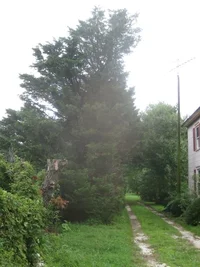
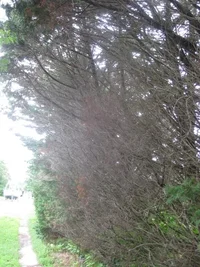
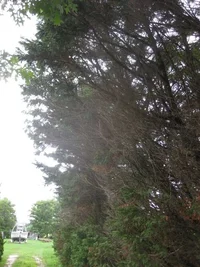
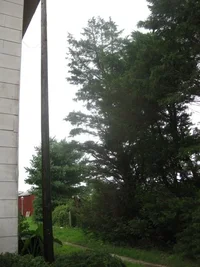
Need to prune/limb and top some leyland cypresses along my driveway. We're about a mile from Chesapeake Bay and hurricanes/northeasters over years have pushed over a row of leylands to about 70° off horizontal (say 20° lean) toward the house. Starting to lose them in storms b/c they are too tall for the NW wind loads (which always come when the ground is saturated and weak) or else during summer microbursts or winter "polar vortex" events which can get pretty ugly around here with all the water heat sink all around...

Trees are up to 30' tall, leaning maybe 20° and with LOTS of branches.
Need to cut back many of the downwind branches (which are leaning over into driveway) and top the trees to shorten lever arm, reduce the load imbalance, allow a substitute leader to grow plumb again and (mainly) prevent them from hitting house when they go.

Don't care about bugs, as I spray these trees for bagworms.
And these trees aren't long for this world, anyway. Adjacent farmer hurts them with herbicide.
Bagworms occasionally almost strip them. And they're just in general miserable leylands.
Lose one every few years to wind, and am slowly replacing them with Thuja "Green Giant."

Taking the issue of disease/bugs/injury out of the question, would you use spurs to climb or not?
Are spurs ever a hindrance/danger/liability, especially when there are many branches?

Also, do you ever use the "crotch" where the spur joins the iron to stand on small branches, without actually digging the gaff into wood? Or is that more likely to trip you up?

I guess the core of my question is, when do you use spurs and when do you not use spurs, if you take the issue of tree health/tree injury/bugs/disease completely out of the equation?

Sorry for all the basic questions – I feel like I'm trying to learn 19 different things at once – but I really appreciate your help so far.

Jeff

IMG_2632.webpIMG_2633.webpIMG_2635.webpIMG_2636.webp.
 
Last edited:
Thanks, JeffGu, yes, I know why topping is a bad idea and I never do it, but in this case it's either top them now or drop them entirely, because I can't risk them falling into the house again. (In my first pic, you can see one that fell into the house this winter...I cut off the upper 75% of the tree but kept the stump (and stood up the root ball with my truck) so that the stump can serve as scaffolding for wild rose bushes and hops to grow on top of it and provide some screening and windbreak...the NNW wind off Chesapeake Bay in winter is BRUTAL)

I've topped some of these same trees before for the same reason (though not this big), and the trees have survived it – but if not, I figure, no harm no foul because they're leyland cypress, the cockroaches of the plant world, and I ain't going to any heroic measures to save them...

Anyway, I already started working on them. Just using boots (no spurs) and lanyard and double-ending the lanyard to go around branches. Seems to work well, now if I can just get the damn saw to stay lit!
 
Last edited:
... Or are you saying to learn without the top rope and then add the top rope for safety only later, after I have the proper techniques in muscle memory? ...

Yes, this ^. Believe it or not, using a top rope while removing a tree with spurs has only recently become the norm. It was SOP to spur up and carry your climbing line, using it only when needed. Safety on spurs is dependent on your skill and understanding of their use. Lacking that, even with a top rope, they can be unsafe.
 
OK, thank you DSMc. That's interesting that the custom used to be to do removals with no top rope.

The guy I watched on Sunday was up about 30-40' or so on a loblolly pine that was leaning maybe 10-20° over somebody's house, and using just the lanyard and spurs. I hung around until he took the top off (they were rigging it down of course) and that tree SNAPPED HARD ... first when it was unweighted (he felled it toward the lean) it snapped UP, then when the slack was out of the rigging rope it snapped back down, and man, that guy had stuff (saw, ropes, etc) flying all over the place.

It looked like it could have shook the living daylights out of him from the shock/impact alone. Or if it didn't kill him, then make him lose his bite with his spurs and send him south that way. Crazy! But somehow he stayed glued to the tree. I suspect maybe he underestimated the weight of that top and took too much off at one time. I sure as heck wouldn't want to be thrashed around that hard on that bucking fronco.

Anyway, thanks again for all the replies. This is a great resource, and I appreciate you tolerating / answering the newbie questions.

What's funny (and cool) though is that the more I get up in the trees, the more I want to do it more. Most of this climbing gear (saddle, rope, biners, etc) I bought 12 yrs ago or so, and even before that, I had a dynamic kernmantle rope I bought to get up on the 12-pitch roof to clean the chimney ... but I never really used the climbing gear much until recently in trees. I'm digging it...
Jeff

 
You witnessed someone who didn't remember Newton's Laws. youtube is clotted with that sort of action. Rag doll climber...whew!

When you climb, especially on spikes, get your footing then get your knee locked. Get off your muscles and onto your bones. That takes a lot less energy.

Read up on some of what Guy M has written about crown reductions. Same for Ed Gilman. Idt doesn't take huge reductions to remove wind load
 
How are you fellas keeping your eyeglasses in place? Almost lost mine twice this morning in a tree, and I would have been in a pickle without them.

Since I'm so good at dropping eyeglasses overboard in the ocean, I put a lanyard on them when fishing. But lanyards on my head kinda make me hinky in a tree...maybe just use thin/weak string or monofilament for the eyeglass lanyard and keep it real short? Or maybe a rubber band? Goggles? You really have to fight your way up into these leyland cypress, it's like Borneo, and the branches will bend a long way before breaking...and they love to try to strip your eyeglasses off.
 
Last edited:
When you climb, especially on spikes, get your footing then get your knee locked. Get off your muscles and onto your bones. That takes a lot less energy.

Thanks, Tom, yeah, I do try to do that. Much less tiring. We do the same thing in rifle competition...muscles tire and start to shake, but bone support is solid / steady...

Read up on some of what Guy M has written about crown reductions. Same for Ed Gilman. Idt doesn't take huge reductions to remove wind load

Will do, thank you for the tip. I did not know that.
 

New threads New posts

Kask Stihl NORTHEASTERN Arborists Wesspur TreeStuff.com Teufelberger Westminster X-Rigging Teufelberger
Back
Top Bottom