knotless rigging

What type and size of webbing slings do you guys use for knotless rigging. I have a ton of 1" nylon tubular webbing and was wondering if that would be appropriate. I would use a beer knot to make the loops. Or is it better to get the stitched loops?

Chris
 
Either way...like any rigging, do the math and fit the gear to the work.

1" tubular works really well for a lot of rigging. The price is right and they're durable.

If I need something a bit heavier I make slings from old climbing ropes using a double fisherman's knot.

Using cord/rope you can capture an eye which makes setting the sling a bit easier.

http://www.climerware.com/dogvine.shtml

There's an illustration in The Tree Climbers Companion too.
 
[ QUOTE ]
I would use a beer knot to make the loops. Or is it better to get the stitched loops?

[/ QUOTE ]

i do both. beer knot, then stitch it to keep it from creeping under low load. i had a beerknot sling on one of my truck chocks that was there forever and then one day i picked it up and the beer knot pulled out. freaked me out, stitched them ever since.
k.
 
[ QUOTE ]
Either way...like any rigging, do the math and fit the gear to the work.

There's an illustration in The Tree Climbers Companion too.

[/ QUOTE ]

To be honest, if one doesn't understand what a "reasonable"
estimate of weight what one is rigging, one can't understand what gear one needs.

I don't like to sound stuffy, but the math really needs to be understood according to ones geographic location. If one doesn't know how to calculate the weights of the limbs ones removing, then one can't determine what the strength of the equipment needed.

Personally, I'd advise the rule of thumb that the weight of the limb will be at a minimum of at least "10" times the weight of the limb being removed. I'm not the only one who agrees with this assumption. One could do this by measuring 1/2 the weight of the limb, the larger diameter part leaving the tips as the other part, then doubling it, which estimates the weight. If you're out west, or down south, then, the estimation will probably show one needs stronger equipment than webbing.

Ask more questions.

Joe

 
[ QUOTE ]

To be honest, if one doesn't understand what a "reasonable"
estimate of weight what one is rigging, one can't understand what gear one needs.
...but the math really needs to be understood ... If one doesn't know how to calculate the weights of the limbs ones removing, then one can't determine what the strength of the equipment needed.

[/ QUOTE ]

100% agreement...and if a rigger can't do even a rough estimation of the weight/load in the rigging system then they need to cut smaller pieces. Or, not do any rigging.

PS-Can you check your last paragraph? I think I know what you're trying to say but it doesn't seem to have come out right
confused.gif
 
Tom: you're correct, the last paragraph didn't make sense. I'm sorry I didn't see myself saying that initially.

That rule of thumb would apply at the rigging point when a block is used, and the piece is vertical, like when doing spar work. I've been told and shown the forces at the block can be anywhere from 12 to 15 x's the weight of the piece in this scenerio. I like the 10 x's the weight of my piece idea as my minimum.

When removing a limb, the piece isn't necessarily vertical. so the 10 x's estimation wouldn't be correct.

For the limb weight estimation, if one looks at the limb, knows the location of its center of mass, and divides the limb at this point, one can measure the woody stem part to come up with a weight for that part of the stem. Doubling this part, since it's 1/2 of the limb, should show a reasonable estimation for the weight of the limb.

Quoting from your original post was a way for me to expand on the topic.

BTW, as for the original post, I use sewn webbing. I'm comfortable with the manufacturers choices for the webbing slings lengths. I've never used webbing tied with knots. I like bigger slings for larger diameter wood and limbs.

I'll shutup now.

Joe
 
[ QUOTE ]


I'll shutup now.

Joe

[/ QUOTE ]

Don't shutup, keep it coming.

I understand the principles of knowing your weight and the system. My main question was more of a general type of what is the common practice. But with each response I give myself the oppurtunity to learn something I didn't know.

Chris
 
[ QUOTE ]
I've never used webbing tied with knots. I like bigger slings for larger diameter wood and limbs.

[/ QUOTE ]

when we get to bigger wood i'll generally shift to no sling at all. at one end of my main rigging line (1/2 inch double braid) i spliced a small eye, to be used w/biner and slings. the other end i've spliced a large eye, to be inverted into choke - w/ a marl and that large splice we have "knotless rigging", preserving nearly all the strength of the rope. quick and easy, works for me.
 
Kathy, How big of an eye are you using to choke the rope. And this only works for wood where you can just slide it over the end right? I am working on picturing this. So you invert it and slide it over the end of the wood to girth it in a sense around the wood? That's a good idea. How big of pieces do you take down with this knotless rigging?
 
I like the idea. I am picturing wrapping the marl first with enough slack to create a loop with the eye, go over the end, and then take the slack out. Now that I think of it, you could put the loop over and slide it down, and add a marl above it too, so it works either way. Si?

-Tom
 
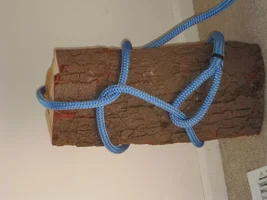
here ya go, a pic. this eye is about 6" and is plenty big. if you're butt-hitching on a spar the marl goes below the splice, if the block is still overhead it's above. and yes, only works when you can slip the splice/loop over the wood.
 

Attachments

  • 168754-Library-948.webp
    168754-Library-948.webp
    44.8 KB · Views: 346
Would there be a benefit of adding a tubular webbing sleave to the large eye? I think the Cobra sleeve is made from Cordura which would be a great material for a wear guard.
 
[ QUOTE ]
when we get to bigger wood i'll generally shift to no sling at all. at one end of my main rigging line (1/2 inch double braid) i spliced a small eye, to be used w/biner and slings. the other end i've spliced a large eye, to be inverted into choke - w/ a marl and that large splice we have "knotless rigging", preserving nearly all the strength of the rope. quick and easy, works for me.

[/ QUOTE ]

Kathy has a great idea. Now why didn't I think of that?

I use 3/8" filament dacron for loops. Had 3 tested and they broke at 10,000 pounds. Had a 7/16's filly dac loop tested and it broke at 12,600 pounds. Also had three 3/8's knotted loops loops tested, tied with a stationary bowline, they broke at 3,500 pounds. The knotted loops all broke at the "horseshoe" bend of the knot. A testiment to proper splicing.

Be aware of the 1" tube webbing loops. Had a 4' loop tested and it broke at 3,700 pounds at the stitching.
 
I needed a new rigging line anyway so I just ordered a 1/2 X 150' NE rigging line w/ a 3" eye on one end and a small eye & thimble on the other from Shelter (About $150). I can't splice, so I don't mind paying a little extra to have it done. Maybe someday I'll learn, but for now I'll stick to the things that I CAN do LOL. Thanks for the great idea, Kathy!

-Tom
 
[ QUOTE ]
Now why didn't I think of that?

[/ QUOTE ]

wow, there's no way i thought of something before norm did - i must have learned it somewhere. can't remember where though..
confused.gif


love the TB clearinghouse for new/old ideas!
safe rigging!
k.
 

New threads New posts

Back
Top Bottom