TheTreeSpyder
Branched out member
- Location
- Florida>>> USA
Continued from thoughts about knot strength as presented Page 5 of Mid-Line Knots/Knots on the Bight Thread .
It is one thing for a knot to be strong, another to be easy to tie, then to untie etc.; and also high on the list of requirements, especially with working knots; is knot security.
Generally this is thought to be done if needed by dogging/jamming machine of knot against slippage with a stopper knot (Overhand, Fig. 8, Stevedore etc.),or 2 half hitches to self etc. strategies.
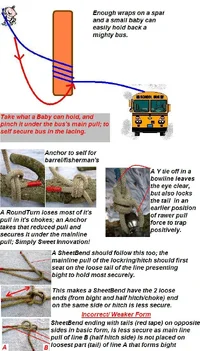
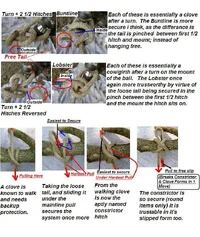
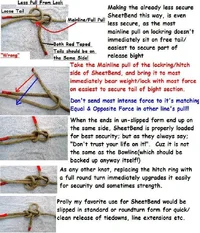
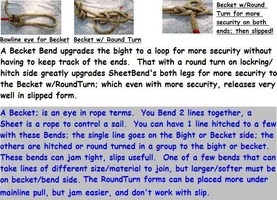
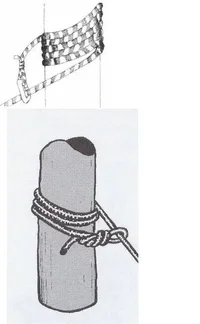
Another popular, dependable pattern can be discerned; of a knot/lacing "sitting on it's own bootstrap", locking itself positively. Generally i think of this as both ends have pull, and reducing one end of pull with wraps and turns to what a baby could hold even if it was a bus smoking the tires, then taking that away from kid and trapping that line under the mainline tension. Even better to catch twice! This can be with the tail, or with a bight of tail in the slipped form rendered for the given knot/hitch. Now of course you have to give more security so in times of intermittent pull from different directions, the tail of reduced pull doesn't fall out from it's position under the mainline tension (or as close as ya can get to).
i think realizing knot functions in these forms affords easier breakdown and familiarity, logical sense, inspection of systems, making up lacings for special stuff, especially away from trees etc.; but still magic with a piece of rope in the applications!
Or something like that...
It is one thing for a knot to be strong, another to be easy to tie, then to untie etc.; and also high on the list of requirements, especially with working knots; is knot security.
Generally this is thought to be done if needed by dogging/jamming machine of knot against slippage with a stopper knot (Overhand, Fig. 8, Stevedore etc.),or 2 half hitches to self etc. strategies.
Another popular, dependable pattern can be discerned; of a knot/lacing "sitting on it's own bootstrap", locking itself positively. Generally i think of this as both ends have pull, and reducing one end of pull with wraps and turns to what a baby could hold even if it was a bus smoking the tires, then taking that away from kid and trapping that line under the mainline tension. Even better to catch twice! This can be with the tail, or with a bight of tail in the slipped form rendered for the given knot/hitch. Now of course you have to give more security so in times of intermittent pull from different directions, the tail of reduced pull doesn't fall out from it's position under the mainline tension (or as close as ya can get to).
i think realizing knot functions in these forms affords easier breakdown and familiarity, logical sense, inspection of systems, making up lacings for special stuff, especially away from trees etc.; but still magic with a piece of rope in the applications!
Or something like that...