Karabiner research report

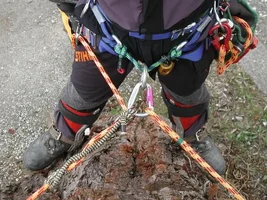
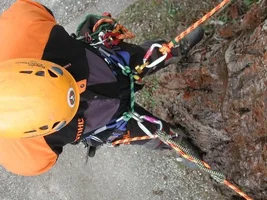
Yes back to biners, I've been looking and looking both here and elsewhere for more carabiner research, specifically any info about tri-loading, that is having three attachments on a biner- two on top and one on bottom- just as it was illustrated in this report. This setup sure works great compared to having 2 separate krabs clanking against each other and the one your hitch is tied on dangling slack between each pull, with eaverything on one crab that biner always stays in a taught upright position. The fear being that too much force will be applied to the GATE side of the karabiner and potentially cause it to break.
Anybody got any links to good research, how about personal opinions? (surely not here:)
 
/forum/images/graemlins/confused.gifWell, do you tri-load or what? I'll attach a picture to get your attention. Maybe some more of these smileys will help too. /forum/images/graemlins/elefant.gif If that doesn't work then my next post will be a poll. /forum/images/graemlins/bud.gif Anything to get your attention. I have a serious question here, do I need to include a picture of my neighbor on a ladder topping his tree with a sawzall? /forum/images/graemlins/blush.gif Sorry but I'm not into that kind of tabloid stuff, I'm looking for intelligent feedback to an honest question. /forum/images/graemlins/ukliam2.gif /forum/images/graemlins/santa.gif
 
What exactly do you mean by "tri-loading"? Please post a pic.
Do you mean on a butt strap type harness when an HMS crab is being loaded along the gate end or using it for friction hitches and loading it near the gate end?
 
This report is the only one that I've ever seen that deals with moving the load away from the major spine of the biner. After reading the report and talking with Paolo it was enough for me to make a change to HMS biners for multiple attachments.
 
In the arb industry there's loads of tri-loading. To understand this, you have to consider the test configurations leading to the specifications stamped on the spine of the krab.
When the manufacturer tests the krab as a rule it'll be pulled in a best case scenario (load on spine) on two twelve millimeter pins. Anything more than this - a 20mm rigging line for instance - is in effect transferring the load in the direction of the nose of the krab, creating in effect a tri-loaded type force.

Also when attaching around large diameter poles (see attachment)... bingo, tri-loaded, with force being applied in three directions.
We have done some testing on krab configurations, which we planned to discuss at TCI, which sadly didn't happen. It is an on-going discussion though, and I feel sure there will be a point in the future when we'll have a more thorough understanding of krab specifications and configurations necessary for our industry.

For now, there's a lot still to learn. On one point I'd agree - backed up by our limited testing so far - with Tom, HMS seems to work well for many of our configurations.
 

Attachments

  • 36210-P3280118.webp
    36210-P3280118.webp
    95.7 KB · Views: 70
... of course, it's all a matter of identifying and discussing the issues. Once we manage to adress the problems of krab configuration, we can go forward. The problems are not insolvable.

The example of tri-loading on a large pole from the last post? There's an easy sollution (see attachment). I'm sure there are others. But we do have to talk.
 

Attachments

  • 36215-P3280114.webp
    36215-P3280114.webp
    67.5 KB · Views: 78
i think it is best to keep the loading over the spine on the long axis. i think of a krab as a single leg device like an open hook, only with mousing.

Even real dual leg devices like clevises and screw links are weaker if wider. But the tensile doesn't drop if longer (on long axis) for that isn't leveraged to the flow of force, it is inline. But, longer has more porabaility of being leveraged. Across is perpendicular to the flow of force throught he device and is levearged, the wider, the more leveraged, and in single leg devices, more leveraged distance potential from 'spine'.
 
Thanks guys, I apologize if I sounded frustrated, I just crave information like a kid after candy.

Norm, I would never dream of hooking a biner to the front dees of a dees of a 4 dee saddle. Or trust anything as drastic as the setup in Mark's first pic for primary life support, maybe as a backup for positioning only.
As for a straight pull with working end of rope and friction hitch on the same biner? Idunno, there's obviously a strength loss by moving the load away from the spine, but how much? Isn't that exactly how a munter hitch works-being bidirectional by changing the load from one side of the hitch to the other thus moving the load away from the spine? Hmmmm... perhaps some more thought and testing in this area...

Tom , do you mean that HMS biners are STRONGER than "D" style when load is moved away from spine, or are they just bigger?
 
Eric,

It isn't that the HMS are stronger it has more to do with how the load is distributed on the biner.

This is another place where the green/yellow/red zone is illustrative. Let's take a d-biner and put two ropes on the end with equal loads. The load is spread out towards the gate which is the weaker axis. The strongest place to set the load, the green zone, is over there in the corner. Moving the loads across to the red zone is bad. On an HMS biner the zones are bigger so less of the load is put over on the gate side of the biner.

The way that ISC makes their HMS biners makes a lot of sense to me. The top of the biner is slanted up and away from the gate. This automatically slides the load away. Also, when the Gecko and it's mini-sister are loaded the biner cants over to the side and the load on the gate is more parallel to the load on the rope. I don't have any clue if this makes any difference but when I think of this as a vector load I like the way it looks.
 

New threads New posts

Back
Top Bottom