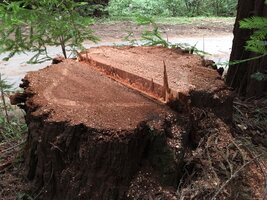
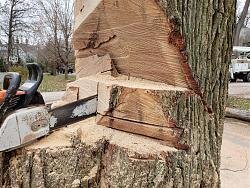
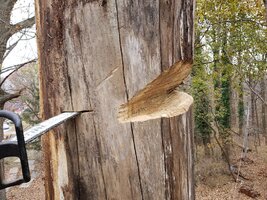
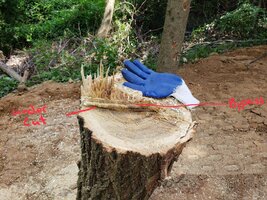
They didn't try to bore the hinge. that was an unintentional dutchman caused by a short bar. They either didn't do a good job of checking for byapss in the face or there was sawdust filling the kerf bypass so they missed it. Both corners looked good, so they missed the bypass.
I had that happen to me once, on a traditional face cut. The bar was short so even after the tip of the bar on the bottom cut bypassed, after I walked around to finish the far corner of the face, it looked clean as the two cuts matched there. The bypass caused by overcutting started 4-6" back from the far edge, and got filled with sawdust, so the face looked like a clean cut.
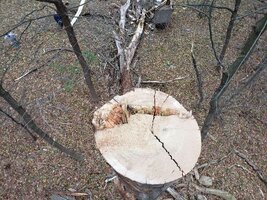
Big Chestnut Oak spar went 45 degrees to the lay and landed right bewtween a nice new shed and one of the biggest and best looking dogwoods I've ever seen.. no damage, but only by the Grace of God. I took 246 pictures of the stump, and suspended operations until I figured out why... That's one of the reasons I favor the plate cut. Only takes about 20 seconds more than a perfectly matched face (which many wouldn't have the skill to pull off anyhow, so it can save time for those that have to fool around with face cut) and you get enough height to the fibers on the front of the hinge that you can't miss a bypass and even if there is a little bypass, it won't cause the hinge to seize, because there is room in the tall hinge fibers to flex and squish a little.
if that all makes sense.
ps.. ou could also use this caption for that vid: why not use a humboldt in suburban arboriculture. it's a lot easier to miss those bypass cuts on a humboldt.



 www.facebook.com