












Hello. I am wondering if anyone is knowledgeable about iron injections and any possible downside. A client had a small (20ft) Maple injected with iron about a year ago, I think by a lawn care service. Now the top half or more of the center stem is dead as well as some low branches. He said decline started right after injections and believes the injections to be the cause. Could this be the case? Thanks all.
Navigation
Install the app
How to install the app on iOS
Follow along with the video below to see how to install our site as a web app on your home screen.
Note: This feature may not be available in some browsers.
More options
You are using an out of date browser. It may not display this or other websites correctly.
You should upgrade or use an alternative browser.
You should upgrade or use an alternative browser.
Iron Damage?
- Thread starter Leroy
- Start date

I have heard of implants causing localized necrosis as well as injections killing tissues when the rate is way off.
Was the maple confirmed for iron deficiency? Not unheard of but manganese is much more common. Perhaps an overdose because Fe wasnt needed?
Was the maple confirmed for iron deficiency? Not unheard of but manganese is much more common. Perhaps an overdose because Fe wasnt needed?

ATH
Been here much more than a while
- Location
- Findlay, Ohio
Mn and Fe can "compete" so if manganese was deficient to start, and they added iron, the Mn deficiency would have been exaggerated.
(A lesson learned the "hard way"...but not this hard!)
(A lesson learned the "hard way"...but not this hard!)

ThatsNotMaple
New member
- Location
- South Jersey
I know some parts of Colorado have notoriously alkaline soils so an Iron deficiency for a Maple may not be completely far fetched. Here in the Eastern portion of the country we definitely see more Manganese chlorosis in Maples than Iron. Sounds like maybe just a misguided effort to solve a common Colorado problem. They could have screwed the rates up and wound up with Fe-toxicity. However, I've learned relatively recently to take the homeowners word with a grain of salt. Maybe explore other possible primary stressors before automatically attributing it an excess amount of Fe.
Also, could a tissue sample resolve the question?
I don't know anything,
ThatsNotMaple
Also, could a tissue sample resolve the question?
I don't know anything,
ThatsNotMaple
ThatsNotMaple
New member
- Location
- South Jersey
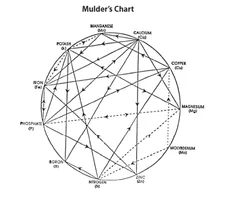
Tandard chart showing synergy and antagonism. Testing kinda helps...
Are there multiple Mulder charts? The one I have has different relationships, and as far as I can tell it would be Manganese that would limit Iron, not the other way around.
Edit: Yet another one shows antagonism between very large amounts of Fe to Mn. Just a little confused as to which chart is more accurate. Any help would be appreciated.
ATH
Been here much more than a while
- Location
- Findlay, Ohio
For sure! Why did they treat the tree in the first place...I'm assuming something was wrong with it or they probably would not have injected it (well....maybe, plenty of jackwads out there selling plenty of unnecessary treatments). So what was wrong before the injection......However, I've learned relatively recently to take the homeowners word with a grain of salt......
I'm still guessing Mn deficient...but that may not be the whole story.
ThatsNotMaple
New member
- Location
- South Jersey
For sure! Why did they treat the tree in the first place...I'm assuming something was wrong with it or they probably would not have injected it (well....maybe, plenty of jackwads out there selling plenty of unnecessary treatments). So what was wrong before the injection.
I'm still guessing Mn deficient...but that may not be the whole story.
I think you may have been onto something about the antagonistic relationship of large amounts of Fe in relation to Mn uptake. Without knowing the actual specifics I would say the process looked something like this:
1. Customer or landscaper noticed chlorosis, decided it had to be addressed.
2. Landscaper sold Fe treatment, as it is a common deficiency in CO and thought it would be safe money.
3. The amount of Fe injected was much more than necessary, and it wound up antagonizing Mn uptake. (With the possibility of Fe-toxicity if that much was injected)
4. Severe Mn deficiency lead to stem die-back.
After reading up on the actual intricacies of the Mulder Chart and considering everyone's input I think this is a safe process to start at. However, it still does not address what an actual soil analysis would come up with and what the starting condition of the tree really was.
Indeed, iron chlorosis is very common here, alkaline clay soil is the norm. I gather the tree was injected by a lawn company, sop for many outfits. The profit must be high because lots of iron injections go down, in town. Have removed lots and lots of small dia dead autumn blaze maples that had bad injection wounds and unaddressed root problems, left in cage, etc. 30- 20 yr old developments. lots of em.
I got the feeling he may have been pressured into the service or at least encouraged. We pruned the tree years ago and twas nice n green, things could have changed. Also failed to mention that within days of injection several small dia low limbs had leaves curl and brown. he called the co and they let him know, that happens, they'll regrow soon.
ATH
Been here much more than a while
- Location
- Findlay, Ohio
I'd start with tissue analysis on this one...but probably worth doing both soil and tissue. Assumptions can be made from one or the other, but together the story is a lot closer to complete......However, it still does not address what an actual soil analysis would come up with and what the starting condition of the tree really was.
Our take was to recommend remove and replace, since half of center stem is dead plus a few decent size low limbs, won't be the finest specimen after removing the dead parts. I guess if a tissue sample were able to confirm too much iron he may have some leverage to get the outfit to pay for replacement or some such thing.
- Location
- Kewaskum, WIsconsin
I was under the impression that these injections should take place in fall or else you risk blowing the leaves off. Are the branches dead or just leafless? I've seen them leaf nicely out the year after an injection that was done too early in the year blew half the leaves off.




















