Inonotus dryadeus?

jed1124

New member
Location
NW,CT
20170719_084736.webp 20170719_083322.webp
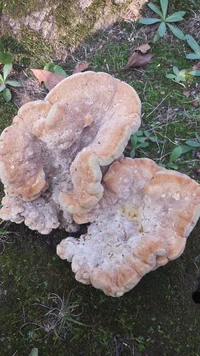
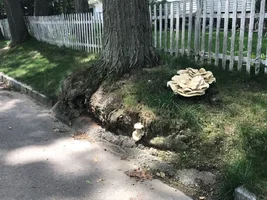
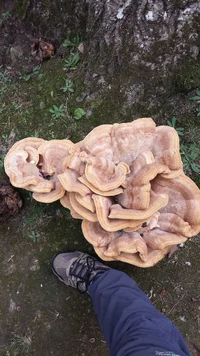
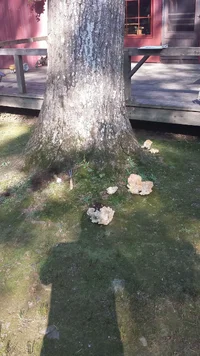
Got a call to look at this tree today. My thought is "weeping conk" but I want to get a second opinion from you guys.
Going to bring a colleague in for a level 3 TRA. Client wants to keep the asset I I want him to as well. Articles on the Web make Inonotus dryadeus a sure thing root rot failure waiting to happen. Target is obvious from the photo.
 
I think so but @KTSmith (or mrtree if he's around anymore...) is best for fungal ID.

Your going to have to have a real good look at those roots too.
 
Thanks JD. Looking forward to hearing from those guys. One of the articles I read was Co authored by KTS on the web. I believe it was called fungal decay of oaks in North America. Good info.
 
It does look like inonotus, but either immature fb of dryaduesa or a different species in the same family. Could always dig and sound the tree for a first step, then if anything is iffy poke some holes or tomography on the tree to be on the safe side.

If the fb is on a root, or trunk of the tree it is always worth a closer look regardless on the species. Even if it's not a pathological it is consuming dead wood, and you need to quantify the volume and strength loss of the dead portion
 
It does look like inonotus, but either immature fb of dryaduesa or a different species in the same family. Could always dig and sound the tree for a first step, then if anything is iffy poke some holes or tomography on the tree to be on the safe side.

If the fb is on a root, or trunk of the tree it is always worth a closer look regardless on the species. Even if it's not a pathological it is consuming dead wood, and you need to quantify the volume and strength loss of the dead portion
From what I've read it is an aggressive pathogen.
 
It can be, it's certainly worth digging. Looks like the fb is right on top of a buttress root. Dig for it and if it's decayed dig at another fb. If all those buttress roots are decayed it doesn't really matter with id cause it's probably f'ed
 
Yes, has MrTree left TreeBuzz or is he just on the road? He's a real asset around here.

Given my usual disclaimers on fungal ID from snapshots, that sure does look like Inonotus dryadeus. Older books would term it Polyporus dryadeus and "white root rot". In 2001, the fungus was designated as the type species of the new genus Pseudoinonotus, which has become the accepted name by many specialists, with some differences of opinion as to proper placement (of course). But sure, I usually use Inonotus.

As Chris Lulely describes in his "Wood Decay Fungi" book, this is a tough one to manage in that decay of buttress and otherwise supporting roots can be extensive with little or no decay in the butt log. Although usually not fast moving within the tree, the major roots can be decaying for some years prior to producing the fruit bodies.
So yes, aggressive pathogen.

 
Yes, has MrTree left TreeBuzz or is he just on the road? He's a real asset around here.

Given my usual disclaimers on fungal ID from snapshots, that sure does look like Inonotus dryadeus. Older books would term it Polyporus dryadeus and "white root rot". In 2001, the fungus was designated as the type species of the new genus Pseudoinonotus, which has become the accepted name by many specialists, with some differences of opinion as to proper placement (of course). But sure, I usually use Inonotus.

As Chris Lulely describes in his "Wood Decay Fungi" book, this is a tough one to manage in that decay of buttress and otherwise supporting roots can be extensive with little or no decay in the butt log. Although usually not fast moving within the tree, the major roots can be decaying for some years prior to producing the fruit bodies.
So yes, aggressive pathogen.
Thank you Kevin!
 
The latest PhD to take a look said Berkley polypore. Either way it a bad deal can anybody recommend somebody in CT that can write a level 3 TRA? The guy I would normally call is on vacation till August.
 
Could be Berkley polypore (genus Bondarzewia) rather than Inonotus. Chris Lulely recently wrote a nice little article on the former for TCI. Still looks to me more like the latter. Of course, the simple verification would be a quick microscopic look at the hyphae in the cap. Even if the fruiting body is tough, a razor-blade section or shaving would show the former as having ornamented, amyloid spores and a dimitic hyphal system (two types of different-appearing hyphae in the cap) while the latter has a monomitic hyphal system (one type of hyphae in the cap) and smooth-ish spores. Without that info, I won't argue further! As an aside, although these two species are similar in appearance and habit, they are pretty darn unrelated. Most experts reckon that Bondarzewia is more closely related to the gilled Russulas (as evidenced by the ornamented, amyloid spores) than to the main line of polypores. Whichever one this is, it's a nice case of convergence of form in unrelated creatures!
 
View attachment 45806 View attachment 45807
Got a call to look at this tree today. My thought is "weeping conk" but I want to get a second opinion from you guys.
Going to bring a colleague in for a level 3 TRA. Client wants to keep the asset I I want him to as well. Articles on the Web make Inonotus dryadeus a sure thing root rot failure waiting to happen. Target is obvious from the photo.
Could be but also may be berkeley's polypore .If you can get a photo of the underside and the edge of the fruiting body you may be able to key it out
 
Just for fun, I've attached a Berkeley that was sent to me by the city arborist just this week. The tree is in my neighborhood. It has the characteristic microscopic features of Bondarzewia. This also was an easy call. I've never seen Inonotus (or anyone else) have such overlapping "fronds" with an over-all vase shape.
 

Attachments

  • Portland_ME Bondarzewia.webp
    Portland_ME Bondarzewia.webp
    235.8 KB · Views: 19
Well, after maturing it is without a doubt the polypore. Thank you to everyone who chimed in. The water droplets really threw me off when it was imature. That sent me right down the Inonutus path.

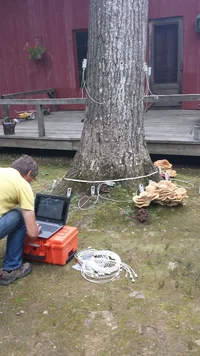
Anyhow, it seems like the tree will have to come down after tomography and resisto graph testing. Unfortunate, but the target cannot be moved.

On the brighter side, the guy I normally use for TRA was on vacation, so I had the opportunity to work with someone new who was great. I'm looking forward to working with him again.
 

Attachments

  • 20170729_090826.webp
    20170729_090826.webp
    638.3 KB · Views: 21
  • 20170729_095128.webp
    20170729_095128.webp
    465.4 KB · Views: 20
Read Kevin's June TCI article before judging. How people can leap from fungal ID to removal judgment still blows my mind.

We pulled 37# of B berkeleyii off a shingle oak in Cincinnati. Flare cleared, soil improved, and a 7-10% reduction 3 years ago and again last year after seeing a bit of Ustulina on it. Owner satisfied, tree growing downward, risk mitigated.

The aggressiveness of the pathogen is dependent upon the strength and susceptibility of the host, and the conditions of the environment. Does anyone remember Mannion's triangle?
 
Do you have an image of the whole tree? Can you persuade the owner to mulch?

And what articles on the web are you reading? Lots of mycophobic snake oil being peddled out there. Caveat lecter!
 
Do you have an image of the whole tree? Can you persuade the owner to mulch?

And what articles on the web are you reading? Lots of mycophobic snake oil being peddled out there. Caveat lecter!
Guy, I don't know what articles you are referring to but I always appreciate your desire to retain an asset. That was my desire with this tree as well, that's why we went forward with tomography and resistograph work. If it was going to be a removal, I wanted to be based off science and not some preconceived notion that fruiting bodies=removal.
Tomography and Resistograph showed about 4" of shell from the base up to about 4.5'. That was not a huge concern as you and I know that shell is very strong wood. What was the concern was the decay of the wood on the underside of the buttress roots and a failure due to them releasing.
The gentleman I worked with to do the TRA specializes in forensic arborculture. His exact words were that he was surprised the tree has not failed already. That was enough for me.
Adding to all this we found out the day we did TRA that the tree had been trenched approximately 6' from the base for a propane line in 2006. 50% of the roots were severed at that time.
 

New threads New posts

Back
Top Bottom