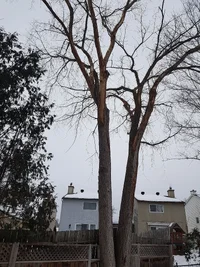
How would you rig this

Went to take a look at a dead elm job today. Tree is 65 percent over the neighbors yard and appears to have a pool under the snow. If you couldnt get access to the neighbors yard, how would you do it?
 

Attachments

  • 20190212_142259.webp
    20190212_142259.webp
    823.6 KB · Views: 136
  • 20190212_142300.webp
    20190212_142300.webp
    992.6 KB · Views: 133
  • 20190212_142319.webp
    20190212_142319.webp
    1 MB · Views: 126
Difficult to tell by pictures, but some possibilities could be re-directing off of the the other stem (depending on integrity...possible multiple ring scenerio), span rigging or slide line with some of the lighter stuff...maybe a combination of all 3. However, sometimes the easiest approach is to knock on the neighbors door and explain the situation. Obviously it will benefit them also to have what is over their property removed at no cost to them
 
The house is about 20' away from the tree and there is a fence and very narrow path between houses out to the street, so a small drop zone for the size of tree. I feel as though it would benefit the neighbors more as if the homeowner lets it go to long there will be some pieces in the pool. Multi ring and small pieces was my intial thought but i like hearing other opinions on tackling problems
 
The house is about 20' away from the tree and there is a fence and very narrow path between houses out to the street, so a small drop zone for the size of tree. I feel as though it would benefit the neighbors more as if the homeowner lets it go to long there will be some pieces in the pool. Multi ring and small pieces was my intial thought but i like hearing other opinions on tackling problems

The problem with small pieces and dead trees is that you may have to go into small wood to get the outer small pieces. No bueno. Don't lie to yourself, you'll be doing something you don't want to do. It may be a crane/bucket job.
 
The taller stem looks like you could set up a nice high overhead rigging point, and after clearing the limbs below it that might interfere with the rope, you could swing fairly large near balances pieces out over the fence... Dead elm is impressively strong and I would have no hesitation about rigging large pieces. Would be good to spread the forces out by running the lowering line through 2 or more crotches, and use good cutting and rigging to keep the movements slow and steady... Most important thing is to put enough money on the job to make it worth the trouble!!!
 
Perhaps similarly i'd work the high vertical's sling shot framework (actually 2 layers) for strength and balanced loading (to that main stem )of rope thru forks being able to pull slanted trees limbs from other side and around.
.
Vertical's Forks would already have some weight dropped off of them quickly for ground crew to process as re-make plan in tree..., so in theory main supports ready to take some load just to be back at what it is used to. Green tree wasn't there would use forks to pull from both sides.
Would get lower , heavier limb on slanted tree this side clean out of the way thru lower vertical slingshot forks for no hang-ups of higher swings. Would look to take next limb seen ,next, from higher crotch(might throw line thru and tie back down to butt. After rigging it's side piece down to lay on the other stuff over pool; to take with next load as sideweight pull on upper fork over pool possibly(probably rig line for that pull would come up UNDER target fork, then back to butt tie trying for some side twist, slight lift around on tight line leaving 1 fork over pool).
.
Tight line for best pirouette pivot over fence. one way to tighten after pulling tight is to throwline bight over vertical's support fork span center, and sweat line in sequences to tight, can even do some upward lifts like that, force earlier/stronger hinge folding. As well as just increase support, and exert side force to twirl around. A prussic on the drop length of rig line between support and target can give very high quick leveraged bend if rig line is very tight. This again can pull sideways on target when ready to fold, or really before to force thicker/stronger fold. Limb's downward pull would be best to force thicker horizontal hinge,as we slant that up towards vertical hinge need more sideways force to force thick hinge,and start turning limb.
.
Would look to take whole pieces also, in few focussed/calculated moves on chessboard of using target's own length ,weight, balance against itself like some kind of martial arts move instead of nickel-ing and dime-ing out in more mess, multiple of risks etc. Mid, rather than butt ties give more clearance to same target,and can tourque sideways better as any side pull is further from hinge pivot. Looking to give 4:30 o'clock type angled drop to face path around, so some gentle, inviting relief hinge downhill , thicker hinge with sideways force. It wants to drop down, you want it to spin sideways , agree on median, use it's want to drop to power coming around to you. Has enough clarence to get some drop it wants w/o too much arguement, especially on correct face and horizontal pressure on hinge to fold to even 4 o'clock. Always giving some relief , never trying for 3 o'clock fold; always some light releif path slant down.
.
Tag / pull line on targets could help pull sideways to spin on stronger hinge more horizontally to this side before tearoff, so hinge is like secondary butt tie that eventually cut. Then tag line might help position to ground, more forgiveness over fence. Can throwline in farther than hitch point if sound wood, even use throwline for tag line some.
.
Smooth is key, Zer0 impact sought for least loading and not shaking any shrapnel free from dry pieces for least risk and cleanup.
 
Last edited:
Do you have a grcs? If not I would try a crane. This is contingent on being able to access it with a crane and that depends on where the driveway is and which side of the street the wires are.

Another option is to network with someone who has a lift to get the tips of the hard one on the ground. Really that’s all you need done and rig the rest from the upright stem.

Really, this is pointless conjecture unless I could see it in person.
 
Last edited:
Rent a lift for the day. Make it easy on yourself. Get off the tree and rig more confidently.

A 50' tow-behind is ok and cheap. A self-propelled requires delivery.


Otherwise, its hard to tell, somewhat.

Inspect the tree thoroughly for cavities, cracks, etc.

Some branches left on the tree will dissipate the wobble. Stripping every last thing your can off the tree, before rigging can be shooting yourself in the foot.

A good quick spur up and inspection, doing the easy stuff along the way to clear out for rigging may help.

Pretensioning lines may help.

Speedlines are often so useful with leaning trees, and you compress the tree with the speedline, if angles are opposite the lean.
 
No grcs, with a 50' lift we wouldnt be able to get the majority of the tree, after going over the house. Crane would be the easiest option for sure. Im confident with good rigging plan we could get it done, just need to plan smart and not rush
 
The taller stem looks like you could set up a nice high overhead rigging point, and after clearing the limbs below it that might interfere with the rope, you could swing fairly large near balances pieces out over the fence... Dead elm is impressively strong and I would have no hesitation about rigging large pieces. Would be good to spread the forces out by running the lowering line through 2 or more crotches, and use good cutting and rigging to keep the movements slow and steady... Most important thing is to put enough money on the job to make it worth the trouble!!!

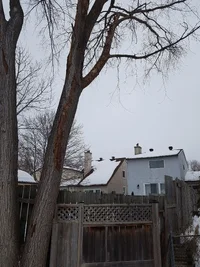
On a leaning dead tree, I have less of a problem with the wood above ground. It's the roots I worry about. I once pushed a 45' tall decayed pine spar at the top of the spar. The visible heartwood core did not break. It looked like sh*t. The spar went sideways about 10 feet, rotating on the decayed root ball and coming to rest on another branch of the oak I was in. I did not expect either the spar not breaking, nor the root ball being that decayed.
 
I agree that using a lift to remove the little stuff is probably the safest. Can you get a high reach bucket truck back there or close enough to matter? A long pole saw can make a lift a lot more practical. Once I started to use a pole saw from a bucket, my ability to get stuff done doubled. Not only can you reach the small stuff, you can also use it to set rigging points above where your lift can reach. Set your lines, move away to safety, and make the cut with a pole saw if possible. I really hate dead trees, if you couldn't tell.
 
The taller stem looks like you could set up a nice high overhead rigging point, and after clearing the limbs below it that might interfere with the rope, you could swing fairly large near balances pieces out over the fence... Dead elm is impressively strong and I would have no hesitation about rigging large pieces. Would be good to spread the forces out by running the lowering line through 2 or more crotches, and use good cutting and rigging to keep the movements slow and steady... Most important thing is to put enough money on the job to make it worth the trouble!!!
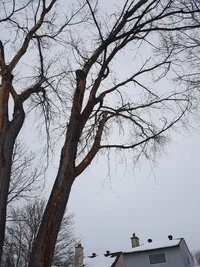
I agree Daniel, dead elm is very strong even no bark dead. I also agree with your rigging set up only I would tip tie pieces small enough to pull without a GRCS and just pull the tips and wood into the lowering point. Many conversations here about when to tip tie this seems like the time.
 
Multiple block “Z” rig. Drift line with a separate line towards the client’s side on the neighbor’s side. Just go ahead and purchase a GRCS or a Hobbs. You are going to need it here and in the future. Balance and swing as much as you can between the two systems untill you are loading in compression on client’s side. Put decent time on the job as your debris amnagement is going to be a time vampire

Tony.
 
Last edited:
Gravity should work to swing those pieces over the fence if the rigging is set up properly... My GRCS hasn't been out of the garage in 2 or 3 years..

But come to think of it, I just looked at a big backyard uprooted tulip leaning into a big chestnut oak.. Might be the perfect time to set up the grcs with a bunch of pulleys.. i was going to set up a lot of redirects out to a truck in the driveway and still might have to but the GRCS could save a lot of trouble if we can use it's power alone... Maybe use multiple pull lines and pull on each separately while the others are tied off... Could be fun... If it works out, this thread is to thank ...
 
Take weight off key support positions on left/vertical tree front side
>>now stronger supports.
.
Take heaviest limb from front side right tree thru left vertical's lower slingshot sturdier frame
.
Run rigging line across higher fork support for more balanced and shared loading to stem
Use said fork span to thowline over rigging line spanned to leverage/sweat/swig load line super tight if not lift target. Some times just a sling and krab climber can reach and use to help leverage line super tight, so rigging line left restricting downward, inviting sideways force on target.
.
I try to come to target from right side support crossover target to left side by crotch with rig line, trace under target, backup thru crotch and back to butt tie a few feet at least. CoG beyond hitch point some. Super tighten and get roll to right to hinge around to front more positively. Turn any downward weight as torque around, were weight and length become your friends not enemies.
.
Ground man good enough can take the inertia on tear off and throw target into yard this side. Tag lines help to flex hinge and help after tearoff also.
 
Last edited:
It all worked out thanks to this thread.. Never left the ground, setting up ropes all day to lift this 120' tulip vertical from 35 degrees sitting in a chestnut oak right over the neighbor's house.. Got the call yesterday morning. A local company wanted 10K and a release signed for no liability if the crane damaged the neighbor's driveway.. I bid 6K for Egyptian style, block and tackle.. We started with 3:1 MA on with the GRCS (which had 2 years of dust on it), and two safety lines, set with 3:1 MA to triangulate vectors... That probably wouldn't have done the job, and fortunately had an extra line set and with a straight shot back to the driveway 200'+ was able to use the pick up truck to bump it up a foot or two at a time and then crank the main line, then take up the two side safety lines consecutively, for 8-10 rounds to stand this beast up some 35'... Tree is standing straight now with 4 support lines and will be bombs away tomorrow, no lowering, nothing to damage , just put it on the ground and go home..

Another highly experienced tree guy who lives around the corner stopped by to lend me a crank handle for the GRCS, and taught me a real nice trick for tying two ropes together when the knot has to run through a crotch.. It was touch and go there for a few.. One of those jobs you take just to see if what you think will work, actually does...
 

New threads New posts

Kask Stihl NORTHEASTERN Arborists Wesspur TreeStuff.com Teufelberger Westminster X-Rigging Teufelberger
Back
Top Bottom