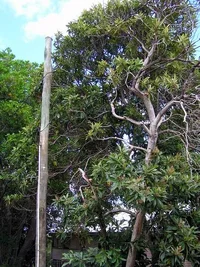
How to remove this tree?

As most of us can tell from the last pic, the right side of the tree is dead. That is also the side with the split. This pic is of the drive where the crane will sit. This is also a neighbors drive, but they want the tree out so it won't fall on their home. We have a signed permission letter to use their drive.
The plan is to use a 40 ton crane. From this drive, it is a 61 foot radius.
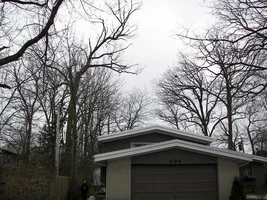
 

Attachments

  • 80035-100_1308.webp
    80035-100_1308.webp
    111.4 KB · Views: 147
We have to wait for the electric company to 'rubber up' the primary and secondary before we can remove the tree. An excellent opportunity to use spider legs. Also, the crane's load line will have to stay above the primary, so we will use synthetic slings to remove the spar sections.
This pic shows the split. In the center of the pic you can see through to the other side. We will have to assess the tree to see if it will support a climber. If not, the climber will stay attached to the load line.
Again, thank you for the positive feedback. Be safe out there.
 

Attachments

  • 80038-100_1311.webp
    80038-100_1311.webp
    104.9 KB · Views: 126
Norm,

How are you going to deal with the approach distance to the electric lines? Will the power company ground them or sleeve the lines?

The trunk seems too close to the lines for anyone but a line clearance tree trimmer to work on.
 
The power company is going to 'rubber up' both the primary and secondary lines. I will try to get pics of the job in progress. No date has been set yet. We're hoping for next week. The 'line clearance' arborists know what TCOT is capable of doing and will gladly let us remove the tree.
 
[ QUOTE ]
Is there any regs. involving working around the "rubbered" lines?

[/ QUOTE ]

Be aware of the rubbered up section when working. Don't turn your back on the energized lines, even though rubbered up. The crane's load line and ball can't go below the primary (crane load line and boom are not insulated). They should be treated as energized lines. The spar sections will have to rigged so they lift straight up. There is no room for error on this job.
 
Norms plan seems to be right on the money. When I saw the driveway I said crane, rubber up the wire use synthetics. You could manage the approach distanse by planning. Leave the truck higher than the wire than rig it up. You may have to be creative to redirect your rope so you pass the wire further than 10'. You also may have to decsend to the ground and reclimb up to keep you rope away also. Then make the cut. After that you may have to finish manually. We do this type of work quite a bit. Plan, plan, plan, plan, thats the name of the game.
 
Would it not make more sense to have the electricity lines shutdown completly?

Why is this not a viable option? Cost?

I am aware of generator back feed, even so, would the electric company not have a procedure for preventing this situation arising if the lines were shutdown completly?

If the climber stays attached to the load line, surely this will make the job extremely hazardous for the climber?

Where will the climber be after he has made his cut?
 
Can some-one please explain the following terms to me.

Primary, what is it, how many volts, how many wires and are they coated?

Secondary, what is it, how many volts, how many wires and are they coated?

Over here, out in the street, service drops come off 240/415v exposed wires which run in 4's. Service drops are usually coated.

Sometimes out in the street you'll see a group of 3 uncoated wires running above the group of 4, these are 11,000v and drop down to transformers to feed the groups of 4 below them with the 240/415v.

So in Norms picture I still have trouble making out the wire detail, how many, volts etc. You just wouldn't really see an exposed 240/415v near a house on a pole like that too often.

Here's a typical picture. the top wire is a bundled coated service drop, the lower ones are telco wires.

I'm just trying to understand what's on the darned pole there?
confused.gif


80086-after.JPG
 

Attachments

  • 80086-after.webp
    80086-after.webp
    110.8 KB · Views: 60
The higher the wire the higher the voltage.

Coated wires may be insulated or just weather resistent.

On street-side poles one uncoated wire running on insulators will usually be 2400 volts which is passed through a transformer to 120/240 volts that passes to a coated set of wires below. From this set a spiral of three wires, two coated, one uncoated is connected to the house (service drop).

A single 2400 volt wire is a single phase. When three uncoated (or weather-proofed) wires occur in a triangle pattern on seperate insulators they are three phases, each wire being one phase carrying the curent at a different phase (of the wave curve).

When insulators are "stacked" then the voltage will be higher, on streets and regular poles 7200 volts.

The phase thing is abit of a problem, sort of like calling three different things a wicket.
 
It's hard to see from those pictures , what is more of a hazard, the tree or the wires ? The trees looks cracked , but is it not broke because it is laying on something ? The tree looks popped , It looks safe to climb , I don't like when trees are have that separation at the crack ,like an overlap. Show me a picture of the stump , be safe.
 
Eric;
There are a few methods to determine operating voltages.
The company will have these voltages marked on their operating diagrams,plans etc.,it can be marked on the transformer,breakers,and can be determined by the height of various insulators.
You don't need to make contact.
You could get caught in a flashover with higher voltages so that's why it's important to know what you are working around.
Can't say what's in your picture but over here it could be insulated 7200+ secondary tap which would be stepped down at a transformer to feed service wires to the prem.
I don't see a clear picture of any insulation on the primary so it may be far less.
That second conductor at the bottom looks like a multi grounded neutral with the primary at the top but I can't say for certain what your utility plant is, just going by what we have here.
 
Tod....Norm.....how excited would you get working around 3 phases of 44kv?

I had to walk from a previous clients Sugar Maple in Barrie due to the above described sitiashun. To warm for my hydro experience. I know I could do it, but I have to look out for those working for me too.
 
Oh, so in Norm's first pic the very top wire is an uncoated 2400v

You certainly have a different system, we dont have any that are 2400v.

79625-100_1304.JPG
 
Am I understanding this correctly; the load line and ball or climber can approach the wire closer than the 3 meters (10ft) from above when the lines are insulated? The min. distance must be adhered to from below the wires?

WP
 
Eric; It could be 2400 or 7200.
Depends on what it needs to supply.
The approach distance is the same between 750 and 150,000 volts for unqualified persons like you and I.
The limits of approach are considered to be measured from the point of planned OR unplanned movement.
This means you can't work on tree or branch that will come within ten feet(3 meters) of any power source.
It may be slightly different where you are.
 
For us when we have the lines rubbered up we still have to observe minimum seperation. The cover is there to protect us if a mistake is made, not to allow us to get closer. The only way we will get closer is power off and grounded.
 
[ QUOTE ]
The crane's load line and ball can't go below the primary (crane load line and boom are not insulated). They should be treated as energized lines. The spar sections will have to rigged so they lift straight up. There is no room for error on this job.

[/ QUOTE ]

So when you go to take picks off the spar, do you have to use synthetic materials to attatch to the load line which is above the primary? Or maybe the crane is big enough to take the spar in one cut?
 
[ QUOTE ]
Would it not make more sense to have the electricity lines shutdown completly?"
<font color="blue"> </font>


If the climber stays attached to the load line, surely this will make the job extremely hazardous for the climber?

[/ QUOTE ]
After the risk assessment, if we think it would be safer for the climber to stay on the ball rig, the crane's lifting capacity goes to 50%. Using spider legs will make it safe for the climber. <font color="blue"> </font>
 

New threads New posts

Back
Top Bottom