How do you decide it's safe to climb below or close to a hanging dead limb?

Winchman

Carpal tunnel level member
I had a tree the other day with a fairly large hanging dead limb sixty feet up. I got a line in the tree where I could use it to move the limb around to see how well it was attached. With just a little jostling, the limb fell to the ground. I've seen others that hang on through lots of serious abuse, and then it takes a lot of sawing to get them to fall. From the ground they looked pretty much the same.

The current situation is a hanger that's tight against the trunk with several live limbs on either side of it. Most of the bark and small stuff has already fallen off, so it's been there a while. There's nothing there that I can get a line on to move it around, and the only good place for a climbing line is going to be right alongside the dead limb.

I hate to leave it hanging there, but I don't want to risk climbing so close to something that may be one nudge away from falling. There are also several other dead limbs above and below the hanger I'd like to get down.

Any suggestions on how to determine the risk here?
 
I had a tree the other day with a fairly large hanging dead limb sixty feet up. I got a line in the tree where I could use it to move the limb around to see how well it was attached. With just a little jostling, the limb fell to the ground. I've seen others that hang on through lots of serious abuse, and then it takes a lot of sawing to get them to fall. From the ground they looked pretty much the same.

The current situation is a hanger that's tight against the trunk with several live limbs on either side of it. Most of the bark and small stuff has already fallen off, so it's been there a while. There's nothing there that I can get a line on to move it around, and the only good place for a climbing line is going to be right alongside the dead limb.

I hate to leave it hanging there, but I don't want to risk climbing so close to something that may be one nudge away from falling. There are also several other dead limbs above and below the hanger I'd like to get down.

Any suggestions on how to determine the risk here?

Set an anchor point that doesn't expose you to danger while you ascend

Throw line around it, try and loosen it from the ground and decide if it's safely lodged or not

Alternatively you can secure it from the ground if you're really keen
 
Well, rats!! I was getting ready to set a line in the tree this morning for a look-see climb when the property owner came out. Apparently I misunderstood where he'd told me the property line is (lots on a curve with no obvious markers or landscape cues), and the tree is actually on the neighbor's property. He was happy with the work I'd done on a tree in his yard yesterday. The neighbor is out of town for a while, so I'll put this on hold.
 
I look for what's holding the hung piece where it is, binoculars help. I start with the assumption that there's a reason it didn't go to the ground. Then I look to find the reason ;-) If the load is distributed at multiple contact points the more stable it is. If it's only hanging on a tearout or one contact point look out.
-AJ
 
Last edited:
I had a 20' oak skinny top leader dead and dry, set like a javelin butt first just the other day. My trick was to set my line over it in the only trustable crotch (dead tree) and wedge it in tighter, with coming up the non-butt side of the trunk. Then I pieced it out finally releasing the last 2 foot piece by unweighting me via lanyard. I had another safety line in the next tree. It was so sketchy I didn't even want to transfer from the safe tree because of having no faith in doing any side loading, keep it all vertical. :)

After I got going I found the transition from real crap wood to solid wood as I made cuts (removal). Then it all felt a lot better.

Maybe my circumstance was easier to find a clear option, I'm sure other hangers would not fit my described scenario.

take care
 
#1 if you can shake it out what’s the target? No target no risk= aerial deadwood is habitat.
If risk is weighted and has to come out, shake it, shake the tree, get a good read on how it’s hung and ALWAYS ascend from the back side, or an adjacent tree.
 
Throwline, Running Bowline test.
Then rig so cant fall if doesn't.
If might want to retrieve rope, leave throwline where can pull Running Bowline open.
Wear Brain Bucket.
.
Have pulled with truck even, but might get rip.
 
I really like the idea of putting a rigging line around it from the ground, then tensioning it to the trunk. It won't fall until the tension is released, so you could climb right next to the hanger. Do what you need to do in the tree. Then, when you can see what's going on at the break you can decide what to do with the hanger--drop, lower, or leave it.
 
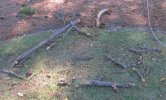
I talked to the owner today, and he's OK with me working in the trees. I also got permission to cut away a lot of vines and dead wood from a dogwood that was in the way of getting a good shot with the Big Shot. So I got a cheap rope in a good crotch high up, and worked it in behind the dead hanging limb. I was tugging a little to get the rope clear of some small branches when the limb broke free.
2020-11-16 Limb.jpg
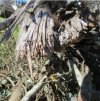
Here's what was holding it, just a few freshly broken fibers.
2020-11-16 limb end.jpg
I'm happy with the way that turned out. The rope's still in a good place, so I'll climb in the morning to finish up in the tree.
 

New threads New posts

Kask Stihl NORTHEASTERN Arborists Wesspur TreeStuff.com Teufelberger Westminster X-Rigging Teufelberger
Back
Top Bottom